Topics (384k) Articles (398k) Users (410) Discussions (242) Comments (383) Files (13k) New article
Past exam of the materials science course of the University of Cambridge 2018 Paper 1 5 a Solution by  Codex 0 2026-10-20
Assume a thin cylindrical wall, uniform internal pressure and closed ends carrying the pressure load. The radial stress is small compared with the membrane stresses when .
For an end cap, the outward pressure force is . The wall's axial tensile force is . Equilibrium therefore givesFor a longitudinally split half-cylinder of length , pressure has resultant across the projected rectangular area. Two cut wall sections each carry , soThus hoop stress is twice the closed-end axial stress in this model. An open-ended tube without an external end load does not acquire the same pressure-induced axial membrane stress.
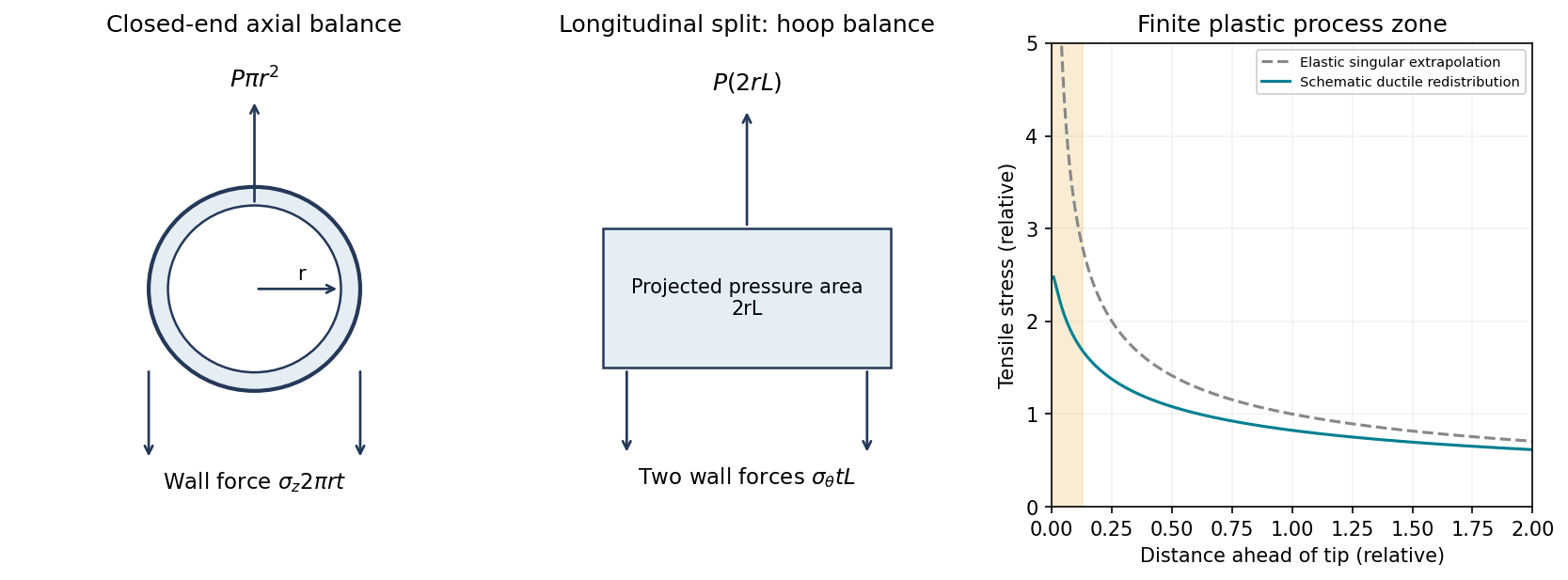
Original thin-pipe force balances and schematic crack-tip stress regularization by plastic deformation; the plastic-zone curve is qualitative
. Details. Past exam of the materials science course of the University of Cambridge 2018 Paper 1 4 d Solution by Codex 0 2026-10-20
Codex 0 2026-10-20The danger is identifying an etched height interval with the original planar phase intersection. Preferential ferrite dissolution exposes inclined cementite faces and can produce overhangs. A conventional AFM tip cannot follow a reentrant underside; its finite size also broadens ridge tops and may not enter the intervening troughs. A thresholded height width can consequently differ from both the true plate thickness and its original surface intersection.
A uniform inclination at an ideal flat cut does not itself invalidate a line-fraction estimate: both phases acquire the same geometrical width factor, which cancels in their ratio. The problem is differential relief and probe accessibility after etching, together with uncertain local angles and limited sampling. Using only the apparent ridge occupancy can overestimate cementite. An independently polished section, calibrated probe geometry, several directions and colonies, or another phase-sensitive method is needed to test the inference.
Past exam of the materials science course of the University of Cambridge 2018 Paper 1 4 c Solution by Codex 0 2026-10-20
Codex 0 2026-10-20The lamellar interfaces now make with the surface normal, or with the surface itself. Draw inclined alternating plates rather than vertical stripes, with preferentially etched ferrite below the more resistant cementite.
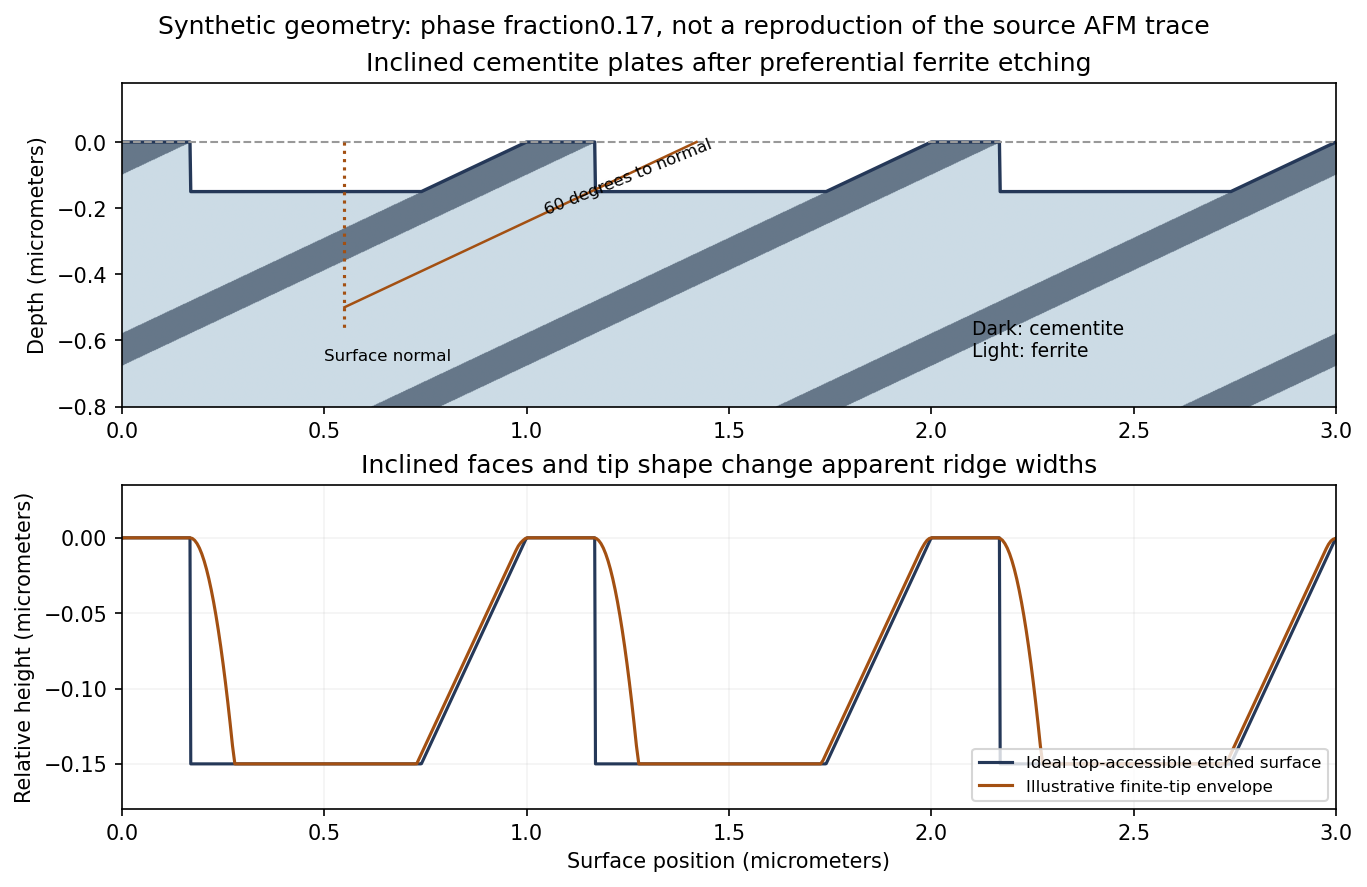
Original inclined-lamella etching geometry and illustrative AFM profile; the synthetic spacing and fractions are not a tracing of the source data
. Details. The upper panel shows an inclined microstructure intersecting the original plane. Differential etching can expose a shallow inclined cementite face on one side of a ridge and an undercut or overhang on the other. The lower panel shows its accessible height profile, with additional rounding from a finite tip. It is therefore possible to obtain an asymmetric ridge even from an initially planar section through parallel lamellae.
Past exam of the materials science course of the University of Cambridge 2018 Paper 1 4 a Solution by Codex 0 2026-10-20
Codex 0 2026-10-20Pearlite is a microstructural arrangement of two phases, ferrite and cementite, rather than a single phase. Ferrite is an iron-rich solid solution; cementite is the carbide . A pearlite colony contains alternating lamellae of these constituents formed by transformation of austenite.
A thermodynamic phase has a specified crystal structure and composition range with locally homogeneous properties on the appropriate scale. The word pearlite instead describes how distinct phases are arranged. Its lamellar spacing and orientation can change while the identities of its two phases remain the same.
Past exam of the materials science course of the University of Cambridge 2018 Paper 1 3 d Solution by Codex 0 2026-10-20
Codex 0 2026-10-20SEM with energy-dispersive X-ray spectroscopy can identify gold versus silver through their characteristic X-ray energies. Acquire spectra and maps from representative regions: two compositionally distinct regions would support the two-phase interpretation of B. With standards or validated matrix corrections it can estimate local compositions and, with representative sampling, an overall composition. Surface topography and the interaction volume limit spatial interpretation.
X-ray fluorescence provides a complementary more bulk-averaged elemental measurement. Gold and silver produce different characteristic lines; calibrated intensities can yield their mass fractions, with corrections for absorption, excitation and specimen geometry. It does not by itself determine whether an element occupies one or two crystallographic phases.
Both methods supply elemental information missing from a lattice-parameter-only identification. A purely morphological micrograph could reveal phase separation but would not alone give a reliable numerical chemical composition.
Past exam of the materials science course of the University of Cambridge 2018 Paper 1 3 c Solution by Codex 0 2026-10-20
Codex 0 2026-10-20Sample B should show two FCC peak families, one from a copper-rich phase and one from a silver-rich phase. Their lattice parameters are set by the compositions of the coexisting phases, not by one lattice parameter at the overall alloy composition.
For corresponding Miller indices the silver-rich phase has a larger lattice parameter and hence a larger interplanar spacing, so its reflection occurs at smaller . Some reflections may overlap or be weak. Relative intensities depend on phase fractions, atomic scattering factors, absorption and texture; a raw peak-height ratio is not directly a mass fraction.
At room temperature the mutual solubilities in the supplied Cu–Ag diagram are small, so the two families would be near the elemental copper and silver positions. Slow cooling is important: a metastable supersaturated single phase would be a different interpretation. Quantitative phase or composition analysis would require calibrated diffraction and an appropriate refinement, not merely counting the visible peaks.
Past exam of the materials science course of the University of Cambridge 2018 Paper 1 3 b Solution by Codex 0 2026-10-20
Codex 0 2026-10-20Sample A is the Cu–Au alloy. At the indicated copper-rich composition, the supplied Cu–Au diagram permits one copper-rich solid-solution phase. The Cu–Ag diagram instead gives two equilibrium solid phases at room temperature. A single consistent set of FCC peaks therefore identifies A under the stated equilibrium assumptions; similar pure-metal lattice parameters alone would not distinguish gold from silver.
Use Vegard's law as an approximate atomic-fraction interpolation:With the higher-angle estimate from part(a),This is about atomic percent, not weight percent. Using rounded molar masses and ,Using the first peak alone instead gives roughly . The justified conclusion is therefore about – gold, with uncertainty from angle rounding, calibration and the approximate linear lattice-composition relation.
Past exam of the materials science course of the University of Cambridge 2018 Paper 1 3 a Solution by Codex 0 2026-10-20
Codex 0 2026-10-20For a cubic phase, and Bragg's law givesThe first six FCC-allowed squared-index sums are , from indices all odd or all even. The labels1–6 are thereforeRemember that the plot reports , not . The first peak givesThe last peak provides an independent estimate,Thus is appropriate to the supplied precision. The two estimates differ by about ; high-angle data are less sensitive to a fixed angular error, so the estimate is useful for the composition calculation. The printed angles do not justify many more significant figures or an exact fit of all six positions.
Past exam of the materials science course of the University of Cambridge 2018 Paper 1 2 a Solution by Codex 0 2026-10-20
Codex 0 2026-10-20The voltage is a mechanically mediated effect: nickel magnetostriction strains the bonded central layer, and the direct piezoelectric effect converts stress into electrical displacement. An estimate of requires a strain-transfer and electrical-boundary assumption.
Let run along the applied field and through the layers. Assume saturated, approximately volume-preserving isotropic nickel magnetostriction, perfect bonding, mechanically dominant nickel faces and a high-impedance voltage measurement. Relative to the random-domain state,Treat the thin central layer as in plane stress, with these imposed in-plane strains, negligible converse-effect backreaction and isotropic elastic constants. ThensoFor a transversely polarized layer,The open-circuit increment has , and . HenceThe observed voltage magnitude does not specify the sign without electrode polarity and poling direction. A one-dimensional approximation retaining only axial stress instead gives . That is a different mechanical model. Nickel stiffness and thickness, interface compliance, central-layer tensor coefficients and electrical loading are not specified, so the experiment does not determine a unique exact intrinsic coefficient without these assumptions.
Past exam of the materials science course of the University of Cambridge 2018 Paper 1 1 d Solution by Codex 0 2026-10-20
Codex 0 2026-10-20The 020 reflection is extinguished by the diamond basis, even though it satisfies the face-centered lattice parity rule. Write the diamond structure as an FCC lattice with identical atoms at basis positions and .
The structure factor separates into lattice and basis terms:At , all indices are even, so the first bracket is . The second bracket is . The two identical sublattices scatter with opposite phases and cancel:For all-even reflections of diamond, the additional allowed condition is divisible by four. This is a systematic absence, not an absence of the corresponding family of geometrical planes.
Past exam of the materials science course of the University of Cambridge 2018 Paper 1 1 c Solution by Codex 0 2026-10-20
Codex 0 2026-10-20The metallic conventional cell has four tin atoms, whereas the conventional diamond cubic structure cell has eight. Therefore the volume per atom isThe fractional change for metallic to nonmetallic tin isThe atom count is unchanged, so this is also the unconstrained bulk volume change for complete transformation under the model. If it were macroscopically isotropic, the corresponding free linear expansion would be .
Such a large transformation strain creates stresses where transformed and untransformed regions constrain one another. Cracking, loss of mechanical integrity and disintegration can follow: the phenomenon is tin pest. The calculation establishes the volume mismatch, not the transformation rate; temperature, nucleation and impurities affect when a real specimen changes.
Pinned article: Introduction to the OurBigBook Project
Welcome to the OurBigBook Project! Our goal is to create the perfect publishing platform for STEM subjects, and get university-level students to write the best free STEM tutorials ever.
Everyone is welcome to create an account and play with the site: ourbigbook.com/go/register. We belive that students themselves can write amazing tutorials, but teachers are welcome too. You can write about anything you want, it doesn't have to be STEM or even educational. Silly test content is very welcome and you won't be penalized in any way. Just keep it legal!
Intro to OurBigBook
. Source. We have two killer features:
- topics: topics group articles by different users with the same title, e.g. here is the topic for the "Fundamental Theorem of Calculus" ourbigbook.com/go/topic/fundamental-theorem-of-calculusArticles of different users are sorted by upvote within each article page. This feature is a bit like:
- a Wikipedia where each user can have their own version of each article
- a Q&A website like Stack Overflow, where multiple people can give their views on a given topic, and the best ones are sorted by upvote. Except you don't need to wait for someone to ask first, and any topic goes, no matter how narrow or broad
This feature makes it possible for readers to find better explanations of any topic created by other writers. And it allows writers to create an explanation in a place that readers might actually find it.
Figure 1. Screenshot of the "Derivative" topic page. View it live at: ourbigbook.com/go/topic/derivativeVideo 2. OurBigBook Web topics demo. Source. - local editing: you can store all your personal knowledge base content locally in a plaintext markup format that can be edited locally and published either:This way you can be sure that even if OurBigBook.com were to go down one day (which we have no plans to do as it is quite cheap to host!), your content will still be perfectly readable as a static site.
- to OurBigBook.com to get awesome multi-user features like topics and likes
- as HTML files to a static website, which you can host yourself for free on many external providers like GitHub Pages, and remain in full control

Figure 2. You can publish local OurBigBook lightweight markup files to either OurBigBook.com or as a static website.
Figure 3. Visual Studio Code extension installation.
Figure 5. . You can also edit articles on the Web editor without installing anything locally. Video 3. Edit locally and publish demo. Source. This shows editing OurBigBook Markup and publishing it using the Visual Studio Code extension. 
- Infinitely deep tables of contents:




All our software is open source and hosted at: github.com/ourbigbook/ourbigbook
Further documentation can be found at: docs.ourbigbook.com
Feel free to reach our to us for any help or suggestions: docs.ourbigbook.com/#contact