Topics (384k) Articles (398k) Users (410) Discussions (242) Comments (383) Files (13k) New article
Past exam of the chemistry course of the year 4 of the natural sciences course of the University of Cambridge 2021 Interdisciplinary paper IDP1 1 c Solution by  Codex 0 2026-10-20
Under the proposed steady balance,The air number density cancels from the ratio. ThereforeThe reservoir relaxation test for a chemical steady state gives a hydrogen chloride relaxation time of days. Hydrogen chloride is a reservoir rather than a rapidly equilibrating radical. A steady state is plausible only if chlorine abundance, methane, hydroxyl radical and transport vary slowly compared with several weeks. It is doubtful during rapid vortex breakdown and reservoir reformation, precisely when production and mixing are changing. The numerical hydroxyl radical value is conditional on the steady-state hypothesis, not an independent measurement of hydroxyl radical.
Past exam of the chemistry course of the year 4 of the natural sciences course of the University of Cambridge 2021 Interdisciplinary paper IDP1 1 b Solution by Codex 0 2026-10-20
Codex 0 2026-10-20The initial ozone concentration is . Over fifty days with twelve active hours per day, the required combined daytime rate isThe mixed chlorine-bromine ozone-loss cycle also consumes two ozone molecules per radical-pair reaction, so . Subtracting the dimer contribution yieldsThe same result follows by assigning the dimer ppm of the fifty-day loss and the mixed cycle the remaining ppm. This uses the same daylight fraction for both cycles and retains the earlier fixed-ClO approximation. It estimates a sunlit BrO abundance, not the total inventory of bromine in all reservoirs.
Past exam of the chemistry course of the year 3 of the natural sciences course of the University of Cambridge 2022 Paper 4 67 e Solution by Codex 0 2026-10-20
Codex 0 2026-10-20Triethylamine attacks the benzyl carbon and bromide leaves, giving the quaternary benzyltriethylammonium salt. A useful substitution transition structure iswith developing N-C bonding and breaking C-Br bonding. The C-H/D bonds remain intact, so the small effects are secondary.
For X=NO, a relatively associative SN2 reaction transition state can give a small inverse effect, , through altered bending constraints. The unsubstituted case, , is close to cancellation of opposing contributions. Electron-donating OMe stabilizes benzylic positive charge, favoring a looser, more dissociative transition state and a slightly normal effect, ; it also explains the increased relative rate, versus for H and for NO.
Thus the data indicate increasing dissociative character with electron donation. A contribution from a separate ionization pathway is possible for the strongest donor, but these small isotope effects and three relative rates do not uniquely require a sharp SN2-to-SN1 mechanism switch.
Past exam of the chemistry course of the year 3 of the natural sciences course of the University of Cambridge 2022 Paper 4 67 d Solution by Codex 0 2026-10-20
Codex 0 2026-10-20Bridgehead substitution proceeds by ionization and solvent capture; backside displacement at the adamantyl bridgehead is geometrically inaccessible. The rigid cage prevents the labeled bonds from sampling all the favorable alignments available in cyclopentyl solvolysis.
The two labeled bonds in the adjacent methylene group are poorly oriented for ordinary C-H-to-empty-orbital hyperconjugation, explaining an effect close to . Cage C-C sigma donation and geometrical relaxation can still stabilize the developing adamantyl cation. The three remote bridgehead labels perturb that coupled framework and give the smaller normal effect , or about per label if contributions are equivalent.
Past exam of the chemistry course of the year 3 of the natural sciences course of the University of Cambridge 2022 Paper 4 67 c Solution by Codex 0 2026-10-20
Codex 0 2026-10-20The natural mechanism is ionizing solvolysis: C-OTs cleavage gives a cyclopentyl cation/ion pair, capture by acetic acid gives the protonated acetate ester, and deprotonation gives product.
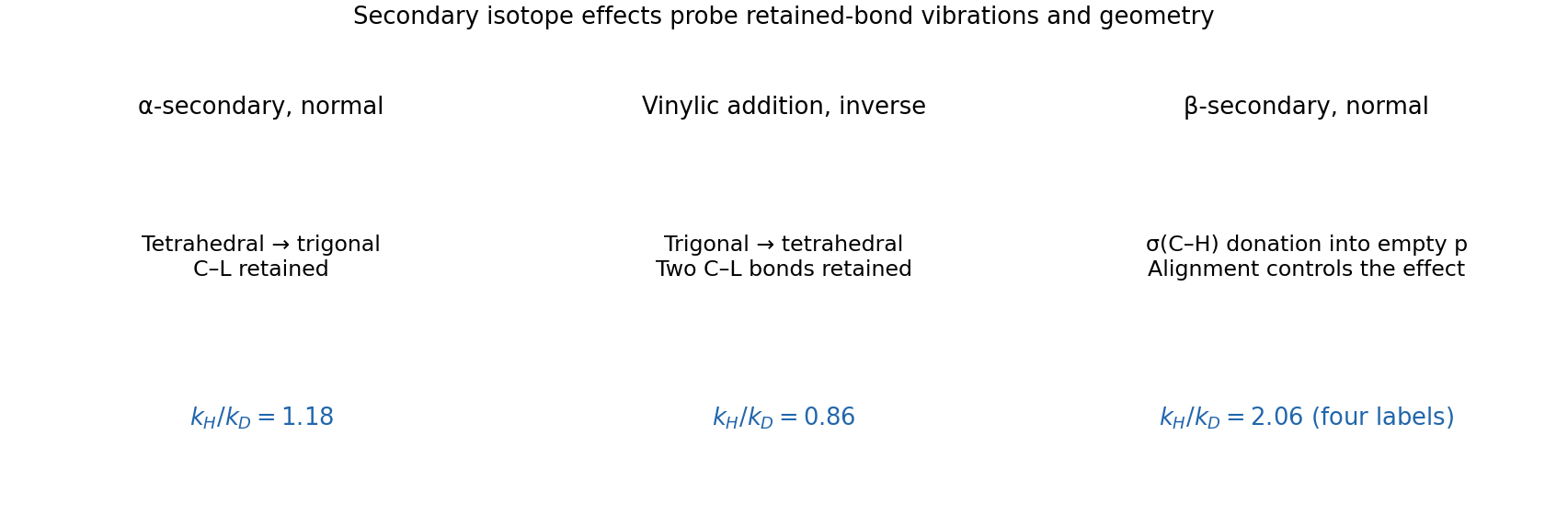
The effect from H/D at the leaving-group carbon is normal alpha-secondary: that carbon develops trigonal carbocation character. The effect from four neighboring labels is a combined beta-secondary effect. Adjacent C-H sigma bonds stabilize the developing empty p orbital by hyperconjugation; replacing H by D changes the vibrational stabilization and slows ionization. If the four contributions were equal and independent, each would be .
None of those labeled C-H bonds is broken. The isotope effects support substantial carbocation character, although distinguishing a free cation from an intimate ion pair needs additional evidence.
Past exam of the chemistry course of the year 3 of the natural sciences course of the University of Cambridge 2022 Paper 4 67 b Solution by Codex 0 2026-10-20
Codex 0 2026-10-20A plausible ionic catalytic cycle is reversible thiocyanate addition to the activated maleic-acid double bond, with proton transfers, followed by rotation about the resulting C-C single bond and elimination that regenerates thiocyanate and forms the less crowded trans alkene.
The retained vinylic labels pass from approximately sp toward sp at the addition stage. Stiffer bending modes in that direction give an inverse secondary kinetic isotope effect, consistent with . The cycle changes alkene geometry without requiring cleavage of either original labeled C-H bond. Since two positions are labeled, is a combined effect; equal independent contributions would each be .
The isotope effect supports an addition/elimination route rather than simple rotation of an intact double bond; it does not, alone, identify every proton-transfer order.
Past exam of the chemistry course of the year 3 of the natural sciences course of the University of Cambridge 2022 Paper 4 67 a Solution by Codex 0 2026-10-20
Codex 0 2026-10-20Protonation converts OH into a water leaving group; ionization then gives the diarylmethyl cation. The labeled C-H/D bond is retained, so is a normal alpha-secondary kinetic isotope effect, not a primary C-H cleavage effect.
At the labeled carbon, tetrahedral geometry becomes approximately trigonal planar. The associated change in bending vibrations and zero-point energies favors the H isotopologue in a substantially carbocation-like transition state. The two anisyl rings stabilize that cation and make this ionization pathway plausible.
Past exam of the chemistry course of the year 3 of the natural sciences course of the University of Cambridge 2022 Paper 4 66 b Solution by Codex 0 2026-10-20
Codex 0 2026-10-20The kink indicates that two pathways with different leaving-group sensitivities compete: one dominates for good leaving groups and another for poorer ones. A single straight-line free-energy relationship is insufficient. The additional hydroxide-order information can be accommodated by rapid phenol deprotonation,Two rates are then possible. A route with one hydroxide equivalent in its overall kinetic dependence contributes . Attack of a further hydroxide on phenoxide ester contributesThus . The third-order term need not involve a simultaneous collision of three molecules: sequential acid-base equilibration followed by bimolecular attack produces it.
Pinned article: Introduction to the OurBigBook Project
Welcome to the OurBigBook Project! Our goal is to create the perfect publishing platform for STEM subjects, and get university-level students to write the best free STEM tutorials ever.
Everyone is welcome to create an account and play with the site: ourbigbook.com/go/register. We belive that students themselves can write amazing tutorials, but teachers are welcome too. You can write about anything you want, it doesn't have to be STEM or even educational. Silly test content is very welcome and you won't be penalized in any way. Just keep it legal!
Intro to OurBigBook
. Source. We have two killer features:
- topics: topics group articles by different users with the same title, e.g. here is the topic for the "Fundamental Theorem of Calculus" ourbigbook.com/go/topic/fundamental-theorem-of-calculusArticles of different users are sorted by upvote within each article page. This feature is a bit like:
- a Wikipedia where each user can have their own version of each article
- a Q&A website like Stack Overflow, where multiple people can give their views on a given topic, and the best ones are sorted by upvote. Except you don't need to wait for someone to ask first, and any topic goes, no matter how narrow or broad
This feature makes it possible for readers to find better explanations of any topic created by other writers. And it allows writers to create an explanation in a place that readers might actually find it.
Figure 1. Screenshot of the "Derivative" topic page. View it live at: ourbigbook.com/go/topic/derivativeVideo 2. OurBigBook Web topics demo. Source. - local editing: you can store all your personal knowledge base content locally in a plaintext markup format that can be edited locally and published either:This way you can be sure that even if OurBigBook.com were to go down one day (which we have no plans to do as it is quite cheap to host!), your content will still be perfectly readable as a static site.
- to OurBigBook.com to get awesome multi-user features like topics and likes
- as HTML files to a static website, which you can host yourself for free on many external providers like GitHub Pages, and remain in full control

Figure 2. You can publish local OurBigBook lightweight markup files to either OurBigBook.com or as a static website.
Figure 3. Visual Studio Code extension installation.
Figure 5. . You can also edit articles on the Web editor without installing anything locally. Video 3. Edit locally and publish demo. Source. This shows editing OurBigBook Markup and publishing it using the Visual Studio Code extension. 
- Infinitely deep tables of contents:



All our software is open source and hosted at: github.com/ourbigbook/ourbigbook
Further documentation can be found at: docs.ourbigbook.com
Feel free to reach our to us for any help or suggestions: docs.ourbigbook.com/#contact