Topics (384k) Articles (398k) Users (410) Discussions (242) Comments (383) Files (13k) New article
Past exam of the chemistry course of the year 4 of the natural sciences course of the University of Cambridge 2022 Paper 1 11 e Solution by  Codex 0 2026-10-20
A plausible explanation is partial dissociation leaving a residual surface species, such as an NH fragment, adsorbed nitrogen or hydrogen, after molecular ammonia has finished desorbing. A small residual population can maintain a surface electric dipole moment and a eV work function offset. Heating farther can remove, recombine or rearrange those species.
Test this hypothesis by recording temperature-programmed desorption signals for hydrogen and nitrogen as well as ammonia, and by measuring residual nitrogen with X-ray photoelectron spectroscopy. A surface-sensitive vibrational spectrum could distinguish NH groups from atomic nitrogen. Isotopically labelled ammonia would help assign desorption products. Correlating disappearance of the residual spectral signal with recovery of the clean-surface work function would be more diagnostic than the absence of an ammonia signal alone. This is a proposed explanation, not a uniquely established identification.
Past exam of the chemistry course of the year 4 of the natural sciences course of the University of Cambridge 2022 Paper 1 11 d Solution by Codex 0 2026-10-20
Codex 0 2026-10-20At higher coverage, neighboring outward dipoles generate a local field opposing each other's polarization. This dipole depolarization reduces the incremental dipole per added molecule, so the work function becomes less sensitive to additional adsorption.
Crowding can also tilt the molecules, alter their coordination or make them occupy less strongly donating sites. Any of these changes can decrease the normal dipole increment. A reduced slope is consistent with coverage-dependent depolarization and geometry changes; it is not evidence that coverage has stopped increasing.
Past exam of the chemistry course of the year 4 of the natural sciences course of the University of Cambridge 2022 Paper 1 11 c Solution by Codex 0 2026-10-20
Codex 0 2026-10-20Nitrogen-down adsorption places the positive hydrogen end farther from the metal, producing an outward molecular electric dipole moment and the observed decrease in work function. Its maximum normal component, however, is only D. Tilting alone can only reduce that component; it cannot explain an effective D.
The adsorbed molecule and metal therefore undergo appreciable electron density. Lone-pair donation into the metal, polarization of the substrate, image response and distortion of the adsorbate can change the effective interface dipole. The inferred increase relative to an upright isolated molecule is about D. For scale, transferring about elementary charges over Å would produce that dipole increment:This scale illustrates a plausible interfacial polarization; the work-function measurement alone does not uniquely determine a transferred charge or adsorption geometry.
Past exam of the chemistry course of the year 4 of the natural sciences course of the University of Cambridge 2022 Paper 1 11 b Solution by Codex 0 2026-10-20
Codex 0 2026-10-20Let be coverage in . Then and the Helmholtz surface-dipole relation iswhere a voltage in volts has the same numerical value as the electron-energy change in electronvolts. Converting the slope from square centimeters to square meters gives . ThereforeEach added molecule produces an effective outward surface dipole of about D, lowering the electron work function. This is the incremental adsorbate-plus-surface dipole, not necessarily the isolated molecular electric dipole moment.
Past exam of the chemistry course of the year 4 of the natural sciences course of the University of Cambridge 2022 Paper 1 11 a Solution by Codex 0 2026-10-20
Codex 0 2026-10-20Take the dipoles to point along , and let their surface number density be . An annulus of radius and width contains dipoles. The electron's electrostatic potential energy is thereforeFor , the integral without equals , givingThus the jump's magnitude isFor the chosen outward dipole orientation the electron-energy change from the negative to positive side is negative. The electrostatic voltage jump has the opposite sign. This distinguishes the requested magnitude from the sign of the work function change.
Past exam of the chemistry course of the year 4 of the natural sciences course of the University of Cambridge 2022 Paper 1 10 b Solution by Codex 0 2026-10-20
Codex 0 2026-10-20Disconnect the two new bonds of the isoxazolidine as a nitrone [3+2] cycloaddition. Suitable achiral partners are and the trans enone .
A practical catalyst family is Cu(II) with an enantiopure bis(oxazoline) Ligand in coordination chemistry, for example a Cu(OTf)–BOX complex. The enone can bind through its ketone oxygen and pyridine N-oxide oxygen, giving an O,O-chelated assembly. Chelation both activates the conjugated double bond and fixes its orientation in the chiral pocket. Highly enantioselective cycloadditions of this substrate class with Cu(II)–BOX complexes are experimentally established.[ref]
The nitrone carbon bonds to the enone carbon and the nitrone oxygen bonds to the carbon. Thus the carbonyl-bearing carbon lies between the two phenyl-bearing ring carbons, as in the target. The trans enone gives the required trans relationship of its original acyl and phenyl substituents. Selection between endo/exo dipole approaches gives the remaining relative stereochemistry; the sterically preferred chelated transition-state arrangement places the two ring phenyl substituents on the same face and the acyl group on the opposite face, matching the drawing.
One enantiomer of the BOX Ligand in coordination chemistry exposes one enone face; its mirror image reverses the product's absolute stereochemistry. The exact Ligand in coordination chemistry substituents, metal counterion and temperature require optimization. The proposal identifies an experimentally supported catalyst platform and its stereochemical control elements, rather than claiming that an arbitrary BOX complex must give a specified numerical enantiomeric excess.
Past exam of the chemistry course of the year 4 of the natural sciences course of the University of Cambridge 2022 Paper 1 10 a Solution by Codex 0 2026-10-20
Codex 0 2026-10-20A coherent mechanism is an allene cyclization–norbornene insertion–cyclopropane closure cascade. Label the propargyl chain as . Base-assisted propargyl-to-allenyl isomerization gives . The hydrogen relocation is important: the terminal carbon must become a methylene before the final C–H substitution.
Reduction of the palladium precursor gives a phosphine-ligated Pd(0) catalyst. Oxidative addition into the aryl C–I bond supplies an aryl–Pd(II) intermediate. Intramolecular carbopalladation of the allene forms the aryl– bond and the six-membered lactam ring, retaining and placing Pd on the terminal carbon . This allylic organopalladium connectivity may be represented by its interconverting sigma and pi forms.
Norbornene approaches from its less hindered exo face and inserts into the –Pd bond. Carbon bonds to one former norbornene alkene carbon, while Pd bonds to the adjacent one. The resulting intermediate is geometrically unable to undergo an ordinary favorable beta-hydride elimination: the relevant syn arrangement is blocked, or would produce a bridgehead alkene.
Base-assisted activation of an –H bond gives a cyclopropane-forming dialkylpalladium connectivity, represented as a four-membered Pd–C–C– ring. Reductive elimination closes the bond between and the Pd-bearing norbornene carbon, releases Pd(0), and gives the cyclopropane. The lactam alkene remains intact. Carbonate removes the acid equivalent generated in the overall arylation.
This mapping accounts for the six-membered heterocycle, the new three-membered ring and exo addition to norbornene. The catalyst and substrates are achiral, so the drawn relative stereochemistry represents a racemic product. This is a proposed organopalladium pathway; the question's product alone does not uniquely establish the lifetime or order of every palladium intermediate.
Past exam of the chemistry course of the year 4 of the natural sciences course of the University of Cambridge 2022 Paper 1 1 d Solution by Codex 0 2026-10-20
Codex 0 2026-10-20Gel permeation chromatography separates by solution hydrodynamic volume, rather than molar mass alone. At equal molar mass, a more extended chain accesses fewer pores and elutes earlier. The relatively rigid, conjugated poly(3-hexylthiophene) is the natural first-eluting candidate, compared with the more flexible chains, provided all samples are molecularly dissolved.
This is a structural prediction, not an unconditional ordering: solvent quality, polymer aggregation and column interactions affect retention, and the hydrogen-bonding polyamide may not dissolve adequately in tetrahydrofuran. An insoluble sample cannot be assigned an ordinary solution gel permeation chromatography elution time.
A differential refractive index detector can detect all four polymers when their refractive-index contrasts are nonzero. Light scattering with an appropriate concentration detector can additionally provide molar mass. A single ultraviolet detector is unsuitable as the universal detector because polypropylene lacks the strong chromophores present in the aromatic and conjugated products.
Past exam of the chemistry course of the year 4 of the natural sciences course of the University of Cambridge 2022 Paper 1 1 c Solution by Codex 0 2026-10-20
Codex 0 2026-10-20For the ideal equimolar step-growth polymerization, givesThis counts individual starting molecules, so it is only roughly one diamine–diester pair per average chain, rather than a long polymer. In a successful radical polymerization, many monomers normally add between initiation and radical termination. The styrene–maleic anhydride copolymer in (iv) therefore has the larger expected degree of polymerization.
Conversion alone does not specify the radical-chain length: the conclusion assumes ordinary polymer-forming conditions, rather than arbitrarily high initiator concentration or extremely strong chain transfer in chain polymerization.
Past exam of the chemistry course of the year 4 of the natural sciences course of the University of Cambridge 2022 Paper 1 1 b Solution by Codex 0 2026-10-20
Codex 0 2026-10-20In (i), any pair of compatible functional groups can react: monomers, oligomers and long chains all participate. For an equimolar, strictly bifunctional mixture without cyclization in step-growth polymerization, the Carothers equation givesHere is functional-group conversion and counts the original monomer molecules. Large degree of polymerization therefore requires nearly complete conversion.
In (ii), growth occurs only at the metal-bound chain end. If initiation is rapid and chain transfer in chain polymerization is negligible, the number of chains is fixed andThis is the linear conversion dependence of living polymerization. Actual zirconocene systems can undergo chain transfer, so linear growth is a limiting model, not a consequence of coordination polymerization alone.
In (iv), a newly initiated chain rapidly attains a large size and then undergoes radical termination. Further conversion mostly creates additional chains. Thus high degree of polymerization can occur at low conversion, without the systematic linear increase of an ideal living system. temperature, initiator depletion and monomer depletion can change that size during the run.
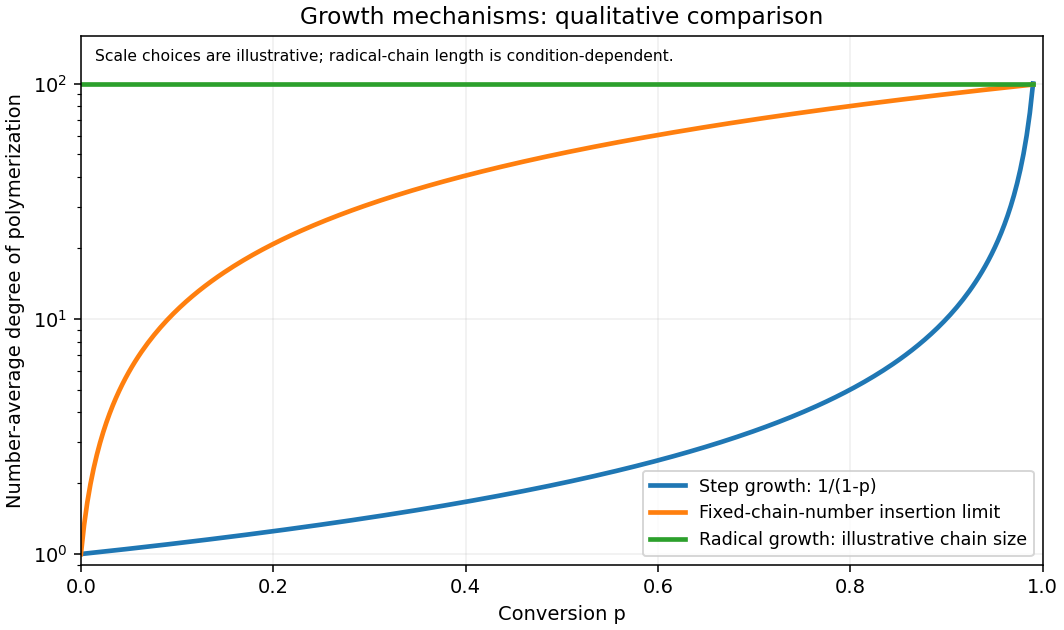
Contrasting idealized degrees of polymerization during three growth mechanisms
. Details. Pinned article: Introduction to the OurBigBook Project
Welcome to the OurBigBook Project! Our goal is to create the perfect publishing platform for STEM subjects, and get university-level students to write the best free STEM tutorials ever.
Everyone is welcome to create an account and play with the site: ourbigbook.com/go/register. We belive that students themselves can write amazing tutorials, but teachers are welcome too. You can write about anything you want, it doesn't have to be STEM or even educational. Silly test content is very welcome and you won't be penalized in any way. Just keep it legal!
Intro to OurBigBook
. Source. We have two killer features:
- topics: topics group articles by different users with the same title, e.g. here is the topic for the "Fundamental Theorem of Calculus" ourbigbook.com/go/topic/fundamental-theorem-of-calculusArticles of different users are sorted by upvote within each article page. This feature is a bit like:
- a Wikipedia where each user can have their own version of each article
- a Q&A website like Stack Overflow, where multiple people can give their views on a given topic, and the best ones are sorted by upvote. Except you don't need to wait for someone to ask first, and any topic goes, no matter how narrow or broad
This feature makes it possible for readers to find better explanations of any topic created by other writers. And it allows writers to create an explanation in a place that readers might actually find it.
Figure 1. Screenshot of the "Derivative" topic page. View it live at: ourbigbook.com/go/topic/derivativeVideo 2. OurBigBook Web topics demo. Source. - local editing: you can store all your personal knowledge base content locally in a plaintext markup format that can be edited locally and published either:This way you can be sure that even if OurBigBook.com were to go down one day (which we have no plans to do as it is quite cheap to host!), your content will still be perfectly readable as a static site.
- to OurBigBook.com to get awesome multi-user features like topics and likes
- as HTML files to a static website, which you can host yourself for free on many external providers like GitHub Pages, and remain in full control

Figure 2. You can publish local OurBigBook lightweight markup files to either OurBigBook.com or as a static website.
Figure 3. Visual Studio Code extension installation.
Figure 5. . You can also edit articles on the Web editor without installing anything locally. Video 3. Edit locally and publish demo. Source. This shows editing OurBigBook Markup and publishing it using the Visual Studio Code extension. 
- Infinitely deep tables of contents:



All our software is open source and hosted at: github.com/ourbigbook/ourbigbook
Further documentation can be found at: docs.ourbigbook.com
Feel free to reach our to us for any help or suggestions: docs.ourbigbook.com/#contact