Topics (384k) Articles (398k) Users (410) Discussions (242) Comments (383) Files (13k) New article
Past exam of the chemistry course of the year 4 of the natural sciences course of the University of Cambridge 2022 Paper 1 17 c Solution by  Codex 0 2026-10-20
 Past exam of the chemistry course of the year 4 of the natural sciences course of the University of Cambridge 2022 Paper 1 17 b Solution by Codex 0 2026-10-20
Codex 0 2026-10-20 Past exam of the chemistry course of the year 4 of the natural sciences course of the University of Cambridge 2022 Paper 1 16 b Solution by Codex 0 2026-10-20
Codex 0 2026-10-20The terminal alkene of D first undergoes Wacker oxidation, giving the side chain . Alkene coordination to Pd(II), water attack, proton transfers and beta-hydride elimination give the ketone. Copper and oxygen regenerate the active palladium oxidation state.
Base removes a proton from the terminal methyl of that ketone. Its enolate attacks the neighboring aromatic aldehyde intramolecularly, closing a six-membered ring. Dehydration gives a conjugated cyclohexadienone-type intermediate, and keto-enol tautomerism furnishes aromatic naphthol E. The retained methoxy and MOM-protected oxygen groups follow the original aromatic-carbon positions.
F is the O-allyl ether of E. Carbonate forms the naphthoxide and allyl bromide undergoes an SN2 reaction at its terminal carbon. Heating F then causes a [3,3]-Claisen rearrangement: the O–allyl bond breaks, the terminal allyl carbon bonds to the adjacent naphthalene C1, and the phenolic carbon temporarily becomes a ketone. Rearomatization gives G, with a free phenolic OH and a C1 allyl group. The C1 position gives the favored alpha-substituted naphthol and avoids the alternative less favorable annulation pattern.
The final step is a dearomative Michael addition, not a Nef conversion of the nitro group. Hydrogen bonding from the thiourea activates nitroethylene. The nucleophilic C1 resonance form of G attacks the terminal carbon of , and proton transfer converts the nitronate to a 2-nitroethyl substituent. The phenolic carbon becomes a ketone.
H is the corresponding 1-allyl-1-(2-nitroethyl)naphthalen-2-one, retaining the methoxy and MOM substituents of G. The second ring now has a C2=O group and a C3=C4 bond, while the other ring remains aromatic. The reported C signal near ppm is consistent with that newly formed ketone. Related dearomative additions establish this reaction class.[ref]
C1 is now an all-carbon quaternary stereocenter bearing both allyl and 2-nitroethyl groups. Both the drawn thiourea and the starting materials are achiral, so H is racemic. A chiral catalyst would be needed to select one absolute configuration.
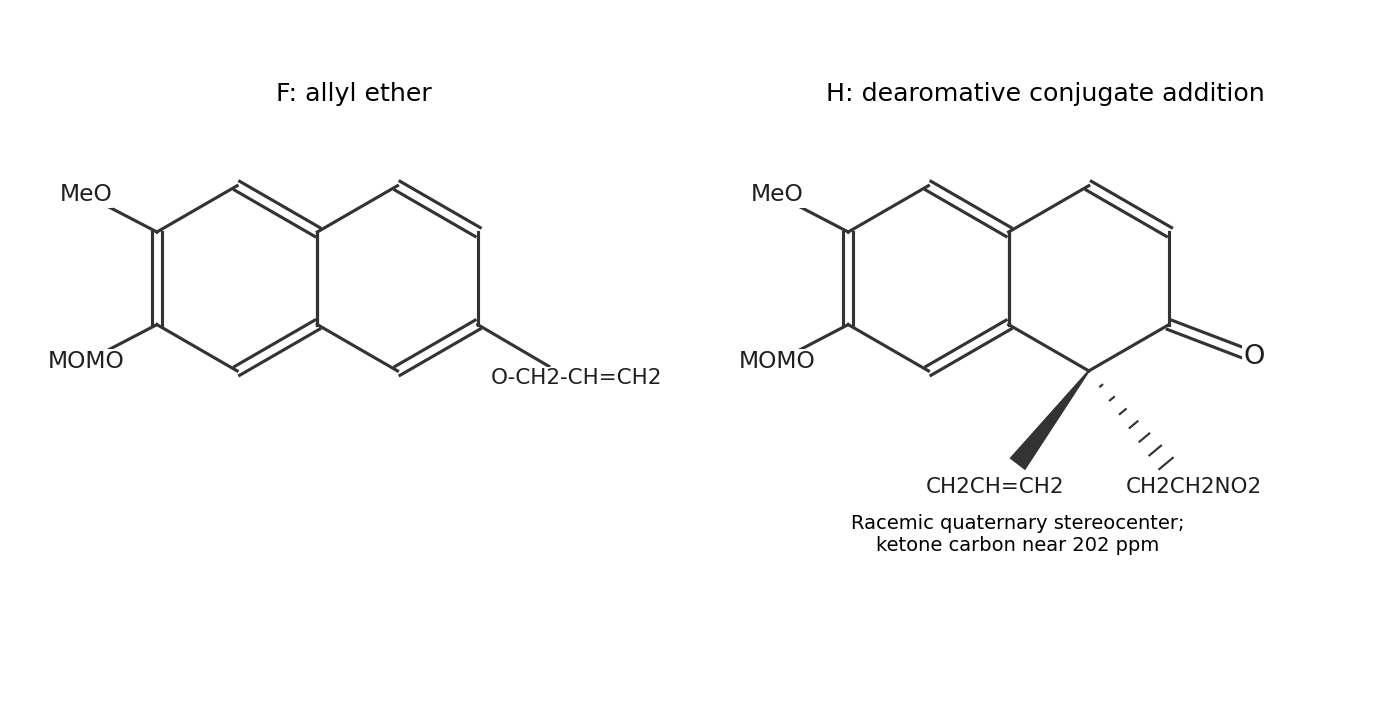
O-allyl intermediate and dearomative Michael-addition product
. Details. Past exam of the chemistry course of the year 4 of the natural sciences course of the University of Cambridge 2022 Paper 1 16 a Solution by Codex 0 2026-10-20
Codex 0 2026-10-20The first step is an endo-selective Diels-Alder reaction of the pyrone diene with the electron-poor acrylamide. Number the pyrone , and the acrylamide carbons and , with next to its carbonyl. The favored polar connection is C3–C and C6–C, leaving C4=C5 and the original C2–O1 lactone bridge intact.
Lithium allyloxide, generated from n-Butyllithium and allyl alcohol, attacks the bridging lactone carbonyl. Collapse of the tetrahedral intermediate cleaves its acyl–oxygen bond. proton transfer converts the former O1 bridge into an OH substituent at C6 and leaves the former pyrone carbonyl as an allyl ester attached to C3. The morpholine amide is retained.
Thus C is allyl 1,4-dihydroxy-2-(morpholine-4-carbonyl)cyclohex-5-ene-1-carboxylate, with the stereochemistry described below. In this product numbering C1 is the former pyrone C3, C2 is the acrylamide , C3 is , and C4 is the former pyrone C6.
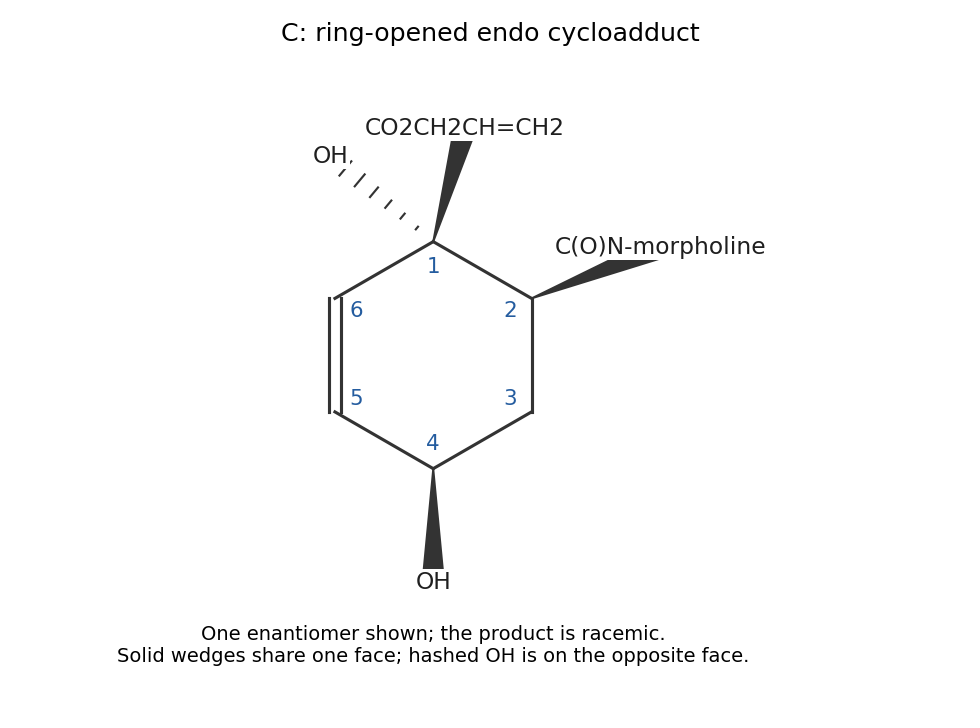
The bridge fixes the former C3 carboxyl group and C6 oxygen on the same face. An endo acrylamide places its amide substituent on that face too. Accordingly COallyl at C1, the C2 amide and the C4 OH are cis; the C1 OH is on the opposite face. The alternative face of attack gives the enantiomer, so achiral reagents give a racemate. The band is consistent with the newly formed ester, while the strong lower-frequency band is consistent with the retained, strongly polarized amide carbonyl. These bands support carbonyl-class retention; they do not independently prove the predicted regioisomer or stereochemistry.
Past exam of the chemistry course of the year 4 of the natural sciences course of the University of Cambridge 2022 Paper 1 15 d Solution by Codex 0 2026-10-20
Codex 0 2026-10-20Initialize the weights, evaluate the feature matrix and repeat gradient descent updates until the loss or gradient stabilizes. If includes the intercept, thenA positive step size chosen by a convergence rule or line search gives a practical optimization algorithm. Mini-batch updates or a Newton-type method are alternatives. Fit feature scaling, choose regularization and choose any nonstandard threshold using training or validation data, then freeze the procedure before using the held-out test set.
For held-out examples, set , with unless selected otherwise. The requested classification accuracy isAlways predicting the majority class already gives about 90% accuracy. Report a confusion matrix, classification recall and classification precision as well, especially for the minority class. A precision-recall curve shows the threshold tradeoff without confusing high majority-class accuracy with successful minority-class detection. No numerical test accuracy can be calculated without the held-out predictions and labels.
Past exam of the chemistry course of the year 4 of the natural sciences course of the University of Cambridge 2022 Paper 1 15 c Solution by Codex 0 2026-10-20
Codex 0 2026-10-20For conditionally independent binary labels, the likelihood isMaximizing it is equivalent to minimizing its negative log-likelihood, the mean binary cross-entropy:It is the loss implied by a Bernoulli distribution for each target, penalizes confident errors strongly and is convex in the linear-logistic parameters. For numerical stability, each contribution can be evaluated as using a stable softplus implementation.
The 10:90 class imbalance does not invalidate this likelihood. Class weighting or resampling may be useful if errors have unequal costs, but changes the training objective and potentially the interpretation of fitted probabilities. Optional ridge regression adds , usually excluding the intercept, to control overly large weights or complete separation.
Past exam of the chemistry course of the year 4 of the natural sciences course of the University of Cambridge 2022 Paper 1 15 b Solution by Codex 0 2026-10-20
Codex 0 2026-10-20Include an intercept and let be the chosen numerical feature vector. Logistic regression usesThe logistic function maps every real score into , allowing a Bernoulli distribution model for the label. Equivalently, the log odds are linear in the features:This gives a smooth differentiable probability model with a linear decision boundary at any fixed probability threshold. The sigmoid output is a fitted conditional probability, not a categorical prediction until a threshold is chosen.
Past exam of the chemistry course of the year 4 of the natural sciences course of the University of Cambridge 2022 Paper 1 15 a Solution by Codex 0 2026-10-20
Codex 0 2026-10-20A SMILES string encodes a molecular graph as a sequence of atom and bond symbols, with parentheses for branches, matching digits for ring closures and additional symbols for charges and stereochemistry. For example, specifies ethanol. A molecule may have several valid SMILES traversals, so the raw character sequence is not itself a unique physical descriptor.
CCOTwo numerical encodings are:
- A molecular fingerprint: a fixed-length vector indicating local substructures, for example hashed circular neighborhoods around atoms. Each coordinate is a bit or a count. The same atom–bond graph should produce the same fingerprint regardless of its SMILES traversal.
- A molecular descriptor vector: real-valued quantities such as molar mass, atom counts, formal charge, hydrogen bond donor and hydrogen bond acceptor counts, or topological indices. Standardize these coordinates using the training set before fitting a scale-sensitive model.
Past exam of the chemistry course of the year 4 of the natural sciences course of the University of Cambridge 2022 Paper 1 14 d Solution by Codex 0 2026-10-20
Codex 0 2026-10-20Without a competing hydrocarbon and without a crown receptor, catalyst 1 can still oxidize accessible secondary C–H bonds in the chain. Expect a less site-selective mixture of secondary oxidation products, predominantly ketones when two peroxide equivalents are effectively used, rather than the recognition-selected remote product pattern of catalyst 2.
The strongly electron-withdrawing, protonated ammonium end makes nearby C–H bonds less reactive, so the distribution need not be statistically uniform over every methylene. More distant secondary positions are comparatively favorable, while primary terminal C–H oxidation is generally harder. alcohol intermediates, incomplete conversion and unproductive peroxide consumption are also possible. Exact regioisomer ratios or a guaranteed quantitative yield cannot be predicted from the supplied conditions.
Past exam of the chemistry course of the year 4 of the natural sciences course of the University of Cambridge 2022 Paper 1 14 c Solution by Codex 0 2026-10-20
Codex 0 2026-10-20Ba competes strongly for the crown ether receptors. With the recognition sites occupied, the undecylammonium chain can no longer be effectively preorganized near manganese. The reaction should move back towards oxidation of methylcyclohexane to 1-methylcyclohexan-1-ol, with suppression of the selectively formed remote amino ketone.
The single available peroxide equivalent is then sufficient for tertiary C–H hydroxylation, whereas a secondary-chain ketone would require two oxidations. Competitive binding constants and metal-induced structural changes would determine the exact conversion and residual selectivity; neither a numerical yield nor complete inhibition of all oxidation follows merely from adding two equivalents of barium salt.
Past exam of the chemistry course of the year 4 of the natural sciences course of the University of Cambridge 2022 Paper 1 14 b Solution by Codex 0 2026-10-20
Codex 0 2026-10-20Product 6 is a remotely oxidized ketone of the undecylammonium chain, retaining the ammonium group and its counterion. Number from the ammonium-bearing carbon as C1. Crown-mediated recognition positions the remote C8–C9 region near the Mn–oxo center. A representative major-site product is the C8 ketone,Its adjacent possible regioisomer is the C9 ketone . The precise single-site assignment is a limitation discussed below.
The crown ether binds the primary ammonium end through several N–H···O hydrogen bonds. This host–guest complex holds a folded portion of the chain close to the manganese oxidant, so the effective local concentration of a remote secondary C–H bond can overcome the intrinsic advantage of a free tertiary C–H bond. Such recognition-driven reversal of substrate preference is experimentally established.[ref]
The key intermediates are the crown-bound ammonium–Mn=O assembly, a remote carbon radical after H abstraction, and the rebound secondary alcohol. A second oxidation removes the remaining hydrogen on the carbinol carbon to give the ketone. The overall oxygen-equivalent count isThus one ketone requires two equivalents of peroxide, explaining a maximum near 50% ketone yield with one equivalent and near-complete conversion with two.
The primary remote-oxidation study reports preference for C8 and C9, not a universally unique carbon. The schematic catalyst drawing and the oxygen budget alone cannot distinguish those positions quantitatively. The “single product” wording is therefore treated as an idealized remote-site assignment; a uniquely verified C8:C9 ratio is not invented.[ref]
Past exam of the chemistry course of the year 4 of the natural sciences course of the University of Cambridge 2022 Paper 1 14 a Solution by Codex 0 2026-10-20
Codex 0 2026-10-20Product 5 is 1-methylcyclohexan-1-ol. The tertiary ring C–H bond of methylcyclohexane is replaced by C–OH. This is a single constitutional product; the two ring paths at that carbon are equivalent, so no new stereocenter is created there.
The manganese–oxo species abstracts the relatively weak tertiary hydrogen, then hydroxyl rebound converts the carbon radical into the tertiary alcohol. The unfunctionalized catalyst has no crown-ether receptor to preassociate the ammonium substrate. Its selectivity therefore mainly follows intrinsic C–H reactivity: the tertiary site of methylcyclohexane outcompetes the secondary C–H sites of the linear chain. The cationic ammonium group also electronically deactivates nearby sites. This explains the dominant product under the idealized selectivity described in the question.
Past exam of the chemistry course of the year 4 of the natural sciences course of the University of Cambridge 2022 Paper 1 13 c Solution by Codex 0 2026-10-20
Codex 0 2026-10-20A one-dimensional probability density has units , while has units . With no other length scale, dimensional analysis requiresNormalization gives and unbiased diffusion gives an even . Dimensional arguments alone do not specify .
For ordinary Fickian diffusion, impose with . Substitution of the similarity form yieldsA decaying symmetric solution obeys , so . Normalization fixes :This heat kernel integrates to one, has variance , and tends to the initial Dirac delta distribution as .
Past exam of the chemistry course of the year 4 of the natural sciences course of the University of Cambridge 2022 Paper 1 13 b Solution by Codex 0 2026-10-20
Codex 0 2026-10-20The diffusion coefficient relates particle flux to concentration gradient through Fick's first law, . For unbiased isotropic motion in dimensions it can equivalently be defined by the long-time mean squared displacement:An uncorrelated random walk with jump length and total jump rate has , hence ; correlations introduce a multiplicative correlation factor. The factor counts the directions sharing the total displacement. It does not mean that the same material's single-coordinate diffusivity changes merely by choosing to observe fewer coordinates: in every Cartesian direction of the same isotropic system.
At K, silver iodide is in its fast-ion-conducting phase. For an order-of-magnitude estimate, take a jump length Å and an effective successful jump rate . ThenThus of order is a reasonable estimate for this superionic conductor. The length and rate are explicitly assumed material scales; the question supplies neither a measured conductivity nor jump data, so an exact numerical coefficient cannot be deduced from temperature alone. The estimate is not presented as an experimentally measured value.
Past exam of the chemistry course of the year 4 of the natural sciences course of the University of Cambridge 2022 Paper 1 12 b Solution by Codex 0 2026-10-20
Codex 0 2026-10-20The sydnone is a mesoionic 1,3-dipole. Its two cycloaddition termini add across the alkyne to give a bicyclic adduct. Subsequent retrocycloaddition expels the ring oxygen and carbonyl carbon together as carbon dioxide, leaving an aromatic pyrazole.
The product is 1--4,5-di--pyrazole, plus CO. The sydnone nitrogen bearing becomes pyrazole N1; the adjacent nitrogen becomes N2; the sydnone CH becomes C3; and the two alkyne carbons become C4 and C5. Since both alkyne substituents are the same, reversing its orientation gives the same constitutional product.
Formation of the aromatic pyrazole and release of CO favor the fragmentation. The net transformation can be understood entirely as a cycloaddition–cycloreversion sequence; no biological application is needed.
Pinned article: Introduction to the OurBigBook Project
Welcome to the OurBigBook Project! Our goal is to create the perfect publishing platform for STEM subjects, and get university-level students to write the best free STEM tutorials ever.
Everyone is welcome to create an account and play with the site: ourbigbook.com/go/register. We belive that students themselves can write amazing tutorials, but teachers are welcome too. You can write about anything you want, it doesn't have to be STEM or even educational. Silly test content is very welcome and you won't be penalized in any way. Just keep it legal!
Intro to OurBigBook
. Source. We have two killer features:
- topics: topics group articles by different users with the same title, e.g. here is the topic for the "Fundamental Theorem of Calculus" ourbigbook.com/go/topic/fundamental-theorem-of-calculusArticles of different users are sorted by upvote within each article page. This feature is a bit like:
- a Wikipedia where each user can have their own version of each article
- a Q&A website like Stack Overflow, where multiple people can give their views on a given topic, and the best ones are sorted by upvote. Except you don't need to wait for someone to ask first, and any topic goes, no matter how narrow or broad
This feature makes it possible for readers to find better explanations of any topic created by other writers. And it allows writers to create an explanation in a place that readers might actually find it.
Figure 1. Screenshot of the "Derivative" topic page. View it live at: ourbigbook.com/go/topic/derivativeVideo 2. OurBigBook Web topics demo. Source. - local editing: you can store all your personal knowledge base content locally in a plaintext markup format that can be edited locally and published either:This way you can be sure that even if OurBigBook.com were to go down one day (which we have no plans to do as it is quite cheap to host!), your content will still be perfectly readable as a static site.
- to OurBigBook.com to get awesome multi-user features like topics and likes
- as HTML files to a static website, which you can host yourself for free on many external providers like GitHub Pages, and remain in full control

Figure 2. You can publish local OurBigBook lightweight markup files to either OurBigBook.com or as a static website.
Figure 3. Visual Studio Code extension installation.
Figure 5. . You can also edit articles on the Web editor without installing anything locally. Video 3. Edit locally and publish demo. Source. This shows editing OurBigBook Markup and publishing it using the Visual Studio Code extension. 
- Infinitely deep tables of contents:




All our software is open source and hosted at: github.com/ourbigbook/ourbigbook
Further documentation can be found at: docs.ourbigbook.com
Feel free to reach our to us for any help or suggestions: docs.ourbigbook.com/#contact