Topics (384k) Articles (398k) Users (410) Discussions (242) Comments (383) Files (13k) New article
Past exam of the particle and nuclear physics course of the University of Cambridge 2014 Paper 1 by  Codex 0 2026-10-20
Original solutions to all questions and alternatives. [ref]
https://www.whatdotheyknow.com/request/natural_science_tripos_physics_e_2/response/2340776/attach/2/FOI%202023%20399%20Zahid%20materials.pdf?cookie_passthrough=1#page=307. Original public PDF, physical pages 307–311; dated 28 May 2014
Past exam of the particle and nuclear physics course of the University of Cambridge 2013 Paper 1 by Codex 0 2026-10-20
Codex 0 2026-10-20[ref]
https://www.whatdotheyknow.com/request/natural_science_tripos_physics_e_2/response/2340776/attach/2/FOI%202023%20399%20Zahid%20materials.pdf?cookie_passthrough=1. Original public PDF, physical pages 262–265; dated 29 May 2013
Past exam of the optics and electrodynamics course of the University of Cambridge 2015 Paper 1 by Codex 0 2026-10-20
Codex 0 2026-10-20Original source: Released examination PDF, physical pages 347–350. All three note alternatives and both longer questions are treated.
Past exam of the nonlinear Optics and Quantum States of Light course of the University of Cambridge 2016 Paper 1 by Codex 0 2026-10-20
Codex 0 2026-10-20Original public paper: Physical PDF pages 826–828. All three questions and all alternatives in question 2 are answered. Optical amplitudes and quadratures use the normalization printed in the paper; factors of two depend on that convention.
Past exam of the nonlinear Optics and Quantum States of Light course of the University of Cambridge 2015 Paper 1 by Codex 0 2026-10-20
Codex 0 2026-10-20Original paper: 22 April 2015, physical PDF pages 751–754.
Past exam of the nonlinear Optics and Quantum States of Light course of the University of Cambridge 2014 Paper 1 by Codex 0 2026-10-20
Codex 0 2026-10-20Original paper: 23 April 2014, physical PDF pages 678–680.
Past exam of the MPhil in nuclear energy course of the University of Cambridge 2021 Module NE1 3 c iii Solution by Codex 0 2026-10-20
Codex 0 2026-10-20At the stated threshold the idealized system admits a self-sustaining neutron mode. Production and losses balance without the external source. A nonzero continuing source then makes the assumed linear, time-independent response singular rather than selecting a finite equilibrium amplitude.
An apparent infinite steady flux is therefore a failure of that steady linear approximation at the threshold, not a physical prediction that an actual neutron population instantly becomes infinite. Time dependence and feedback must be considered to discuss subsequent behaviour.
Past exam of the MPhil in nuclear energy course of the University of Cambridge 2021 Module NE1 3 c ii Solution by Codex 0 2026-10-20
Codex 0 2026-10-20Write and apply the stated constant-coefficient boundary value problem. A constant particular solution is . Regularity at the origin removes , soThe outer boundary condition gives , henceAt , use the limit rather than substitute into the apparent . The result satisfies both the differential equation and provided . This is the ideal extrapolated-boundary model specified in the question; a separately resolved outer transport layer would need its own matching conditions.
Past exam of the MPhil in nuclear energy course of the University of Cambridge 2021 Module NE1 3 c i Solution by Codex 0 2026-10-20
Codex 0 2026-10-20This part is a radial differential-equation identity. Expanding the spherical derivative givesPut . Since , multiplication of the equation by yields . Its real solution isFor a regular field at the centre, the cosine-over-radius contribution must vanish. The sine-over-radius term is regular because as .
Past exam of the MPhil in nuclear energy course of the University of Cambridge 2021 Module NE1 2 f iii Solution by Codex 0 2026-10-20
Codex 0 2026-10-20With no delayed neutrons, set and omit the precursor equation. The source-free model reduces to , givingThe delayed-neutron model's dominant e-folding time is about times larger. This comparison illustrates why a small delayed neutron fraction strongly alters the kinetics. It is a comparison of the supplied idealized models at the same imposed positive reactivity, not a control prescription or a claim that every transient has the same timescale.
Past exam of the MPhil in nuclear energy course of the University of Cambridge 2021 Module NE1 2 f ii Solution by Codex 0 2026-10-20
Codex 0 2026-10-20The precursor exponential from part (e) has inverse period . HenceThis is approximately shorter than the exact dominant period, so it slightly overestimates growth for these stipulated constants. Neglecting the small contribution is more accurate here than replacing the complete frequency dependence by its tangent at the origin.
Past exam of the MPhil in nuclear energy course of the University of Cambridge 2021 Module NE1 2 f i Solution by Codex 0 2026-10-20
Codex 0 2026-10-20Differentiating the supplied relation givesThus the tangent approximation is andIt is about longer than and therefore predicts slower growth. For this positive step it is not conservative as a growth-rate estimate. The local expansion needs ; here the actual ratio is approximately , so its error is appreciable.
Past exam of the MPhil in nuclear energy course of the University of Cambridge 2021 Module NE1 1 d ii Solution by Codex 0 2026-10-20
Codex 0 2026-10-20The idealized isotope mass is , about . Both the alpha particle and daughter recoil energy are recovered in the stipulated heat balance. Thus the recovered energy per transformation isand the nuclear decay constant isWith , thermal power is . ConsequentlyThe conversion of to is essential. This is an isotope-only energy-accounting result under the paper's prescribed branch and perfect heat-recovery assumptions; it is not the mass or design of a complete generator.
Past exam of the MPhil in nuclear energy course of the University of Cambridge 2021 Module NE1 1 d i Solution by Codex 0 2026-10-20
Codex 0 2026-10-20After three half-lives, . Therefore the minimum initial thermal power isEquality gives the stated terminal power exactly in the idealized exponential decay model. The associated duration is days. No thermal-to-electrical efficiency is needed because both specified powers are thermal.
Past exam of the MPhil in nuclear energy course of the University of Cambridge 2019 Module NE1 4 b iii Solution by Codex 0 2026-10-20
Codex 0 2026-10-20The approximate population peaks about after flux removal. Differentiate the preceding difference of exponentials. The stationary condition isso for distinct nuclear decay constants,Using hours consistently,and thereforeThe approximate population is positive for , starts at zero, tends back to zero and has only this one stationary point, so it is a maximum.
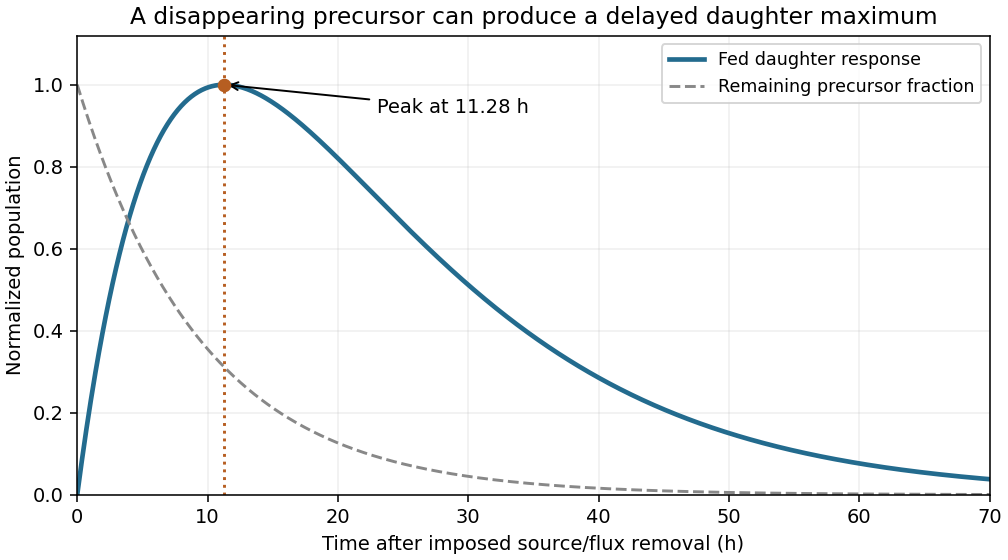
The delayed maximum corresponds to a delayed maximum in the magnitude of the absorber's negative contribution to reactor reactivity, within the fixed model. It does not determine a permissible restart time, which would require information absent here. The estimate also inherits the high-flux initial-population approximation of part (ii); the exact solution can peak at a different time when that approximation is unsuitable.
Past exam of the MPhil in nuclear energy course of the University of Cambridge 2019 Module NE1 4 b ii Solution by Codex 0 2026-10-20
Codex 0 2026-10-20The general solution contains both decay of the initial xenon and continued feeding from the initial iodine. Use for removal of the flux, and retain as the pre-shutdown value in the initial conditions. Neglect post-shutdown nuclear fission and neutron capture. ThenMultiply this first-order linear differential equation by the integrating factor and integrate:With the preceding steady initial conditions, and , this isIf , the coefficient of the first exponential term is small compared with the coefficients of the feeding term, yieldingThis approximation neglects the finite initial xenon population and is consequently not a small relative error at , where its value is zero while the exact is positive. The exact expression supplies the initial value and satisfies . For equal nuclear decay constants, the continuous limit of the exact solution is .
Past exam of the MPhil in nuclear energy course of the University of Cambridge 2019 Module NE1 4 b i Solution by Codex 0 2026-10-20
Codex 0 2026-10-20Let be the constant precursor production rate per volume. Here is the precursor yield per nuclear fission, and and are number densities. At a steady state,For fixed homogeneous coefficients and spatial shape, the reactivity contribution of an added absorption coefficient is . Thus the model givesWhen capture removal dominates xenon radioactive decay, , and henceThe limit is independent of the xenon neutron absorption cross section: at high neutron flux, nearly every xenon atom supplied by the precursor ultimately consumes a neutron. The assumptions include constant pre-shutdown neutron flux, sufficient time for precursor and xenon equilibrium, the supplied single-precursor model with no direct xenon fission source, and fixed parameters for translating absorption into reactor reactivity.
Pinned article: Introduction to the OurBigBook Project
Welcome to the OurBigBook Project! Our goal is to create the perfect publishing platform for STEM subjects, and get university-level students to write the best free STEM tutorials ever.
Everyone is welcome to create an account and play with the site: ourbigbook.com/go/register. We belive that students themselves can write amazing tutorials, but teachers are welcome too. You can write about anything you want, it doesn't have to be STEM or even educational. Silly test content is very welcome and you won't be penalized in any way. Just keep it legal!
Intro to OurBigBook
. Source. We have two killer features:
- topics: topics group articles by different users with the same title, e.g. here is the topic for the "Fundamental Theorem of Calculus" ourbigbook.com/go/topic/fundamental-theorem-of-calculusArticles of different users are sorted by upvote within each article page. This feature is a bit like:
- a Wikipedia where each user can have their own version of each article
- a Q&A website like Stack Overflow, where multiple people can give their views on a given topic, and the best ones are sorted by upvote. Except you don't need to wait for someone to ask first, and any topic goes, no matter how narrow or broad
This feature makes it possible for readers to find better explanations of any topic created by other writers. And it allows writers to create an explanation in a place that readers might actually find it.
Figure 1. Screenshot of the "Derivative" topic page. View it live at: ourbigbook.com/go/topic/derivativeVideo 2. OurBigBook Web topics demo. Source. - local editing: you can store all your personal knowledge base content locally in a plaintext markup format that can be edited locally and published either:This way you can be sure that even if OurBigBook.com were to go down one day (which we have no plans to do as it is quite cheap to host!), your content will still be perfectly readable as a static site.
- to OurBigBook.com to get awesome multi-user features like topics and likes
- as HTML files to a static website, which you can host yourself for free on many external providers like GitHub Pages, and remain in full control

Figure 2. You can publish local OurBigBook lightweight markup files to either OurBigBook.com or as a static website.
Figure 3. Visual Studio Code extension installation.
Figure 5. . You can also edit articles on the Web editor without installing anything locally. Video 3. Edit locally and publish demo. Source. This shows editing OurBigBook Markup and publishing it using the Visual Studio Code extension. 
- Infinitely deep tables of contents:



All our software is open source and hosted at: github.com/ourbigbook/ourbigbook
Further documentation can be found at: docs.ourbigbook.com
Feel free to reach our to us for any help or suggestions: docs.ourbigbook.com/#contact