Original paper: Public original PDF, physical pages 299–302; cover on page 299 and questions on pages 300–302.
For two-element polarization identification, assume ideal elements and use an intensity detector. For each source, test both element orders while rotating their relative axes. The circular source followed by the quarter-wave plate and then the polarizer is the combination that gives full intensity modulation. The plate converts circular light to linear light, and the downstream polarizer then obeys Malus's law.
If the polarizer comes first, it transmits half the circular source's intensity and the downstream lossless plate cannot change that intensity. Unpolarized light also gives constant half-intensity in either order: a wave plate leaves it unpolarized, while a polarizer followed by a wave plate has no final analyzer. Thus the modulating source is circular, its first element is the quarter-wave plate, and its second is the polarizer; the remaining source is unpolarized. Testing both orders avoids needing to know either source's original brightness.
For the oblique coupling of parallel Hertzian dipoles, a lossless Hertzian dipole has directional gain . The separation is , and both transmitting and receiving patterns have , so . Reciprocity gives matched receiving effective area . The emitted polarization matches the transverse projection of the receiving dipole axis, so there is no additional polarization mismatch. ConsequentlyBoth the off-axis transmitting pattern and the off-axis receiving aperture matter. This assumes the stated far field, conjugate matching and negligible dissipative antenna losses.
Interpret the motion as uniform rectilinear motion: the charge is stationary in an inertial rest frame and has no radiation field. Constant speed alone is insufficient; a curved trajectory has acceleration and can radiate even in vacuum.
In a transparent medium, a charge can move faster than the light phase velocity without exceeding . The induced polarization disturbance then adds coherently on a Cherenkov cone, with . ThusThis is the kinematic threshold limit for the specified refractive index; appreciable emission requires exceeding it, and dispersion selects which frequencies satisfy the condition.
In the magnetic Aharonov-Bohm effect, coherent electron paths enclose inaccessible magnetic flux even though the field vanishes along the paths. The magnetic vector potential contributes relative phaseRecombination turns this phase into a fringe displacement. For an electron , changing flux by gives one full fringe period. Reversing the loop orientation reverses the phase sign. A gauge change modifies each path's phase convention but leaves the closed-loop phase and observed interference unchanged. The accessible region surrounds excluded flux, so a globally trivial gauge cannot remove that phase.
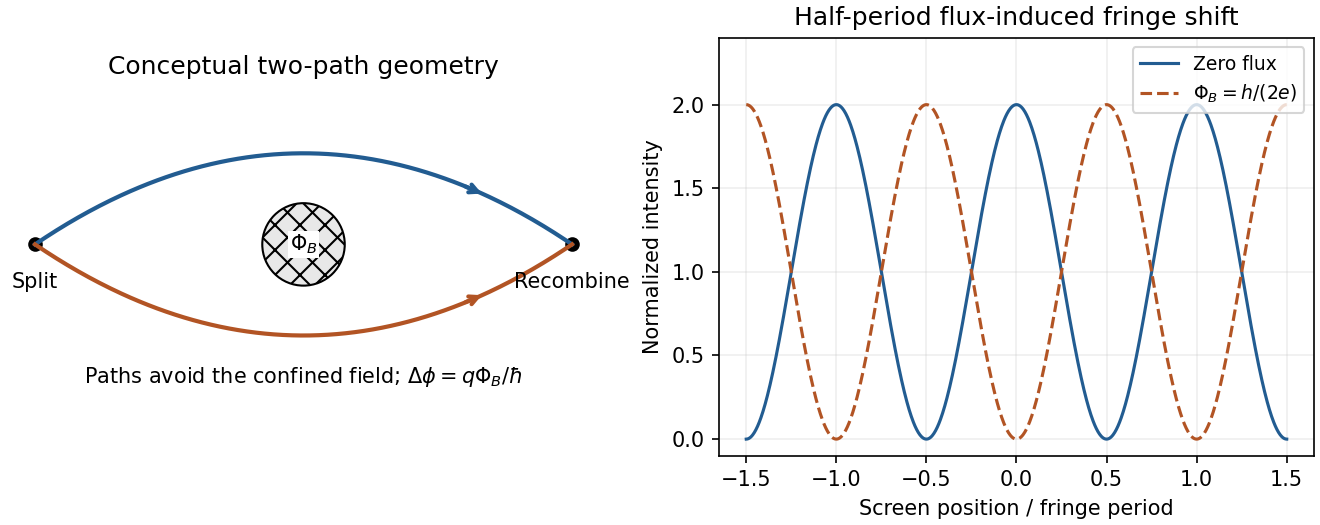
Original two-path Aharonov-Bohm schematic and the half-period fringe shift from half an electron flux period; paths avoid the flux region
. Details. 
A shielded toroidal magnet provides a concrete test: electron holography compared waves passing through its hole and outside it. Superconducting and copper coatings confined the field and excluded electrons from the magnet; the measured relative phase tested enclosed flux rather than a classical Lorentz deflection along the paths.[ref]
Evidence for Aharonov-Bohm effect with magnetic field completely shielded from electron wave by Akira Tonomura and others. Physical Review Letters 56, 792 (1986), primary abstract: shielded toroid and electron-holographic relative phase
Photonic structures control light through the spatial arrangement of dielectric material. Waveguides confine transverse modes; periodic photonic crystals combine interference and scattering to produce a photonic band structure . A photonic band gap excludes propagating modes in specified directions and polarizations. A one-dimensional stop band is not automatically a complete three-dimensional gap.
A simple example is a distributed Bragg reflector with alternating high- and low-index layers. At normal incidence, the quarter-wave choicelets successive interface reflections reinforce near the design wavelength. A departure from periodicity can create a localized defect mode inside the stop band. An isolated defect forms a cavity; a line defect can guide light through otherwise forbidden bulk propagation. Finite structures leak and real materials absorb, so ideal band arguments do not ensure infinite confinement.
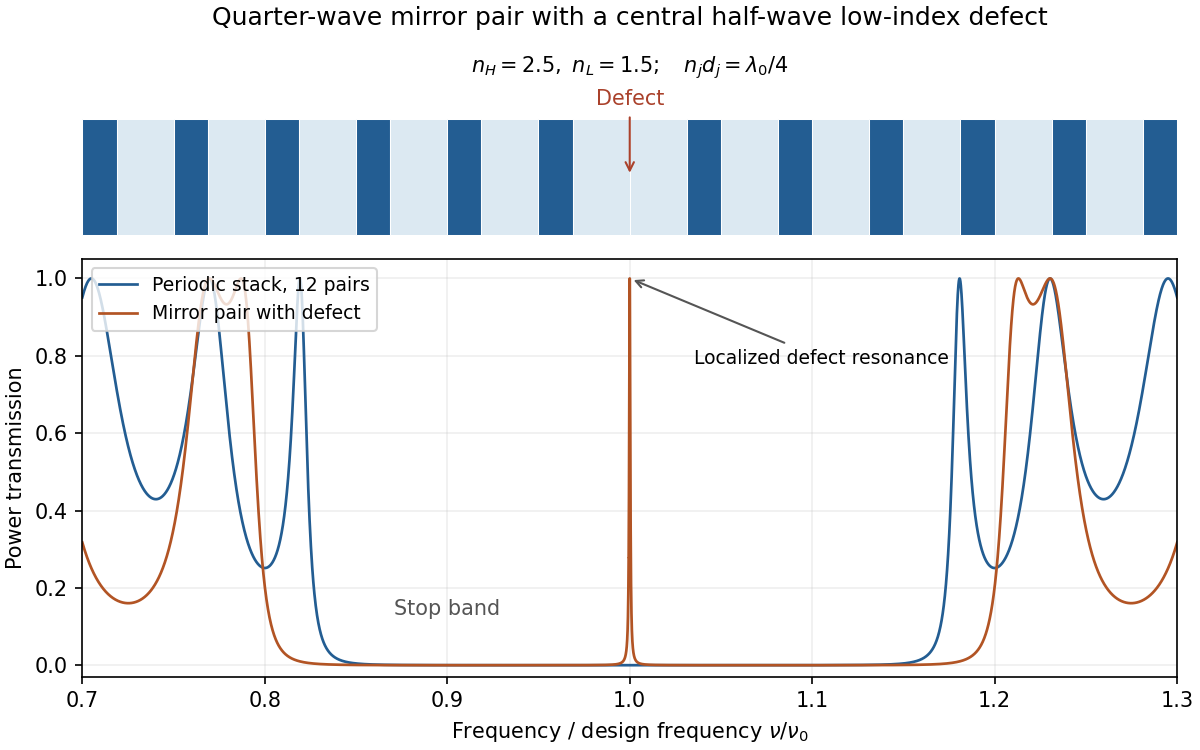
Original transfer-matrix calculation for lossless quarter-wave dielectric stacks, showing a stop band and a transmission resonance from a central defect
. Details. 
Changing the photonic density of states can suppress or enhance spontaneous emission and control how emitters couple to selected modes. This is distinct from electronic band-gap engineering: it is the electromagnetic modes that are being structured. A complete electromagnetic gap overlapping an emitter's transition is the ideal mechanism proposed for suppressing otherwise allowed spontaneous emission.[ref]
Inhibited Spontaneous Emission in Solid-State Physics and Electronics by Eli Yablonovitch. Physical Review Letters 58, 2059 (1987), primary abstract: three-dimensional periodic dielectric and overlapping electromagnetic gap
Synchrotron radiation is emitted by relativistic charges accelerated along curved paths. A magnetic field can supply the transverse acceleration while doing no work on the charge; the radiated energy must ultimately be replenished if the orbit energy is to remain constant. Relativistic beaming confines much of the radiation to angles of order about the instantaneous velocity.
For circular motion of curvature radius and ,The exact classical circular-orbit power contains an additional factor . A distant observer sees short pulses as the beamed direction sweeps past, producing a broad high-frequency spectrum. Radiation is predominantly linearly polarized in the orbital plane and becomes elliptically polarized off it. The critical frequency is a spectral scale, not a monochromatic emission frequency or a hard cutoff.
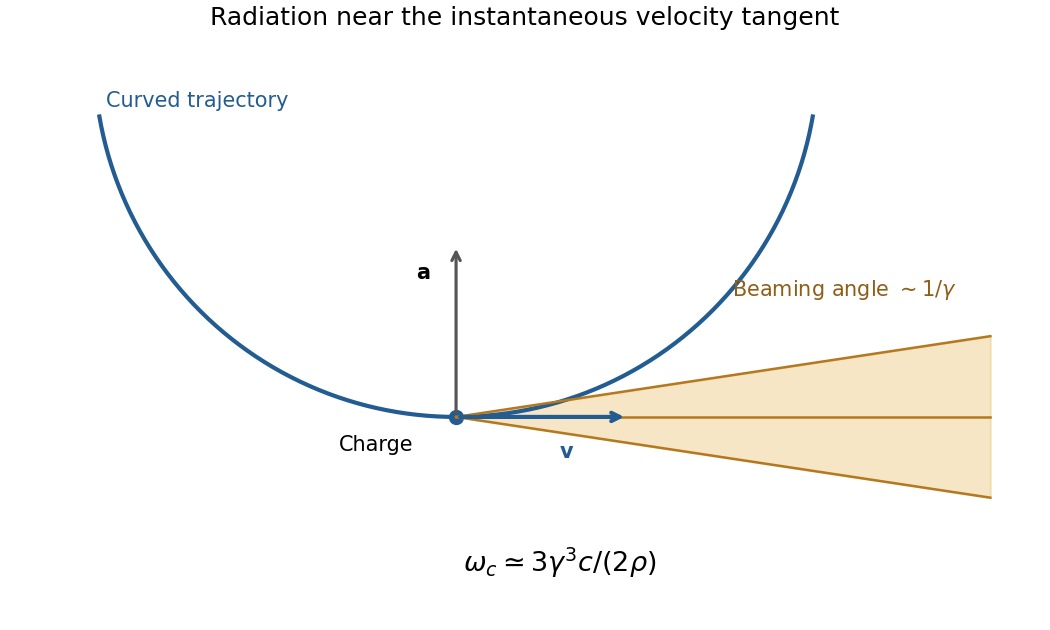
Original geometric synchrotron-beaming schematic: radiation near the velocity tangent, cone angle of order inverse Lorentz factor and curved electron trajectory
. Details. 
Storage rings provide intense radiation for spectroscopy and diffraction, while relativistic electrons in astrophysical magnetic fields also produce synchrotron emission. The classical theory relates total power, angular beaming and spectrum to the particle's trajectory; sufficiently strong quantum recoil requires corrections.[ref]
On the Classical Radiation of Accelerated Electrons by Julian Schwinger. Physical Review 75, 1912 (1949), primary abstract: total radiation, angular preference and high-frequency spectrum of accelerated energetic electrons
Use metric and common spacetime origins. A four-vector transforms as under a Lorentz transformation. A Lorentz invariant is a scalar unchanged by that transformation. Since ,The wave phase labels the same stage of a physical oscillation at a spacetime event, independently of the observer's coordinates. Equal-phase wavefronts and interference phase differences are physical; fixing a common phase origin makes the continuous phase a Lorentz scalar. For a plane wave,The gradient of a scalar is a covector; raising its index gives the four-wavevector . Under an boost,For vacuum light, , givingA photon has four-momentum , with . For two photons separated by angle ,In the centre-of-momentum frame the least possible pair energy is , when both final particles are at rest. Thus the threshold has ; above it, excess energy supplies their kinetic energy. ThereforeThe kinematic equality is a limiting threshold; nonzero production phase space requires energies above it. For parallel photons no finite threshold is available, whereas head-on incidence minimizes the required energy:The blackbody-peak photon pair-production estimate, using the frequency-spectrum blackbody peak, at , gives , or . If “peak” means the wavelength-spectrum peak, instead gives . The spectral convention changes the prefactor, not the conclusion that photons of order a few are needed for this idealized peak-photon threshold.
Temporal coherence compares the field at different times at one location: a narrow spectrum maintains a predictable phase relation over a longer delay. Spatial coherence compares the field at different locations at the same time: different angular source components illuminate a baseline with different phase differences, which wash out interference when averaged. These are properties of correlations, not claims that all thermal source points have a common phase.
Assume a distant spatially incoherent, quasimonochromatic source, small angles, identical slit transmission, matched polarizations and equal mean intensity at the two slits. For an angular component , the relative input phase is . Let be the additional observation-plane phase. Incoherent angular components add intensities, givingIts extrema are , henceFor symmetric , is a real cosine transform. Physical visibility is its normalized absolute value; the printed proportionality omits that qualification. A negative signed coherence reverses fringe phase rather than giving negative contrast. This is the small-angle Van Cittert-Zernike theorem. Temporal coherence analogously depends on the Fourier transform of the spectrum.
A Michelson stellar interferometer uses separated collecting mirrors to obtain a large adjustable projected baseline without requiring a monolithic objective of that diameter. Each collector supplies light to a common combiner. Optical path compensation keeps the delay within the temporal coherence range; varying mirror separation samples spatial coherence and resolves stellar angular structure finer than a small collector alone.
Let be the normalized signed coherence of one star, and take the baseline along the projected binary separation. The equal-brightness binary-star visibility for identical profiles centred at giveFor uniform circular discs of angular diameter ,For binary separation from visibility-zero spacing, the rapid binary visibility zeros satisfy , so their repeated spacing is . The slower single-star envelope first vanishes at . The stellar angular diameter from a visibility envelope and the binary separation follow by fitting both scales; multiple baselines distinguish envelope zeros from binary zeros.
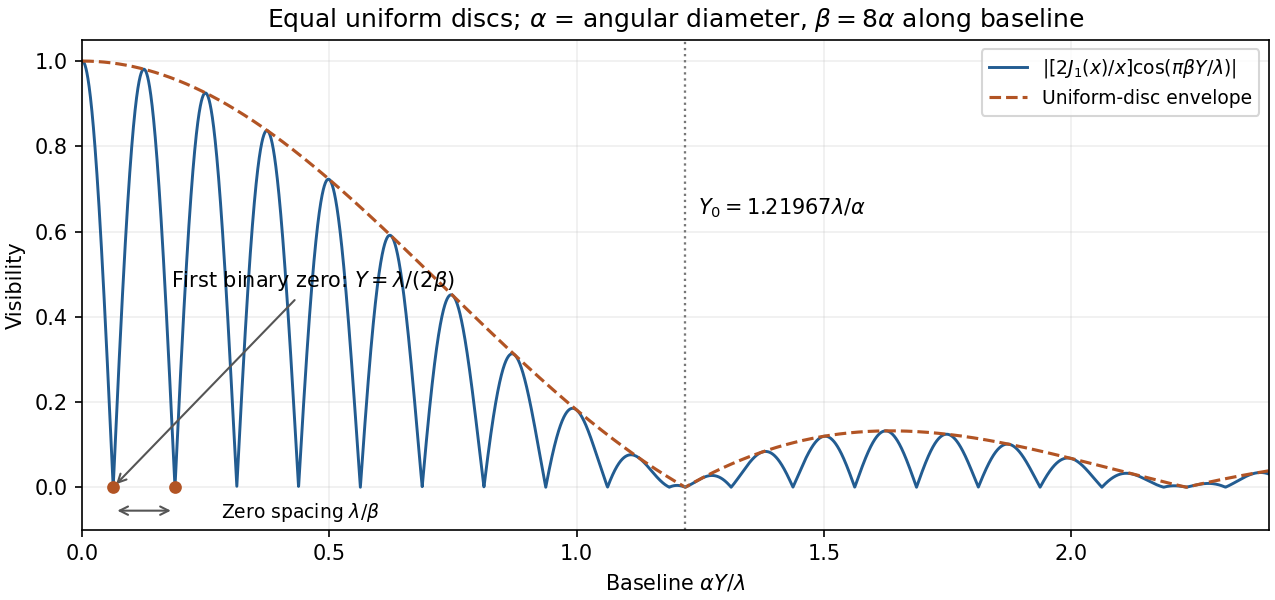
Original normalized binary-star visibility sketch for two uniform circular discs, with projected separation eight times their diameter; binary zeros and the stellar-diameter envelope are labelled
. Details. 
Angular width alone does not specify a unique brightness profile. If the intended one-dimensional model is a uniform angular strip of full width , replace the disc factor by with ; its first envelope zero is . Limb darkening changes the disc envelope too. Rotating the baseline is necessary to recover an unknown separation direction; a single orientation measures only its projection.
Articles by others on the same topic
There are currently no matching articles.