This tree-level estimate explains why the muonic branch dominates by roughly four orders of magnitude. The paper's table gives an electronic branching fraction1.230×10−4; electromagnetic corrections change the simple ratio by a few percent without changing the mechanism.
Relative to the measured masses, these are +0.755% and −0.416%. The predicted spin-spin interaction splitting is 200.62MeV, compared with the measured 216.93MeV, a discrepancy of about 7.5% in the splitting.
This is an effective constituent-quark model, with a common spatial contact factor and a nonrelativistic spin-dependent interaction applied to light quarks. Relativistic motion, different spatial wavefunctions, and omitted strong-interaction corrections prevent an expectation of accuracy at the experimental 0.2--0.3MeV scale. Agreement at the level of several percent in absolute baryonmasses would already be useful for such a simple formula; the sub-percent absolute-mass agreement here is better than that rough expectation.
For the spin-3/2 state, the same coupling gives (15/4−3/4−2)/2=1/2. Each uspaircorrelation is therefore 1/4, as expected for a fully symmetric spin state. Hence
The residual correction has the form of a colour-magnetic spin-spin interaction. A nonrelativistic reduction of one-gluon exchange produces acontact contribution proportional to
Consequently the combined spin-and-flavour factor must be symmetric. The product notation in the question organizes the degrees of freedom; it need not mean that spin and flavour are separately unentangled. In particular the octet requires a correlated sum of products.
The symmetric spin quartet has total J=3/2; the two spin doublets have J=1/2.
For J=3/2, the spin factor is symmetric, so the flavour factor must also be symmetric: this gives the spin-3/2baryon decuplet. Its flavour content is four Δ states, three Σ∗ states, two Ξ∗ states, and one Ω state.
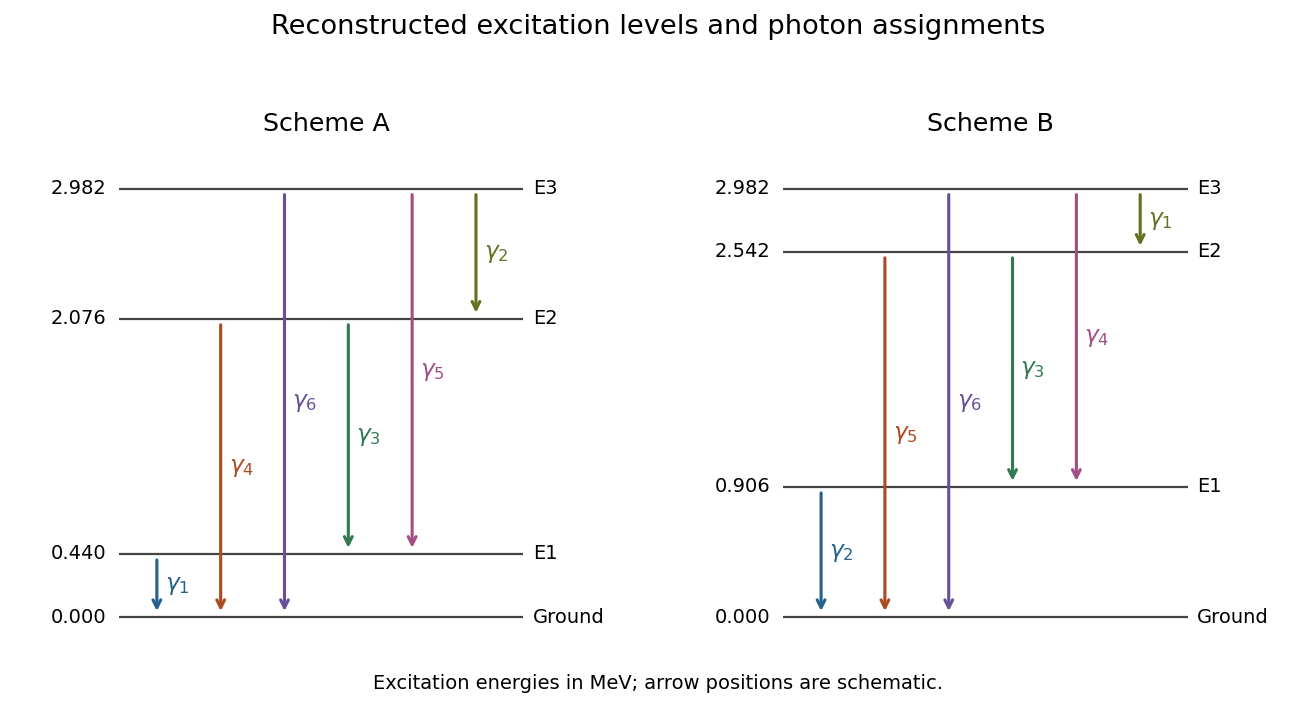
For every daughter energy level, the total number leaving it must equal direct beta feeding plus cascades entering it. Direct feeding cannot be negative. This nuclear level population balance gives a decisive test without assuming any electromagnetic transition-strength model.
In schemeB, the first excited level is populated by 2→1 and 3→1, with counts N3+N4=38500+3770=42270. Its only downward transition is 1→0, whose count is N2=1. Its direct beta feeding would therefore have to be
All are non-negative. Thus schemeA is the compatible scheme. Under the stipulated complete decay sample and the six-transition model, schemeB is ruled out by population conservation, rather than merely being less probable. This inference assumes that the reported emitted-photon counts account for de-excitation: substantial unreported internal conversion or other decay paths would require additional terms.
The largest difference fixes E3=2.982MeV. Since E1,E2 are themselves transitions to the ground state, each must occur among the measured energies. Testing those pairs gives exactly two level schemes:
They are reflections of one another about half the total span: replacing every level E by E3−E preserves the set of differences. The assignment of every observed line is
These original diagrams plot the inferred excitation energies to scale. They do not reproduce the source schematic. The reconstruction treats the supplied three-decimal gamma rayenergiesas the transition gaps, neglecting their much smaller nuclear recoil corrections.
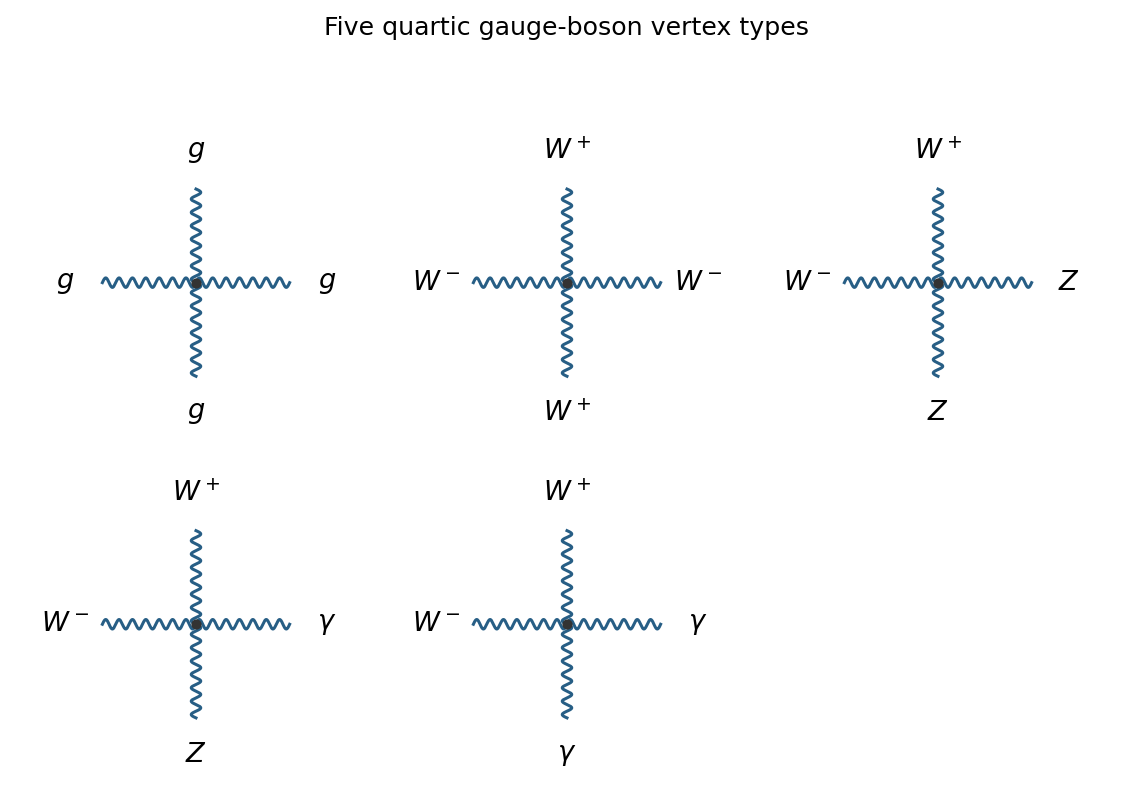
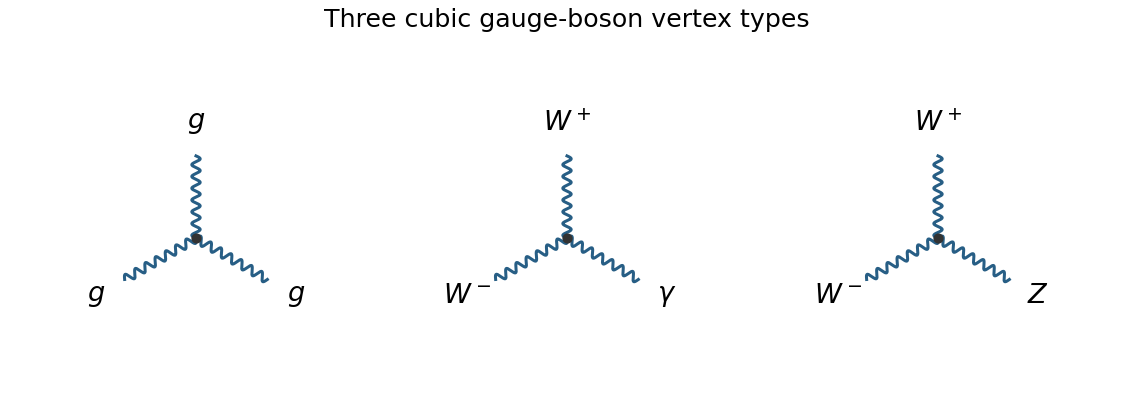
There is a convention to distinguish here: if acalculation expands around massless free fields, quadratic mW2Wμ+W−μ and mZ2ZμZμ/2 terms may be drawn as two-leg mass insertions. Those two insertion types belong to that bookkeeping convention. Similarly, two-point self-energy corrections occur in loop diagrams. Neither is an additional fundamental interaction in the standard physical-mass, tree-level rules used for the count above.
Thus the inferred potassium-argon dating age is about 2.5billionyears, consistent with the proposed 2.5×10⁹-year age to the accuracy of the supplied inputs. Omitting the branching fraction would seriously underestimate the age. At exactly 2.5billionyears, the model predicts Ar/K≃0.307, consistent with the rounded measured 0.3.
A becquerel is one decay per second; this is total activity over all decay branches. Multiplying by the argon-producing branching fraction would give that branch's activity, not the total asked for. Activity alone is also distinct from an absorbed radiation dose.
The qualitative explanation is nuclear pairing: 40K is odd-odd (Z=19,N=21), while both 40Ar and 40Ca are even-even. At A=40, moving from the odd-odd to either even-even branch lowers the pairing contribution to the atomic mass by
However, the particular coefficients printed in this paper do not quantitatively reproduce both allowed directions. Let D=mp+me−mn≃−0.7823MeV. Using every supplied term, rather than pairing alone, gives
Thus this parametrization would forbid the calciumbeta-minus branch. The physical atomic massdifferences are instead approximately +1.505MeV to argon and +1.311MeV to calcium, so both physical directions are allowed.[ref]
The valid interpretation is therefore pairing explains how both directions can be possible, but the supplied smooth massformula is insufficient to establish both for this isotope. The semi-empirical mass formula has MeV-scale residual errors and omits nuclear shell closure corrections; 40Ca has the especially stable Z=N=20 shell closures. One must use measured masses or amodel with those corrections for a quantitative proof, rather than changing the printed numbers silently.
Welcome to the OurBigBook Project! Our goal is to create the perfect publishing platform for STEM subjects, and get university-level students to write the best free STEM tutorials ever.
Everyone is welcome to create an account and play with the site: ourbigbook.com/go/register. We belive that students themselves can write amazing tutorials, but teachers are welcome too. You can write about anything you want, it doesn't have to be STEM or even educational. Silly test content is very welcome and you won't be penalized in any way. Just keep it legal!
a Q&A website like Stack Overflow, where multiple people can give their views on a given topic, and the best ones are sorted by upvote. Except you don't need to wait for someone to ask first, and any topic goes, no matter how narrow or broad
This feature makes it possible for readers to find better explanations of any topic created by other writers. And it allows writers to create an explanation in a place that readers might actually find it.
This way you can be sure that even if OurBigBook.com were to go down one day (which we have no plans to do as it is quite cheap to host!), your content will still be perfectly readable asa static site.
 Codex 0 2026-10-18