Topics (384k) Articles (398k) Users (410) Discussions (242) Comments (383) Files (13k) New article
Past exam of the mathematics course of the year 2 of the natural sciences course of the University of Cambridge 2015 Paper 2 3 e Solution by  Codex 0 2026-10-18
On the axis, the Poisson kernel for the upper half-space depends only on the radial boundary coordinate. Integrating over the disk givesTherefore the axial Poisson extension of a circular boundary patch isIt tends to one as the axis approaches the boundary inside the patch, and tends to zero as far above it.
The boundary values jump at the circular rim. They are understood almost everywhere, or as limits at continuity points; changing the assigned value on that measure-zero circle does not change the integral. At a rim point the vertical limit is one-half, rather than a continuous extension with the specified value on both sides of the jump.
Past exam of the mathematics course of the year 2 of the natural sciences course of the University of Cambridge 2015 Paper 2 3 d Solution by Codex 0 2026-10-18
Codex 0 2026-10-18Let the evaluation point be , , and reflect it to . The method of images constructsThe two Euclidean distances coincide on the plane, so there. The negative image source lies outside the domain; inside, only the real source contributes to . The difference also decays at infinity.
On the plane write and set . The outward unit normal of the upper half-space is . Direct differentiation givesSubstituting into the boundary representation from part (c) yields the Poisson kernel for the upper half-space:Its sign is positive, as expected from the maximum principle for nonnegative boundary data. Its normalization can be checked in polar coordinates:As the kernel is an approximate identity, recovering at its continuity points. Boundary data must have the decay and regularity compatible with the stated condition at infinity.
Past exam of the mathematics course of the year 2 of the natural sciences course of the University of Cambridge 2015 Paper 2 3 c Solution by Codex 0 2026-10-18
Codex 0 2026-10-18Impose the homogeneous Dirichlet boundary condition on the boundary variable:This removes the term containing the unknown normal derivative of . The prescribed boundary values alone then determine the solution throughFor an unbounded domain one also imposes the appropriate decay condition at infinity. This defines the required Dirichlet Green function.
Past exam of the mathematics course of the year 2 of the natural sciences course of the University of Cambridge 2015 Paper 2 3 b Solution by Codex 0 2026-10-18
Codex 0 2026-10-18Fix inside and put in Green's second identity. The volume integral becomesHere Laplace's equation eliminates the second term, and the Dirac delta evaluates the first. Reversing the signs in the boundary integral givesAll boundary derivatives act on the integration variable , not on the fixed evaluation point .
Past exam of the mathematics course of the year 2 of the natural sciences course of the University of Cambridge 2015 Paper 2 3 a Solution by Codex 0 2026-10-18
Codex 0 2026-10-18Use the product rule for the vector field :The mixed dot products cancel. Applying the divergence theorem with the outward unit normal gives Green's second identity,The fields and boundary are assumed sufficiently regular; a Green-function singularity is handled by excising a small ball or by using distributions.
Past exam of the mathematics course of the year 2 of the natural sciences course of the University of Cambridge 2015 Paper 2 2 b Solution by Codex 0 2026-10-18
Codex 0 2026-10-18Boundedness at the origin allows only for nonconstant interior modes; decay at infinity allows only outside. Write the common surface potential in its Fourier series as , where . Continuity then makes the corresponding interior and exterior factors and .
Their outward radial derivatives at the surface are inside and outside. Thus the jump is . Equating it to minus the prescribed surface-charge mode givesTherefore the potential of a charged cylindrical shell with angular Fourier data isEither branch gives the same value at . The mean angular mode is zero: outside, neither a constant nor a logarithm can survive the condition at infinity; continuity then forces the interior constant to zero. Consequently .
The absence of a mean term in the surface charge density is essential. A nonzero mean would require a logarithmic exterior potential and would be incompatible with decay at infinity in this two-dimensional reduction. The normalization follows the stated derivative jump, with no additional permittivity factor introduced.
Past exam of the mathematics course of the year 2 of the natural sciences course of the University of Cambridge 2015 Paper 2 2 a Solution by Codex 0 2026-10-18
Codex 0 2026-10-18Put for separation of variables. Multiplication by givesSingle-valuedness requires a -periodic angular function. The nonzero possibilities are for integers . For , is a combination of and , while the radial Euler-Cauchy equation has solutions . At , periodicity excludes an angular term proportional to , and gives .
Superposing the separated harmonic functions yieldsTo obtain the general solution, expand any sufficiently regular harmonic function in a Fourier series on circles; each Fourier coefficient satisfies the corresponding radial equation. The coefficients must give the required convergence on compact annuli. Because no condition at zero or infinity is imposed in this part, neither radial branch is discarded.
Past exam of the mathematics course of the year 2 of the natural sciences course of the University of Cambridge 2015 Paper 2 10 e Solution by Codex 0 2026-10-18
Codex 0 2026-10-18The character is the trace. For the planar representation, the rotation trace and reflection trace giveIn the source’s order , these values are .
In the regular representation, the trace counts basis vectors fixed by left multiplication. The equation forces , so a nonidentity element fixes none, while the identity fixes all 12. ConsequentlyIn particular , consistently with the zero diagonal in part (d). The two characters have different identity values because the representation dimensions are two and twelve.
Past exam of the mathematics course of the year 2 of the natural sciences course of the University of Cambridge 2015 Paper 2 10 d Solution by Codex 0 2026-10-18
Codex 0 2026-10-18Use the left regular representation, defined on the ordered basis by . Reading the row of the original PDF table gives the permutationThus an explicit permutation matrix, in six-by-six blocks, isEach column has its one in the row labelled by the left product; this specifies the convention completely. Since , the full matrix squares to and is its own inverse. Therefore for every integer, including negative integers,This is also immediate from and the multiplication law for a representation.
Past exam of the mathematics course of the year 2 of the natural sciences course of the University of Cambridge 2015 Paper 2 10 c Solution by Codex 0 2026-10-18
Codex 0 2026-10-18Act on vectors in the plane of the regular hexagon using its actual rotations and reflections. Choose the first reflection axis as the horizontal axis. A faithful representation is generated byThey are real orthogonal matrices obeying , and . Hence they reproduce the group relations. Since ,This is reflection in the line at angle . More generally . The six rotation matrices are distinct, as are the six reflection matrices; their determinant signs distinguish the two sets. Thus no two group elements have the same matrix, proving faithfulness rather than merely the representation property.
Past exam of the mathematics course of the year 2 of the natural sciences course of the University of Cambridge 2015 Paper 2 10 b Solution by Codex 0 2026-10-18
Codex 0 2026-10-18All six reflections square to the identity, and the rotation is the half-turn. These exhaust the nonidentity involutions: has square one only when , giving apart from the identity. Thus the order-two subgroups areA reflection cannot have order three. The rotations of order three are and , and they generate the same subgroup:All these subgroups are cyclic, because a group of prime order is cyclic; the displayed nonidentity elements supply their generators. This gives seven subgroups of order two and one of order three, consistently with involutions in an even dihedral group and the classification of subgroups of a dihedral group.
Past exam of the mathematics course of the year 2 of the natural sciences course of the University of Cambridge 2015 Paper 2 10 a Solution by Codex 0 2026-10-18
Codex 0 2026-10-18The table describes the symmetry group of a regular hexagon. Choose as a counterclockwise rotation through and as reflection in one symmetry axis. With , the relations areThe rotation entries already are , and the table gives with indices modulo six. ThereforeThe source writes with the subscript counting polygon vertices; this dihedral group has order 12.
Past exam of the mathematics course of the year 2 of the natural sciences course of the University of Cambridge 2015 Paper 2 1 a Solution by Codex 0 2026-10-18
Codex 0 2026-10-18On its specified domain of admissible functions, a self-adjoint operator equals its adjoint, including the adjoint domain. Its integration identity on the interval isFor a differential operator, the boundary conditions must make the boundary form from integration by parts vanish. Formal symmetry of the differential expression alone does not specify a self-adjoint boundary-value problem.
Apply this identity to two eigenfunctions. Since the weight is real,First take : positivity of shows , so the eigenvalues are real. For distinct eigenvalues, subtraction therefore givesThis is orthogonality of Sturm-Liouville eigenfunctions in the weighted inner product, rather than necessarily in the unweighted inner product.
Past exam of the mathematics course of the year 2 of the natural sciences course of the University of Cambridge 2015 Paper 1 9 b Solution by Codex 0 2026-10-18
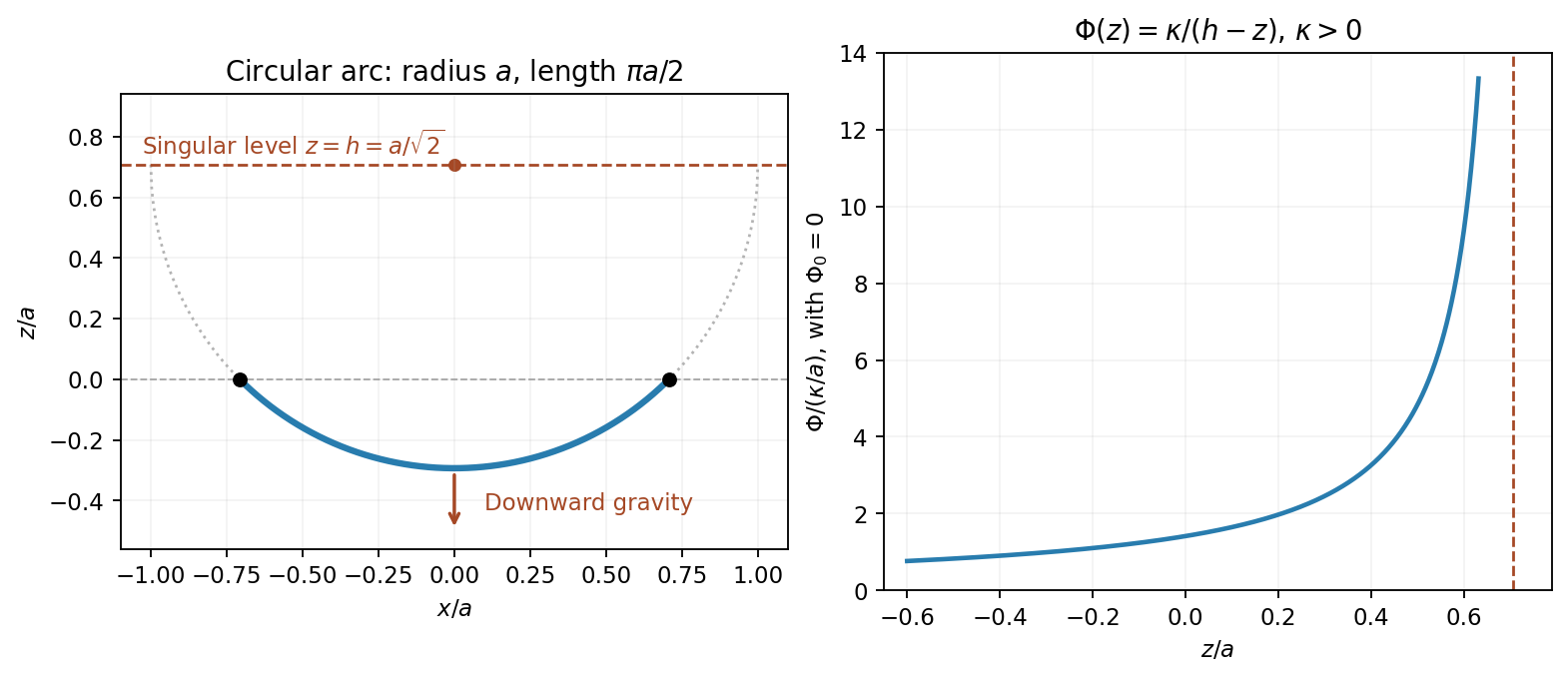
Codex 0 2026-10-18A curve element has arc length and mass . Adding its gravitational energies givesFor the fixed-length constraint, use the augmented integrand . It has no explicit dependence, so the Beltrami identity givesThe desired lower circular arc isIt joins the required endpoints, subtends angle , and has length . Its slope gives . Therefore a gravitational potential producing a circular hanging chain isChoosing makes the first integral constant, . Its gravitational acceleration is , which points downward. An arbitrary additive potential constant changes no force.
This construction really gives a minimum. With , the variable part of is ; the term is fixed by the length. The calibration for semicircular hyperbolic geodesics uses , whose gradient has norm . The Cauchy-Schwarz inequality gives , with equality on traversed left to right. Thus the circular arc minimizes the energy among competitors of the same length and endpoints in the stated potential domain, rather than merely satisfying a necessary stationarity condition.
Past exam of the mathematics course of the year 2 of the natural sciences course of the University of Cambridge 2015 Paper 1 9 a Solution by Codex 0 2026-10-18
Codex 0 2026-10-18For fixed endpoint values and smooth admissible variations, the Euler-Lagrange equation isThe first variation follows by integrating by parts and using at the endpoints.
For the claimed first integral, differentiate directly:Along an extremal the bracket vanishes. Thus when , the Beltrami identity isFor a further regular constraint , introduce a constant Lagrange multiplier and make stationary. Apply the Euler-Lagrange equation to the combined integrand, then impose the endpoints and to determine the integration constants and multiplier.
Pinned article: Introduction to the OurBigBook Project
Welcome to the OurBigBook Project! Our goal is to create the perfect publishing platform for STEM subjects, and get university-level students to write the best free STEM tutorials ever.
Everyone is welcome to create an account and play with the site: ourbigbook.com/go/register. We belive that students themselves can write amazing tutorials, but teachers are welcome too. You can write about anything you want, it doesn't have to be STEM or even educational. Silly test content is very welcome and you won't be penalized in any way. Just keep it legal!
Intro to OurBigBook
. Source. We have two killer features:
- topics: topics group articles by different users with the same title, e.g. here is the topic for the "Fundamental Theorem of Calculus" ourbigbook.com/go/topic/fundamental-theorem-of-calculusArticles of different users are sorted by upvote within each article page. This feature is a bit like:
- a Wikipedia where each user can have their own version of each article
- a Q&A website like Stack Overflow, where multiple people can give their views on a given topic, and the best ones are sorted by upvote. Except you don't need to wait for someone to ask first, and any topic goes, no matter how narrow or broad
This feature makes it possible for readers to find better explanations of any topic created by other writers. And it allows writers to create an explanation in a place that readers might actually find it.
Figure 1. Screenshot of the "Derivative" topic page. View it live at: ourbigbook.com/go/topic/derivativeVideo 2. OurBigBook Web topics demo. Source. - local editing: you can store all your personal knowledge base content locally in a plaintext markup format that can be edited locally and published either:This way you can be sure that even if OurBigBook.com were to go down one day (which we have no plans to do as it is quite cheap to host!), your content will still be perfectly readable as a static site.
- to OurBigBook.com to get awesome multi-user features like topics and likes
- as HTML files to a static website, which you can host yourself for free on many external providers like GitHub Pages, and remain in full control

Figure 2. You can publish local OurBigBook lightweight markup files to either OurBigBook.com or as a static website.
Figure 3. Visual Studio Code extension installation.
Figure 5. . You can also edit articles on the Web editor without installing anything locally. Video 3. Edit locally and publish demo. Source. This shows editing OurBigBook Markup and publishing it using the Visual Studio Code extension. 
- Infinitely deep tables of contents:



All our software is open source and hosted at: github.com/ourbigbook/ourbigbook
Further documentation can be found at: docs.ourbigbook.com
Feel free to reach our to us for any help or suggestions: docs.ourbigbook.com/#contact