Topics (384k) Articles (398k) Users (410) Discussions (242) Comments (383) Files (13k) New article
Past exam of the mathematics course of the year 1 of the natural sciences course of the University of Cambridge 2016 Paper 2 14 a Solution by  Codex 0 2026-10-18
An integrating factor isMultiplying the linear ordinary differential equation by it givesThe right-hand side integrates to , soThis holds on every interval where the coefficient is defined. If , intervals cannot cross ; equivalently the family is on either half-line, with an independently chosen constant.
Past exam of the mathematics course of the year 1 of the natural sciences course of the University of Cambridge 2016 Paper 2 13 c Solution by Codex 0 2026-10-18
Codex 0 2026-10-18Cubing and adding the parametrized coordinates yieldsTherefore the implicit algebraic curve isFor , every nonorigin real point on this curve has and can be recovered using ; the origin is already included. The equation is invariant under exchanging and , so its reflection line is . In the parametrization that reflection corresponds to replacing by . If , the implicit cubic degenerates to the line , whereas the given parametrization only describes the origin, so this degenerate case must be kept separate.
Past exam of the mathematics course of the year 1 of the natural sciences course of the University of Cambridge 2016 Paper 2 13 a Solution by Codex 0 2026-10-18
Codex 0 2026-10-18Take for the sketch; changing its sign rotates the picture by . The parametric curve passes through at and through at . As it returns towards the origin, since and . The positive- branch makes a loop in the first quadrant, leaving the origin tangent to the positive axis and returning tangent to the positive axis.
For a more precise sketch, differentiation givesThe loop has its largest at and largest at . Their coordinates are and its reflection in .
The parameter value is excluded. Cancelling the common factor in the sum givesThus the asymptote is . As , and ; as , and . The branch approaches the origin from the fourth quadrant as , while connects the other infinite branch to the origin through the second quadrant.
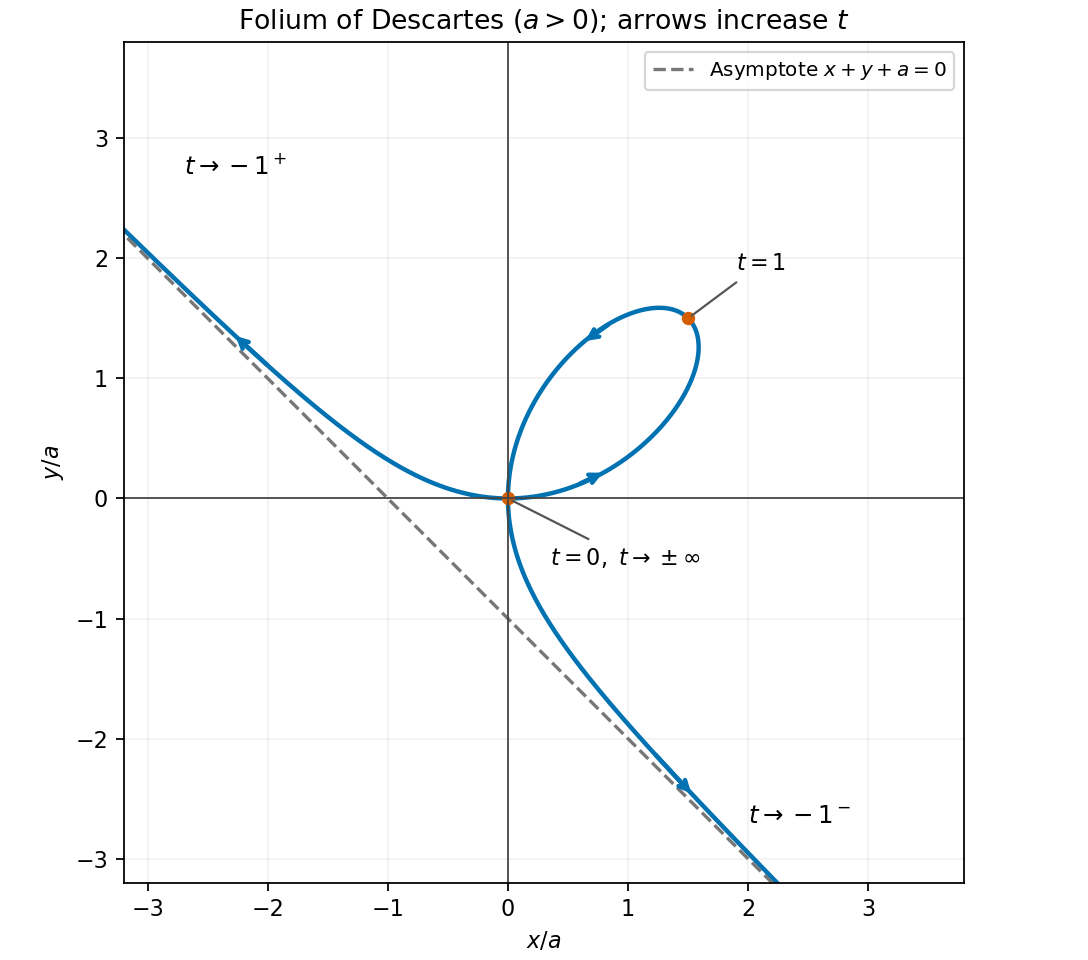
This is the folium of Descartes. If , the parametrization degenerates to the origin for every defined parameter value and there is no nontrivial loop.
Past exam of the mathematics course of the year 1 of the natural sciences course of the University of Cambridge 2016 Paper 2 12 e Solution by Codex 0 2026-10-18
Codex 0 2026-10-18The upward orientation of corresponds to traversing the boundary from the apex to the starting rim, around the rim in increasing azimuth, and back to the apex. This is the indicated orientation and is outward from the solid. Integrate that vector area element directly:The radial integrals are in the horizontal components and in the vertical component. Hence the vector area isThe absolute value is needed only because the original statement permits negative . Reversing the boundary orientation reverses the entire vector. For a full rotation the horizontal components cancel, leaving , the signed projected area of the base.
Past exam of the mathematics course of the year 1 of the natural sciences course of the University of Cambridge 2016 Paper 2 12 d Solution by Codex 0 2026-10-18
Codex 0 2026-10-18 Past exam of the mathematics course of the year 1 of the natural sciences course of the University of Cambridge 2016 Paper 2 12 c Solution by Codex 0 2026-10-18
Codex 0 2026-10-18Use the embedded surface parametrizationIts tangent vectors have cross productwhose magnitude is . Thus the surface area isWith , the radial integral becomes . Evaluating its endpoints givesThis is the scalar-area part of the paraboloid sector surface measures.
Past exam of the mathematics course of the year 1 of the natural sciences course of the University of Cambridge 2016 Paper 2 12 b Solution by Codex 0 2026-10-18
Codex 0 2026-10-18The volume element in cylindrical coordinates is . Integrating from the base to the curved surface givesHenceFor a complete rotation this is half the volume of the enclosing cylinder.
Past exam of the mathematics course of the year 1 of the natural sciences course of the University of Cambridge 2016 Paper 2 12 a Solution by Codex 0 2026-10-18
Codex 0 2026-10-18Put so that the radial range respects the stated allowance . With the azimuth measured from the starting meridian, the cylindrical coordinates of the curved surface satisfyAt all azimuths describe the same apex. The surface is a sector of an elliptic paraboloid.
Past exam of the mathematics course of the year 1 of the natural sciences course of the University of Cambridge 2016 Paper 2 11 d Solution by Codex 0 2026-10-18
Codex 0 2026-10-18The opposite face lies in the plane spanned by through the origin. Directly,The distance from a point to a plane is the absolute normal component, soHere , so the perpendicular foot is the origin, a vertex of the opposite triangular face. Thus the distance to the actual face equals the distance to its containing plane.
Past exam of the mathematics course of the year 1 of the natural sciences course of the University of Cambridge 2016 Paper 2 11 c Solution by Codex 0 2026-10-18
Codex 0 2026-10-18Set . Since these vectors form a basis, write . The reciprocal basis givesA point is in the closed tetrahedron precisely when it is a convex combination of the four vertices, with weights . Thus the necessary and sufficient conditions areThese four half-spaces are the four inward sides of its faces. This is tetrahedron membership via scalar triple products; making all inequalities strict describes the interior.
Past exam of the mathematics course of the year 1 of the natural sciences course of the University of Cambridge 2016 Paper 2 11 b Solution by Codex 0 2026-10-18
Codex 0 2026-10-18Take two edge vectors in the face, and . Their cross product is the face normal vectorThe face plane is . Every term in except vanishes, givingThe scalar triple product is nonzero, so this normal cannot vanish.
Past exam of the mathematics course of the year 1 of the natural sciences course of the University of Cambridge 2016 Paper 2 10 b Solution by Codex 0 2026-10-18
Codex 0 2026-10-18The gradient vanishes at the origin. Its Hessian matrix there iswith eigenvalues and . The quadratic term is therefore indefinite, so the origin is a saddle point of a scalar function. Equivalently, the leading term is positive along and negative along .
Pinned article: Introduction to the OurBigBook Project
Welcome to the OurBigBook Project! Our goal is to create the perfect publishing platform for STEM subjects, and get university-level students to write the best free STEM tutorials ever.
Everyone is welcome to create an account and play with the site: ourbigbook.com/go/register. We belive that students themselves can write amazing tutorials, but teachers are welcome too. You can write about anything you want, it doesn't have to be STEM or even educational. Silly test content is very welcome and you won't be penalized in any way. Just keep it legal!
Intro to OurBigBook
. Source. We have two killer features:
- topics: topics group articles by different users with the same title, e.g. here is the topic for the "Fundamental Theorem of Calculus" ourbigbook.com/go/topic/fundamental-theorem-of-calculusArticles of different users are sorted by upvote within each article page. This feature is a bit like:
- a Wikipedia where each user can have their own version of each article
- a Q&A website like Stack Overflow, where multiple people can give their views on a given topic, and the best ones are sorted by upvote. Except you don't need to wait for someone to ask first, and any topic goes, no matter how narrow or broad
This feature makes it possible for readers to find better explanations of any topic created by other writers. And it allows writers to create an explanation in a place that readers might actually find it.
Figure 1. Screenshot of the "Derivative" topic page. View it live at: ourbigbook.com/go/topic/derivativeVideo 2. OurBigBook Web topics demo. Source. - local editing: you can store all your personal knowledge base content locally in a plaintext markup format that can be edited locally and published either:This way you can be sure that even if OurBigBook.com were to go down one day (which we have no plans to do as it is quite cheap to host!), your content will still be perfectly readable as a static site.
- to OurBigBook.com to get awesome multi-user features like topics and likes
- as HTML files to a static website, which you can host yourself for free on many external providers like GitHub Pages, and remain in full control

Figure 2. You can publish local OurBigBook lightweight markup files to either OurBigBook.com or as a static website.
Figure 3. Visual Studio Code extension installation.
Figure 5. . You can also edit articles on the Web editor without installing anything locally. Video 3. Edit locally and publish demo. Source. This shows editing OurBigBook Markup and publishing it using the Visual Studio Code extension. 
- Infinitely deep tables of contents:



All our software is open source and hosted at: github.com/ourbigbook/ourbigbook
Further documentation can be found at: docs.ourbigbook.com
Feel free to reach our to us for any help or suggestions: docs.ourbigbook.com/#contact