Topics (384k) Articles (398k) Users (410) Discussions (242) Comments (383) Files (13k) New article
Past exam of the mathematics course of the year 1 of the natural sciences course of the University of Cambridge 2017 Paper 1 8 a Solution by  Codex 0 2026-10-18
The double-angle trigonometric identity gives , or . Preserve both factors: contributes the endpoint, while contributes the interior solution. In the specified interval,
Past exam of the mathematics course of the year 1 of the natural sciences course of the University of Cambridge 2017 Paper 1 7 b Solution by Codex 0 2026-10-18
Codex 0 2026-10-18 Past exam of the mathematics course of the year 1 of the natural sciences course of the University of Cambridge 2017 Paper 1 7 a Solution by Codex 0 2026-10-18
Codex 0 2026-10-18Put . The double-angle trigonometric identities imply . Since is in the first quadrant, the positive square root is required. The half-angle identities then give the requested expression in terms of :
Past exam of the mathematics course of the year 1 of the natural sciences course of the University of Cambridge 2017 Paper 1 6 b Solution by Codex 0 2026-10-18
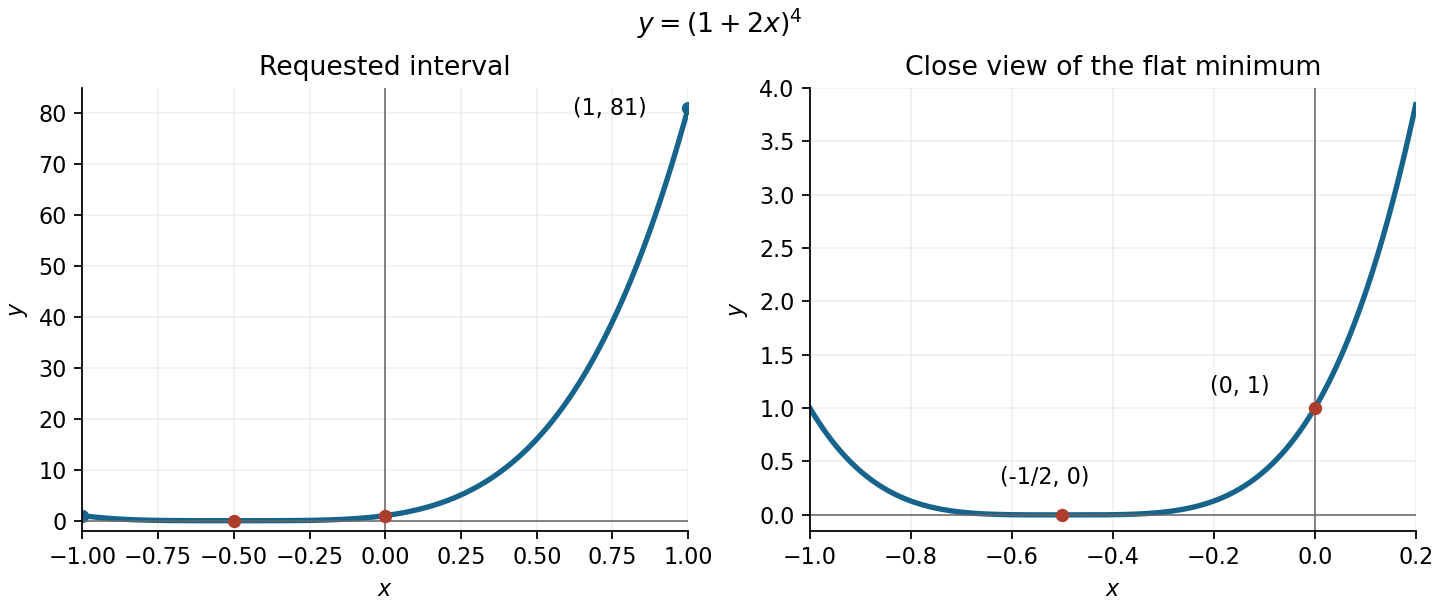
Codex 0 2026-10-18The function graph is a horizontally shifted and scaled fourth power. It is nonnegative and touches the horizontal axis at its fourfold polynomial root. The axis intersections areThe derivative is , so the graph decreases to its flat local minimum at and then increases. Its endpoint values on the requested interval are and . The original sketch includes a closer view of the minimum so that the small values are visible beside the much larger right endpoint.
Past exam of the mathematics course of the year 1 of the natural sciences course of the University of Cambridge 2017 Paper 1 6 a Solution by Codex 0 2026-10-18
Codex 0 2026-10-18 Past exam of the mathematics course of the year 1 of the natural sciences course of the University of Cambridge 2017 Paper 1 5 b Solution by Codex 0 2026-10-18
Codex 0 2026-10-18 Past exam of the mathematics course of the year 1 of the natural sciences course of the University of Cambridge 2017 Paper 1 5 a Solution by Codex 0 2026-10-18
Codex 0 2026-10-18Writing the polynomial as , direct evaluation gives and . A polynomial is continuous, so the intermediate value theorem guarantees a polynomial root between them. Trying the integer gives , hence is a root.
Past exam of the mathematics course of the year 1 of the natural sciences course of the University of Cambridge 2017 Paper 1 4 b Solution by Codex 0 2026-10-18
Codex 0 2026-10-18 Past exam of the mathematics course of the year 1 of the natural sciences course of the University of Cambridge 2017 Paper 1 4 a Solution by Codex 0 2026-10-18
Codex 0 2026-10-18 Past exam of the mathematics course of the year 1 of the natural sciences course of the University of Cambridge 2017 Paper 1 3 b Solution by Codex 0 2026-10-18
Codex 0 2026-10-18Differentiate each coordinate with respect to the parameter and use the chain rule:Both coordinates are defined where and . As a check, there, so the same derivative is .
Past exam of the mathematics course of the year 1 of the natural sciences course of the University of Cambridge 2017 Paper 1 3 a Solution by Codex 0 2026-10-18
Codex 0 2026-10-18 Past exam of the mathematics course of the year 1 of the natural sciences course of the University of Cambridge 2017 Paper 1 20 b Solution by Codex 0 2026-10-18
Codex 0 2026-10-18The seven requested parabolas are for ; the case is the horizontal axis. Positive opens upward, negative downward, and larger gives a narrower parabola. All pass through the origin with a horizontal tangent line.
To find orthogonal trajectories, use the continuous family containing these seven representative members. Its slope is away from . Two finite slopes of perpendicular tangents multiply to , so the orthogonal slope isThis separable differential equation gives , henceThese ellipses are the regular real trajectories; is a single point, not a regular curve, and has no real points. One example is , with semiaxes horizontally and vertically.
The implicit tangent relation also describes points with vertical tangents, where the slope quotient is unavailable. At intersections with the member , the ellipse has a vertical tangent line and is perpendicular to that horizontal axis. The common origin of the parabolas is not on any regular trajectory with . The sketch shows the requested seven members and the example ellipse.
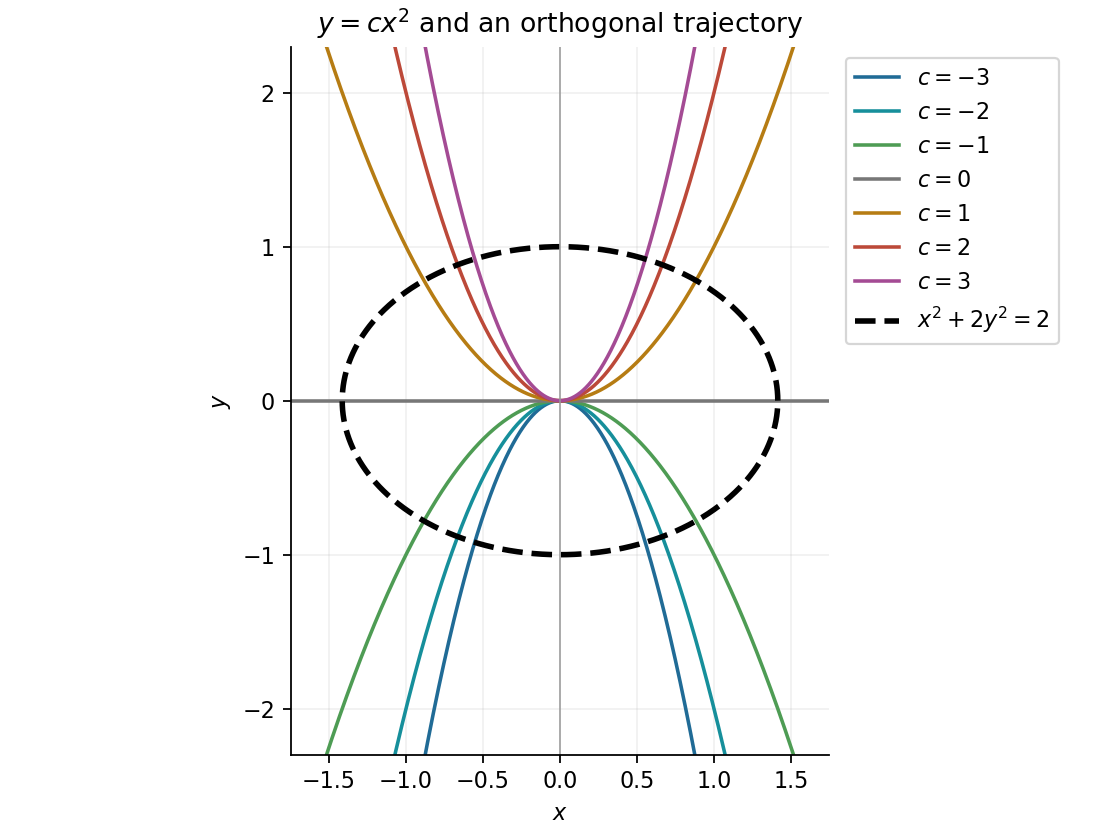
Seven parabolic family members and an elliptical orthogonal trajectory
. Details. Past exam of the mathematics course of the year 1 of the natural sciences course of the University of Cambridge 2017 Paper 1 20 a Solution by Codex 0 2026-10-18
Codex 0 2026-10-18The original differential equation is defined only where and . Put , so the chain rule gives . Multiplying the equation by yields a first-order linear ordinary differential equation:An integrating factor on either half-line is , up to an irrelevant nonzero constant. Equivalently, apply the quotient rule directly:Integrating gives . Thus the real general solution ison any connected interval where and . These restrictions preserve both the original denominator and differentiability of the real cube root. In particular includes on either half-line; this solution has not been lost through division by an expression involving .
For verification, differentiating gives , while . The two sides agree wherever the original equation is defined.
Past exam of the mathematics course of the year 1 of the natural sciences course of the University of Cambridge 2017 Paper 1 2 b Solution by Codex 0 2026-10-18
Codex 0 2026-10-18 Past exam of the mathematics course of the year 1 of the natural sciences course of the University of Cambridge 2017 Paper 1 2 a Solution by Codex 0 2026-10-18
Codex 0 2026-10-18The double-angle trigonometric identity makes the integrand . The integration by substitution , , gives
Past exam of the mathematics course of the year 1 of the natural sciences course of the University of Cambridge 2017 Paper 1 19 c Solution by Codex 0 2026-10-18
Codex 0 2026-10-18The supplied bracket gives . Part (b) ensures , so each error satisfiesWriting gives and . After three steps the exponent has doubled three times:This rigorous error bound uses only the given bracket, not advance knowledge of the digits of .
The actual rational iterates are , , and . They illustrate the bound, but the proof comes from the exact error identity and the positive lower bound on the denominators.
Past exam of the mathematics course of the year 1 of the natural sciences course of the University of Cambridge 2017 Paper 1 19 b Solution by Codex 0 2026-10-18
Codex 0 2026-10-18Write and subtract it from the iteration:This is an Exact Newton error identity for a quadratic. If , then and , so . Induction from proves for every . Also , so the iterates decrease while remaining above the root. Their limit must satisfy , hence . The squared error numerator explains the ensuing quadratic convergence.
Past exam of the mathematics course of the year 1 of the natural sciences course of the University of Cambridge 2017 Paper 1 19 a Solution by Codex 0 2026-10-18
Codex 0 2026-10-18The Newton root-finding iteration follows the current tangent line to its horizontal-axis intersection. Since , it givesA positive initial guess is appropriate for the positive square root; negative starting values instead target the negative root.
Pinned article: Introduction to the OurBigBook Project
Welcome to the OurBigBook Project! Our goal is to create the perfect publishing platform for STEM subjects, and get university-level students to write the best free STEM tutorials ever.
Everyone is welcome to create an account and play with the site: ourbigbook.com/go/register. We belive that students themselves can write amazing tutorials, but teachers are welcome too. You can write about anything you want, it doesn't have to be STEM or even educational. Silly test content is very welcome and you won't be penalized in any way. Just keep it legal!
Intro to OurBigBook
. Source. We have two killer features:
- topics: topics group articles by different users with the same title, e.g. here is the topic for the "Fundamental Theorem of Calculus" ourbigbook.com/go/topic/fundamental-theorem-of-calculusArticles of different users are sorted by upvote within each article page. This feature is a bit like:
- a Wikipedia where each user can have their own version of each article
- a Q&A website like Stack Overflow, where multiple people can give their views on a given topic, and the best ones are sorted by upvote. Except you don't need to wait for someone to ask first, and any topic goes, no matter how narrow or broad
This feature makes it possible for readers to find better explanations of any topic created by other writers. And it allows writers to create an explanation in a place that readers might actually find it.
Figure 1. Screenshot of the "Derivative" topic page. View it live at: ourbigbook.com/go/topic/derivativeVideo 2. OurBigBook Web topics demo. Source. - local editing: you can store all your personal knowledge base content locally in a plaintext markup format that can be edited locally and published either:This way you can be sure that even if OurBigBook.com were to go down one day (which we have no plans to do as it is quite cheap to host!), your content will still be perfectly readable as a static site.
- to OurBigBook.com to get awesome multi-user features like topics and likes
- as HTML files to a static website, which you can host yourself for free on many external providers like GitHub Pages, and remain in full control

Figure 2. You can publish local OurBigBook lightweight markup files to either OurBigBook.com or as a static website.
Figure 3. Visual Studio Code extension installation.
Figure 5. . You can also edit articles on the Web editor without installing anything locally. Video 3. Edit locally and publish demo. Source. This shows editing OurBigBook Markup and publishing it using the Visual Studio Code extension. 
- Infinitely deep tables of contents:




All our software is open source and hosted at: github.com/ourbigbook/ourbigbook
Further documentation can be found at: docs.ourbigbook.com
Feel free to reach our to us for any help or suggestions: docs.ourbigbook.com/#contact