Topics (384k) Articles (398k) Users (410) Discussions (242) Comments (383) Files (13k) New article
Past exam of the mathematics course of the year 1 of the natural sciences course of the University of Cambridge 2016 Paper 1 11 c Solution by  Codex 0 2026-10-18
For real , squaring the two nonnegative moduli gives . In Cartesian coordinates this isAssume and put . Dividing by yields . Since and , the requested complex equation hasIndeed these choices make the mixed term . Completing the square givesThe Circles of Apollonius therefore haveThe radius is positive for the stated range. No spurious point at has been introduced: at that point the undivided equation would require . Positive gives a circle above the real axis, while gives one below it.
Past exam of the mathematics course of the year 1 of the natural sciences course of the University of Cambridge 2016 Paper 1 11 b Solution by Codex 0 2026-10-18
Codex 0 2026-10-18A quotient with nonzero denominator has zero complex modulus exactly when its numerator is zero. ThusAt that point , so the solution is admissible.
Past exam of the mathematics course of the year 1 of the natural sciences course of the University of Cambridge 2016 Paper 1 11 a Solution by Codex 0 2026-10-18
Codex 0 2026-10-18The original PDF places a complex modulus around the quotient; those bars are essential. Its denominator excludes . Using , the case becomes . In Cartesian coordinates,This locus is the real axis, the perpendicular bisector of the points and in the complex plane. The excluded denominator point does not lie on it.
Past exam of the mathematics course of the year 1 of the natural sciences course of the University of Cambridge 2016 Paper 1 1 b Solution by Codex 0 2026-10-18
Codex 0 2026-10-18The polynomial factors asThus the repeated polynomial root is , of multiplicity two. Its repetition can also be checked from and .
Past exam of the mathematics course of the year 1 of the natural sciences course of the University of Cambridge 2016 Paper 1 1 a Solution by Codex 0 2026-10-18
Codex 0 2026-10-18The sum-of-cubes polynomial factorization isMultiplication cancels the two mixed cubic terms and leaves precisely the two cubes.
Past exam of the mathematics course of the year 1 of the natural sciences course of the University of Cambridge 2015 Paper 2 6 b Solution by Codex 0 2026-10-18
Codex 0 2026-10-18Each Cartesian component of contributes to the divergence, while the constant vector contributes zero. Hence
Past exam of the mathematics course of the year 1 of the natural sciences course of the University of Cambridge 2015 Paper 2 6 a Solution by Codex 0 2026-10-18
Codex 0 2026-10-18 Past exam of the mathematics course of the year 1 of the natural sciences course of the University of Cambridge 2015 Paper 2 20 d Solution by Codex 0 2026-10-18
Codex 0 2026-10-18Adding the steady and transient parts givesIntegrating the sine across the channel gives . ThusFor even the signed flow rate is zero, because positive and negative velocity lobes cancel. For odd the bracket is two. Both expressions vanish initially and approach their steady values exponentially; gives the trivial zero solution throughout.
Past exam of the mathematics course of the year 1 of the natural sciences course of the University of Cambridge 2015 Paper 2 20 c Solution by Codex 0 2026-10-18
Codex 0 2026-10-18Separate . On a nonzero product region,A decaying temporal factor requires , with . The zero spatial boundary values give and , hence with . Zero or negative separation parameters give no nonzero spatial mode with both boundary values zero.
The initial profile is already exactly the sine eigenfunction. Its coefficient therefore determines a single separated solution:The exponential tends to zero because . More generally sine orthogonality would determine a sum of such modes, but all other coefficients vanish here. This is the transient of the heat equation with a single stationary sine forcing.
Past exam of the mathematics course of the year 1 of the natural sciences course of the University of Cambridge 2015 Paper 2 20 b Solution by Codex 0 2026-10-18
Codex 0 2026-10-18The steady profile has no time derivative. Substituting and using its steady equation cancels the forcing, givingThe initial condition isThe resulting heat equation is independent of , as are its boundary conditions. Its initial amplitude still depends on ; removing a source from the evolution equation does not remove it from the whole problem.
Past exam of the mathematics course of the year 1 of the natural sciences course of the University of Cambridge 2015 Paper 2 20 a Solution by Codex 0 2026-10-18
Codex 0 2026-10-18In a steady state, . Since the second derivative of the sine is times itself,The zero boundary values at force . Therefore
Past exam of the mathematics course of the year 1 of the natural sciences course of the University of Cambridge 2015 Paper 2 19 c Solution by Codex 0 2026-10-18
Codex 0 2026-10-18Introduce a second multiplier and useThe stationary equations become . Writing givesThe two constraints determine the constants throughEquivalently, with , and . This is the maximum entropy distribution with a prescribed finite mean.
For nonconstant , a strictly positive solution exists exactly when . The mean's derivative with respect to is , so is unique in that case. At either extreme mean no strictly positive solution exists. If all , feasibility requires and the extra constraint is redundant: , while are not separately identifiable. The negative entropy Hessian ensures that any feasible interior stationary point is the unique constrained maximum.
Past exam of the mathematics course of the year 1 of the natural sciences course of the University of Cambridge 2015 Paper 2 19 b Solution by Codex 0 2026-10-18
Codex 0 2026-10-18Use . Differentiating with respect to each positive givesEvery is therefore equal; normalization forcesThe Hessian matrix of is diagonal with entries , so its quadratic form is strictly negative for every nonzero perturbation. In particular it is negative along the tangent space , making this the unique global maximum on the positive probability simplex. This is the maximum entropy distribution on a finite set, using natural logarithms.
Past exam of the mathematics course of the year 1 of the natural sciences course of the University of Cambridge 2015 Paper 2 19 a Solution by Codex 0 2026-10-18
Codex 0 2026-10-18At a regular constrained stationary point, the change in along every allowed tangent direction must vanish. Thus its gradient is normal to the constraint curve, giving the Lagrange multiplier equationsprovided . Solve these equations for , then classify the candidates using the constraint or a constrained second-derivative test. Points where the constraint gradient vanishes require separate analysis.
For variables and regular independent constraints , use one multiplier per constraint:There are scalar equations in the unknowns. Independence of the constraint gradients is the regularity condition; boundary points must be treated separately when present.
Past exam of the mathematics course of the year 1 of the natural sciences course of the University of Cambridge 2015 Paper 2 18 d Solution by Codex 0 2026-10-18
Codex 0 2026-10-18The given identity immediately yields . Thus only the fundamental sine coefficient changes: becomes . No new integral is needed. The first five nonzero terms areThis also follows from translation of a Fourier series: a half-period delay multiplies the th harmonic by , leaving the constant and even harmonics unchanged and reversing the only odd harmonic present.
Past exam of the mathematics course of the year 1 of the natural sciences course of the University of Cambridge 2015 Paper 2 18 c Solution by Codex 0 2026-10-18
Codex 0 2026-10-18Put , so the nonzero half-cycle is . The constant coefficient isThe sine coefficients satisfyby sine orthogonality. For the cosine coefficients, the product-to-sum identity gives, when ,The case is zero directly. HenceThe first five nonzero terms, counting the constant as the zero-frequency term, areThe general coefficient formula specifies every remaining term. This is the Fourier series of a half-wave rectified sinusoid; the waveform is continuous at the joins, so the series gives its actual value there.
Past exam of the mathematics course of the year 1 of the natural sciences course of the University of Cambridge 2015 Paper 2 18 b Solution by Codex 0 2026-10-18
Codex 0 2026-10-18The sine and cosine functions are orthogonal over a complete period. For positive integers ,while every mixed sine-cosine integral and every integral of a nonconstant single harmonic is zero. These identities follow from the product-to-sum formulas and the integer-period endpoint values.
Multiply the Fourier series by and integrate. All terms except vanish, giving . Repeating with sine isolates . ThusIntegrating without a harmonic also gives . The factor on the constant term in the chosen convention is essential.
Past exam of the mathematics course of the year 1 of the natural sciences course of the University of Cambridge 2015 Paper 2 18 a Solution by Codex 0 2026-10-18
Codex 0 2026-10-18 Past exam of the mathematics course of the year 1 of the natural sciences course of the University of Cambridge 2015 Paper 2 17 f Solution by Codex 0 2026-10-18
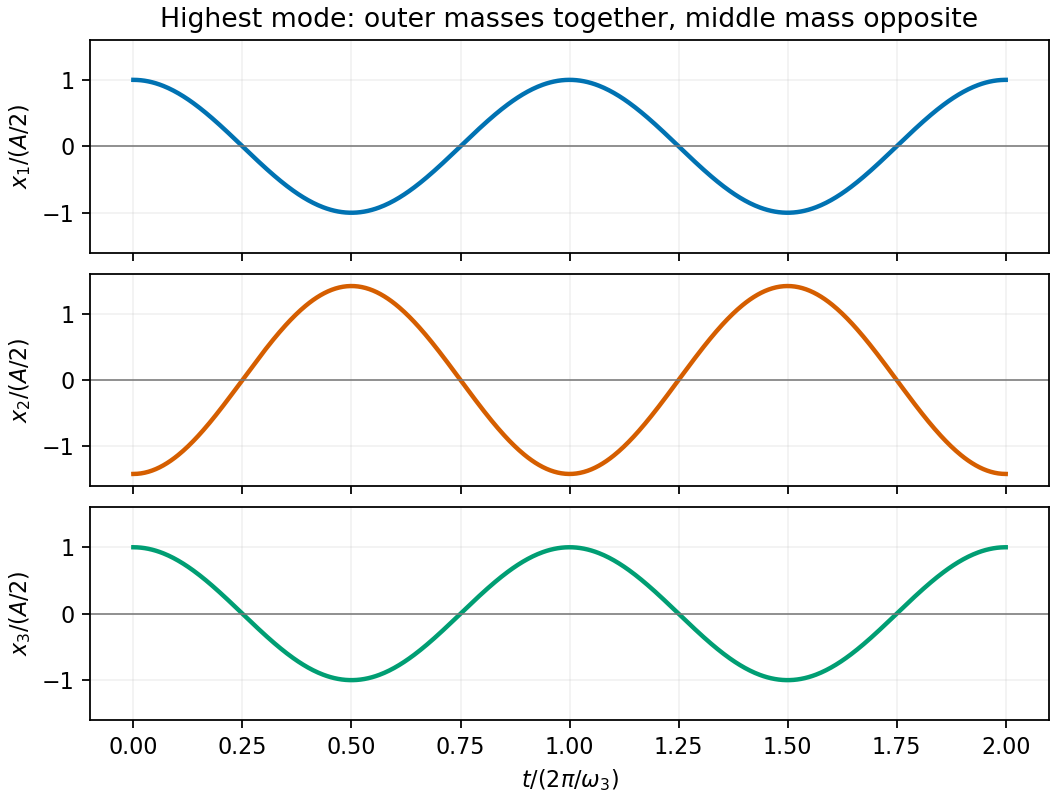
Codex 0 2026-10-18The largest angular-frequency magnitude is . With overall amplitude , the corresponding displacements areThus the two outer masses move together, while the middle mass moves oppositely with times their amplitude. All three have the same period .
Past exam of the mathematics course of the year 1 of the natural sciences course of the University of Cambridge 2015 Paper 2 17 e Solution by Codex 0 2026-10-18
Codex 0 2026-10-18The pairwise dot products of the normalized vectors areTheir squared norms are respectively , , and , all one. Hence they form an orthonormal basis. This also follows from the spectral theorem for real symmetric matrices, because is symmetric and its three eigenvalues are distinct.
Pinned article: Introduction to the OurBigBook Project
Welcome to the OurBigBook Project! Our goal is to create the perfect publishing platform for STEM subjects, and get university-level students to write the best free STEM tutorials ever.
Everyone is welcome to create an account and play with the site: ourbigbook.com/go/register. We belive that students themselves can write amazing tutorials, but teachers are welcome too. You can write about anything you want, it doesn't have to be STEM or even educational. Silly test content is very welcome and you won't be penalized in any way. Just keep it legal!
Intro to OurBigBook
. Source. We have two killer features:
- topics: topics group articles by different users with the same title, e.g. here is the topic for the "Fundamental Theorem of Calculus" ourbigbook.com/go/topic/fundamental-theorem-of-calculusArticles of different users are sorted by upvote within each article page. This feature is a bit like:
- a Wikipedia where each user can have their own version of each article
- a Q&A website like Stack Overflow, where multiple people can give their views on a given topic, and the best ones are sorted by upvote. Except you don't need to wait for someone to ask first, and any topic goes, no matter how narrow or broad
This feature makes it possible for readers to find better explanations of any topic created by other writers. And it allows writers to create an explanation in a place that readers might actually find it.
Figure 1. Screenshot of the "Derivative" topic page. View it live at: ourbigbook.com/go/topic/derivativeVideo 2. OurBigBook Web topics demo. Source. - local editing: you can store all your personal knowledge base content locally in a plaintext markup format that can be edited locally and published either:This way you can be sure that even if OurBigBook.com were to go down one day (which we have no plans to do as it is quite cheap to host!), your content will still be perfectly readable as a static site.
- to OurBigBook.com to get awesome multi-user features like topics and likes
- as HTML files to a static website, which you can host yourself for free on many external providers like GitHub Pages, and remain in full control

Figure 2. You can publish local OurBigBook lightweight markup files to either OurBigBook.com or as a static website.
Figure 3. Visual Studio Code extension installation.
Figure 5. . You can also edit articles on the Web editor without installing anything locally. Video 3. Edit locally and publish demo. Source. This shows editing OurBigBook Markup and publishing it using the Visual Studio Code extension. 
- Infinitely deep tables of contents:



All our software is open source and hosted at: github.com/ourbigbook/ourbigbook
Further documentation can be found at: docs.ourbigbook.com
Feel free to reach our to us for any help or suggestions: docs.ourbigbook.com/#contact