Topics (119k) Articles (119k) Users (287) Discussions (237) Comments (383) Files (715) New article
www.biorxiv.org/content/10.1101/2022.09.19.508583v1.fullIt is also interesting to see how they are interested in co-culture with HeLa cells, presumably to enable infectious bacterial disease studies.
CVI-syn3B strains differ from JCVI-syn3.0 by the presence of 19 additional non-essential genes that result in a more easily manipulated cell. JCVI-syn3B additionally includes a dual loxP landing pad that enables easy Cre recombinase mediated insertion of genes
At biology.indiana.edu/news-events/news/2023/lennon-minimal-cells.html (2023) they let it re-evove to it it would regain some fitness, and it did.
Before:
7 my-feature HEAD
|
6
|
5 master
|
4
|
3
|
2
|
1
Oh, commit 6 was crap:
git rebase -i HEAD~2Mark
6 to be modified.After:Better now, ready to push.
7 my-feature HEAD
|
6v2
|
5 master
|
4
|
3
|
2
|
1Before:
5 master
|
4 7 my-feature HEAD
| |
3 6
|/
2
|
1Action:
git rebaseAfter:Ready to push with linear history!
7 my-feature HEAD
|
6
|
5 master
|
4
|
3
|
2
|
1 Git tips But which commit from master did we conflict with exactly? by  Ciro Santilli 40 Updated 2025-07-16
Ciro Santilli 40 Updated 2025-07-16git rebase does not tell you that, and that sucks.We only know which commit from the feature branch caused the problem.
Generally we can guess or it is not needed, but
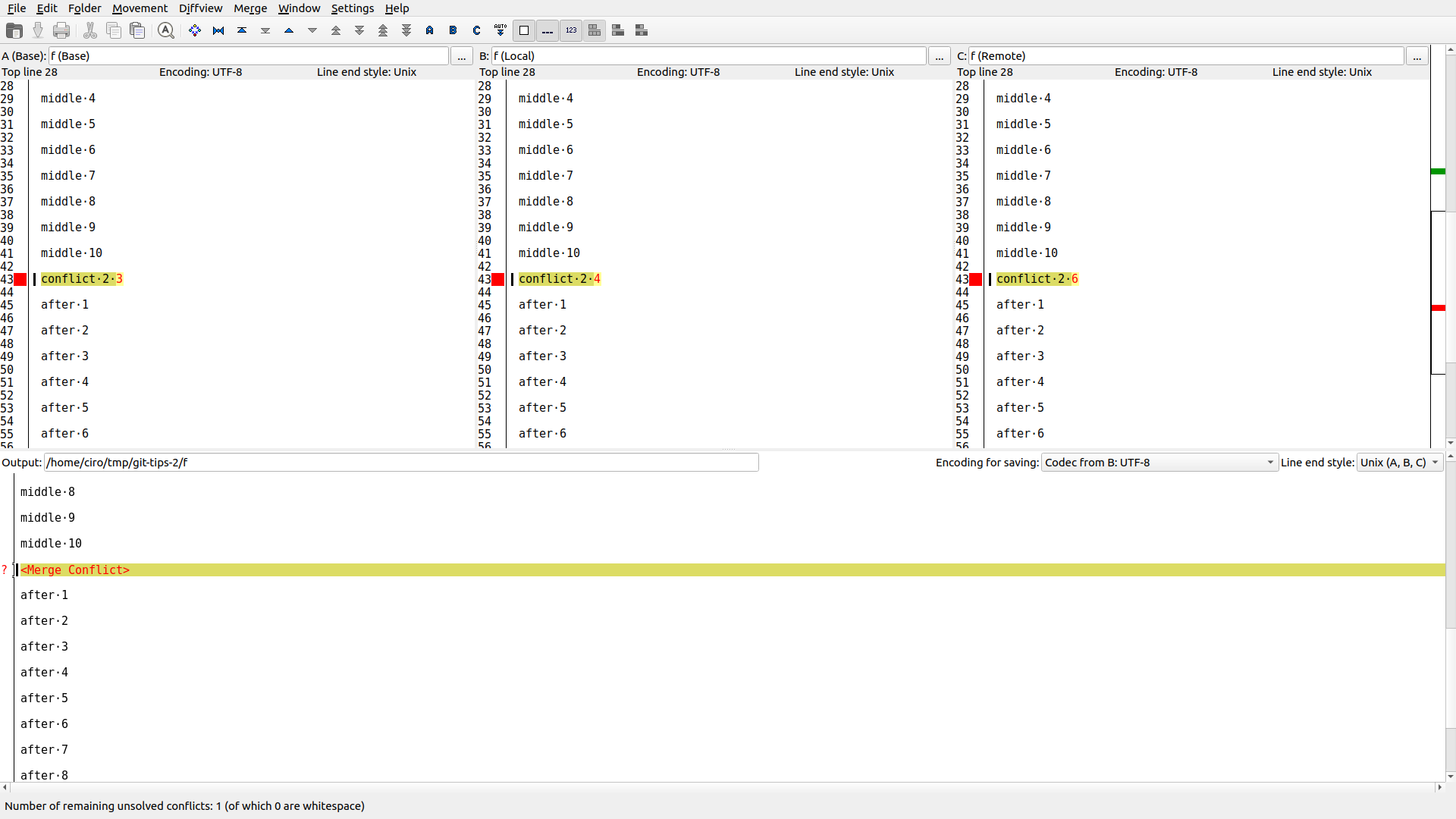
imerge does look promising: stackoverflow.com/questions/18162930/how-can-i-find-out-which-git-commits-cause-conflictsThese are good free newbie GUI options:
sudo apt install meld
git mergetool --tool meld

sudo apt install kdiff3
git mergetool --tool kdiff3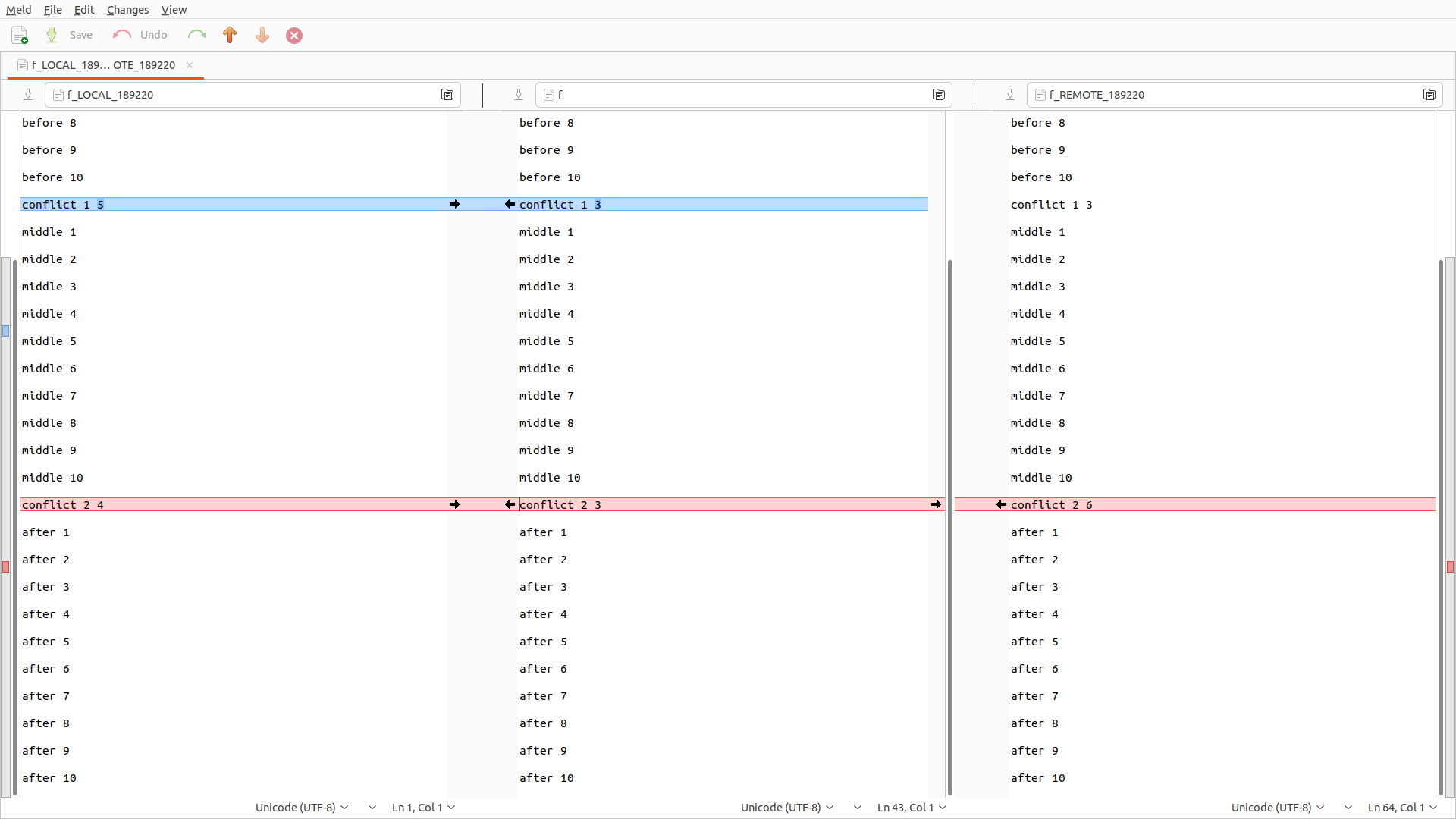
git-tips-2.sh
#!/usr/bin/env bash

set -eux

add() (
  rm -f f
  for i in `seq 10`; do
    printf "before $i\n\n" >> f
  done
  printf "conflict 1 $1\n\n" >> f
  for i in `seq 10`; do
    printf "middle $i\n\n" >> f
  done
  printf "conflict 2 $2\n\n" >> f
  for i in `seq 10`; do
    printf "after $i\n\n" >> f
  done
  git add f
)

rm -rf git-tips-2
mkdir git-tips-2
cd git-tips-2
git init

for i in 1 2 3; do
  add $i $i
  git commit -m $i
done

add 3 4
git commit -m 4

add 5 4
git commit -m 5

git checkout HEAD~2
git checkout -b my-feature

add 3 6
git commit -m 6

add 7 6
git commit -m 7diff3 conflict is basically what you always want to see, either by setting it as the default as per stackoverflow.com/questions/27417656/should-diff3-be-default-conflictstyle-on-git:git config --global merge.conflictstyle diff3git checkout --conflict=diff3With this, conflicts now show up as:
++<<<<<<< HEAD
 +5
++||||||| parent of 7b0f59d (6)
++3
++=======
+ 6
++>>>>>>> 7b0f59d (6)
7b0f59d is the SHA-2 of commit 6.instead of the inferior default:
++<<<<<<< ours
 +5
++=======
+ 6
++>>>>>>> theirs
We can also observe the current tree state during resolution:so we understand that we are now at 5 and that we are trying to apply our commit
* b4ec057 (HEAD, master) 5
* 0b37c1b 4
| * fbfbfe8 (my-feature) 7
| * 7b0f59d 6
|/
* 661cfab 3
* 6d748a9 2
* c5f8a2c 16So it is much clearer what is happening:and so now we have to decide what the new code is that will put both of these together.
We now reach:and the tree looks like:So we understand that:
++<<<<<<< HEAD
 +11
++||||||| parent of fbfbfe8 (7)
++6
++=======
+ 7
++>>>>>>> fbfbfe8 (7)* ca7f7ff (HEAD) 6
* b4ec057 (master) 5
* 0b37c1b 4
| * fbfbfe8 (my-feature) 7
| * 7b0f59d 6
|/
* 661cfab 3
* 6d748a9 2
* c5f8a2c 1and after resolving that one we now reach:
* e1aaf20 (HEAD -> my-feature) 7
* ca7f7ff 6
* b4ec057 (master) 5
* 0b37c1b 4
* 661cfab 3
* 6d748a9 2
* c5f8a2c 1Principal investigator: Simon M. Lucas.
- SQLite with
rowid: stackoverflow.com/questions/8190541/deleting-duplicate-rows-from-sqlite-database - SQL Server has crazy "CTEs" change backing table extension: stackoverflow.com/questions/18390574/how-to-delete-duplicate-rows-in-sql-server
At twitter.com/togelius/status/1328404390114435072 called out on DeepMind Lab2D for not giving them credit on prior work!As seen from web.archive.org/web/20220331022932/http://gvgai.net/ though, DeepMind sponsored them at some point.
This very much looks like like GVGAI which was first released in 2014, been used in dozens (maybe hundreds) of papers, and for which one of the original developers was Tom Schaul at DeepMind...
CIA 2010 covert communication websites Wayback Machine crawl date search by Ciro Santilli 40 Updated 2025-07-16
Ciro Santilli 40 Updated 2025-07-16 CIA 2010 covert communication websites Wayback Machine CDX scanning by Ciro Santilli 40 Updated 2025-07-16
Ciro Santilli 40 Updated 2025-07-16The Wayback Machine has an endpoint to query cralwed pages called the CDX server. It is documented at: github.com/internetarchive/wayback/blob/master/wayback-cdx-server/README.md.
This allows to filter down 10 thousands of possible domains in a few hours. But 100s of thousands would be too much. This is because you have to query exactly one URL at a time, and they possibly rate limit IPs. But no IP blacklisting so far after several hours, so it's not that bad.
Once you have a heuristic to narrow down some domains, you can use this helper: ../cia-2010-covert-communication-websites/cdx.sh to drill them down from 10s of thousands down to hundreds or thousands.
We then post process the results of cdx.sh with ../cia-2010-covert-communication-websites/cdx-post.sh to drill them down from from thousands to dozens, and manually inspect everything.
From then on, you can just manually inspect for hist on your browser.
Pinned article: Introduction to the OurBigBook Project
Welcome to the OurBigBook Project! Our goal is to create the perfect publishing platform for STEM subjects, and get university-level students to write the best free STEM tutorials ever.
Everyone is welcome to create an account and play with the site: ourbigbook.com/go/register. We belive that students themselves can write amazing tutorials, but teachers are welcome too. You can write about anything you want, it doesn't have to be STEM or even educational. Silly test content is very welcome and you won't be penalized in any way. Just keep it legal!
Intro to OurBigBook
. Source. We have two killer features:
- topics: topics group articles by different users with the same title, e.g. here is the topic for the "Fundamental Theorem of Calculus" ourbigbook.com/go/topic/fundamental-theorem-of-calculusArticles of different users are sorted by upvote within each article page. This feature is a bit like:
- a Wikipedia where each user can have their own version of each article
- a Q&A website like Stack Overflow, where multiple people can give their views on a given topic, and the best ones are sorted by upvote. Except you don't need to wait for someone to ask first, and any topic goes, no matter how narrow or broad
This feature makes it possible for readers to find better explanations of any topic created by other writers. And it allows writers to create an explanation in a place that readers might actually find it.
Figure 1. Screenshot of the "Derivative" topic page. View it live at: ourbigbook.com/go/topic/derivativeVideo 2. OurBigBook Web topics demo. Source. - local editing: you can store all your personal knowledge base content locally in a plaintext markup format that can be edited locally and published either:This way you can be sure that even if OurBigBook.com were to go down one day (which we have no plans to do as it is quite cheap to host!), your content will still be perfectly readable as a static site.
- to OurBigBook.com to get awesome multi-user features like topics and likes
- as HTML files to a static website, which you can host yourself for free on many external providers like GitHub Pages, and remain in full control

Figure 2. You can publish local OurBigBook lightweight markup files to either OurBigBook.com or as a static website.
Figure 3. Visual Studio Code extension installation.
Figure 5. . You can also edit articles on the Web editor without installing anything locally. Video 3. Edit locally and publish demo. Source. This shows editing OurBigBook Markup and publishing it using the Visual Studio Code extension. 
- Infinitely deep tables of contents:


All our software is open source and hosted at: github.com/ourbigbook/ourbigbook
Further documentation can be found at: docs.ourbigbook.com
Feel free to reach our to us for any help or suggestions: docs.ourbigbook.com/#contact