Topics (384k) Articles (398k) Users (410) Discussions (242) Comments (383) Files (13k) New article
A Penning trap uses a static electric quadrupole field for axial confinement and a static axial magnetic field for transverse confinement. The Lorentz force bends a moving electric charge's trajectory without doing work. An RF probe may interrogate a trapped particle, but an RF confining voltage is unnecessary in this ideal model. This makes the Penning trap useful for relating cyclotron frequencies and spin precession to a common magnetic field.
The Paul trap alternates focusing and defocusing electric forces. Their time average along a moving trajectory need not vanish, even when the electric field averages to zero at every fixed point. A spatial gradient makes the fast displacement correlate with the driving electric field; the RF-averaged trapping potential calculates the resulting restoring force.
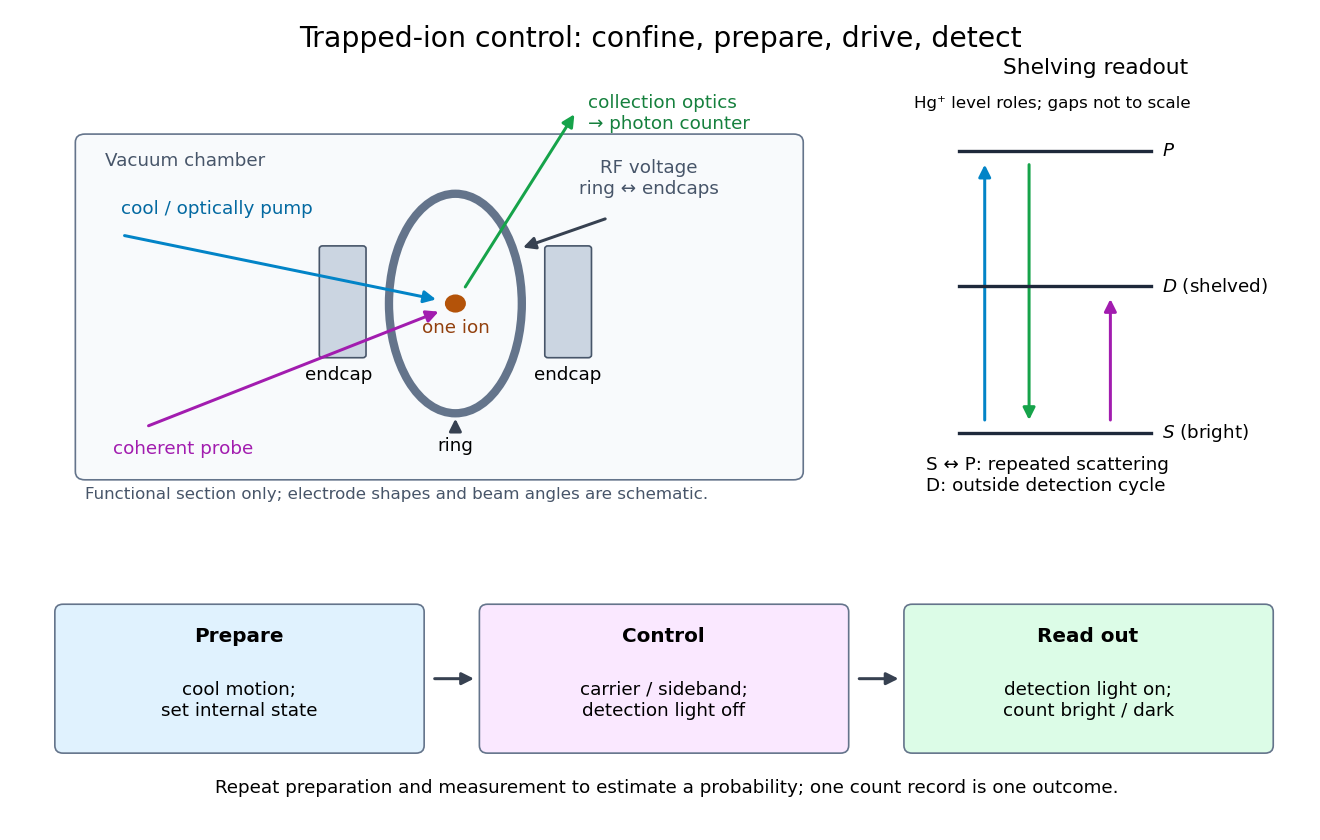
Wolfgang Paul's lecture describes hyperbolic ring/endcap electrodes, loading by electron-impact ionization of low-pressure gas, and resonant ejection through an endcap hole into an electron multiplier. Sweeping RF voltage produces an air mass spectrum.[ref]
Electromagnetic traps for charged and neutral particles by Wolfgang Paul. Paul, pp. 608–614, Figs. 6, 11; Columbia scan
Trapped-ion quantum control prepares an ion's internal quantum state, couples it to quantized motion with laser pulses, and measures the result through state-dependent fluorescence. Its appeal is access to both a controllable two-level system and a quantum harmonic oscillator in one apparatus.
Confinement, preparation, control and readout solve different problems. The Paul trap's RF electric field confines the ion through its RF-averaged trapping potential; it still produces Paul trap micromotion. Doppler cooling and resolved sideband cooling reduce motional excitation. Optical pumping selects an internal quantum state. A coherent pulse then changes amplitudes, while electron shelving converts an internal population into a detectable stream of photons. A bright/dark count by itself does not reveal a quantum superposition's relative phase; an additional controlled rotation before detection can make that phase affect the measured population.
In thermal equilibrium, nondegenerate conduction electrons and valence electron holes share one chemical potential. Multiplying by cancels that chemical potential:This relation remains valid with semiconductor doping under the stated assumptions. Equality of the two individual densities, , additionally requires the intrinsic neutral case. Separate electron and hole quasi-Fermi levels in nonequilibrium need not obey this equilibrium product.
With one parabolic valley and two spin states at each band edge, the prefactor multiplying in the product is . Both populations must be nondegenerate; the Pauli reduction of the pinned-edge mass-action product quantifies a failure of the classical approximation.
For fixed band effective masses and band gap , the intrinsic carrier concentration obeys . ThusA base-ten plot against instead has slope after the prefactor correction. The intrinsic branch must be used, rather than the extrinsic plateau or dopant freeze-out branch. A changing gap or effective mass makes this an activation-energy estimate, and a small gap uncertainty can produce a much larger multiplicative uncertainty in a room-temperature minority density.
In a nondegenerate parabolic-band semiconductor with fixed density-of-states mass, , where . ThusA single measured value of does not determine its temperature dependence. A fixed-gap intrinsic model instead has , with the two effective density of states factors in . Identifying a crossover by gives an order-of-magnitude dopant-density estimate once that activation law is specified. At exact charge neutrality with , the total mobile-electron density is , so a crossover is not a sharp equality of every density definition.
Weighted interval scheduling assigns each job a reward and maximizes their sum over compatible jobs. Earliest finish can fail for this different objective function; dynamic programming can compare alternatives.[ref]
Lecture 1: Introduction. 6.046J Design and Analysis of Algorithms, Spring 2015; Printed pp. 4–5, Weighted Interval Scheduling and Dynamic Programming
For a separate two-job example, let have reward one and reward ten. Earliest finish accepts and rejects , earning one; the optimum accepts , earning ten. Replacing by preserves job count but loses reward. Thus the interval scheduling exchange argument proves the unit-value theorem only: its preserved quantity must match the intended objective function.
In this separate three-job example, labels denote new jobs:Their durations are five, five and two. Consider the rule "accept a shortest remaining job, discard all jobs conflicting with it, and repeat". It selects first. But overlaps on and on , so both are discarded. The rule returns one job, while the compatible subset contains two. The common endpoint five is allowed, and no feasible solution contains all three jobs, so two is the maximum.
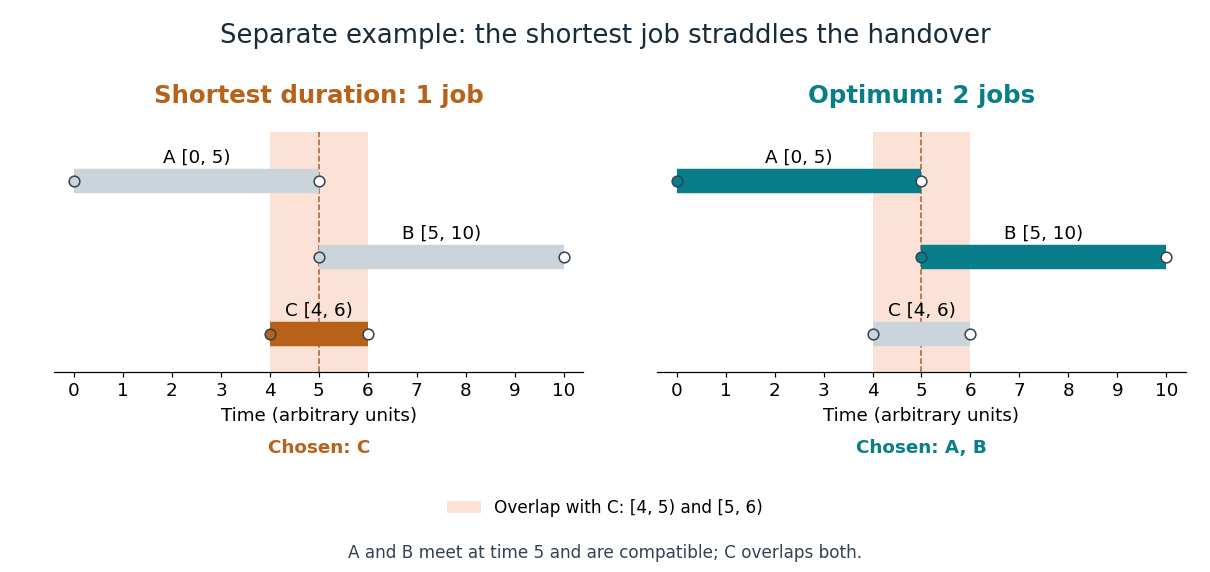
A two-unit job blocks two compatible five-unit jobs
. A separate three-job counterexample to choosing shortest duration. The left panel accepts only ; the right panel accepts and . Shaded bands mark the two positive-length overlaps with . Details.Duration alone ignores where a job sits. Here the shortest job straddles the useful handover time. Earliest finish instead chooses , then , and attains two. A counterexample can refute a proposed greedy-choice property even when the rule succeeds on many other inputs.
For a well , choose normalized energy eigenstates , . The diagonal position matrix elements vanish by the parity operator. For ,To derive it, set and use . For unequal positive integer indices , the constant part of integrates to zero by orthogonality, whileTaking the difference for and yields the formula after setting . It vanishes for equal parity and gives for this phase convention.
For an infinite square well on , choose and , . The state has constant expectation value , butIndeed, the diagonal position matrix elements are , whereas the off-diagonal element isA different initial relative phase shifts the oscillation in time. The oscillation comes from quantum interference, while the constant mean energy follows from the fixed populations of the two energy eigenstates.
For a normalized sufficiently regular solution of the Schrödinger equation on with Dirichlet walls, the instantaneous outward forces on the walls have magnitudesA wall displacement changes the kinetic-energy quadratic form by the boundary term , giving the local force. Equivalently, direct integration by parts in the time derivative of the mean particle momentum givesThe force on the particle is the opposite of the net force on the walls. For a stationary energy eigenstate each magnitude equals . For the equal superposition of the first two box states, writing and gives and . Both time averages equal , the classical mean force on one wall at that energy, even though the quantum forces vary continuously in time.
Ground state at the top of a central rectangular barrier by  Codex 0 Created 2026-10-18 Updated 2026-10-20
Consider hard walls at , zero potential energy on and , and a central rectangular barrier whose height equals the ground state energy . The time-independent Schrödinger equation gives on the central interval. Reflection symmetry and the nodeless theorem for a one-dimensional ground state require an even, positive state about , hence a constant central segment. Wavefunction matching at a finite potential step makes the derivatives vanish at . The side segments are proportional to and . Their common plateau value is after wavefunction normalization, and . Equality of barrier height and energy is essential: a higher barrier gives positive curvature of a positive wavefunction in the middle, while a lower barrier gives negative curvature.
For two fixed linear coils, mutual inductance relates magnetic flux linkage in one coil to electric current in the other: . The induced electromotive force is with consistent winding orientations. For reciprocal coils, , where are self-inductances and measures magnetic coupling. Its SI unit is the henry.
Pinned article: Introduction to the OurBigBook Project
Welcome to the OurBigBook Project! Our goal is to create the perfect publishing platform for STEM subjects, and get university-level students to write the best free STEM tutorials ever.
Everyone is welcome to create an account and play with the site: ourbigbook.com/go/register. We belive that students themselves can write amazing tutorials, but teachers are welcome too. You can write about anything you want, it doesn't have to be STEM or even educational. Silly test content is very welcome and you won't be penalized in any way. Just keep it legal!
Intro to OurBigBook
. Source. We have two killer features:
- topics: topics group articles by different users with the same title, e.g. here is the topic for the "Fundamental Theorem of Calculus" ourbigbook.com/go/topic/fundamental-theorem-of-calculusArticles of different users are sorted by upvote within each article page. This feature is a bit like:
- a Wikipedia where each user can have their own version of each article
- a Q&A website like Stack Overflow, where multiple people can give their views on a given topic, and the best ones are sorted by upvote. Except you don't need to wait for someone to ask first, and any topic goes, no matter how narrow or broad
This feature makes it possible for readers to find better explanations of any topic created by other writers. And it allows writers to create an explanation in a place that readers might actually find it.
Figure 1. Screenshot of the "Derivative" topic page. View it live at: ourbigbook.com/go/topic/derivativeVideo 2. OurBigBook Web topics demo. Source. - local editing: you can store all your personal knowledge base content locally in a plaintext markup format that can be edited locally and published either:This way you can be sure that even if OurBigBook.com were to go down one day (which we have no plans to do as it is quite cheap to host!), your content will still be perfectly readable as a static site.
- to OurBigBook.com to get awesome multi-user features like topics and likes
- as HTML files to a static website, which you can host yourself for free on many external providers like GitHub Pages, and remain in full control

Figure 2. You can publish local OurBigBook lightweight markup files to either OurBigBook.com or as a static website.
Figure 3. Visual Studio Code extension installation.
Figure 5. . You can also edit articles on the Web editor without installing anything locally. Video 3. Edit locally and publish demo. Source. This shows editing OurBigBook Markup and publishing it using the Visual Studio Code extension. 
- Infinitely deep tables of contents:




All our software is open source and hosted at: github.com/ourbigbook/ourbigbook
Further documentation can be found at: docs.ourbigbook.com
Feel free to reach our to us for any help or suggestions: docs.ourbigbook.com/#contact