Topics (384k) Articles (398k) Users (410) Discussions (242) Comments (383) Files (13k) New article

Limited Papain digestion of IgG cuts each immunoglobulin heavy chain on the N-terminus side of the hinge crosslinks, releasing two Fab fragments and one Fc fragment.[ref]
The structure of a typical antibody molecule. Immunobiology: The Immune System in Health and Disease, 5th edition by Charles A. Janeway, Jr. and others; §3-3 and Figure 3.3: papain cut positions and two Fab plus one Fc
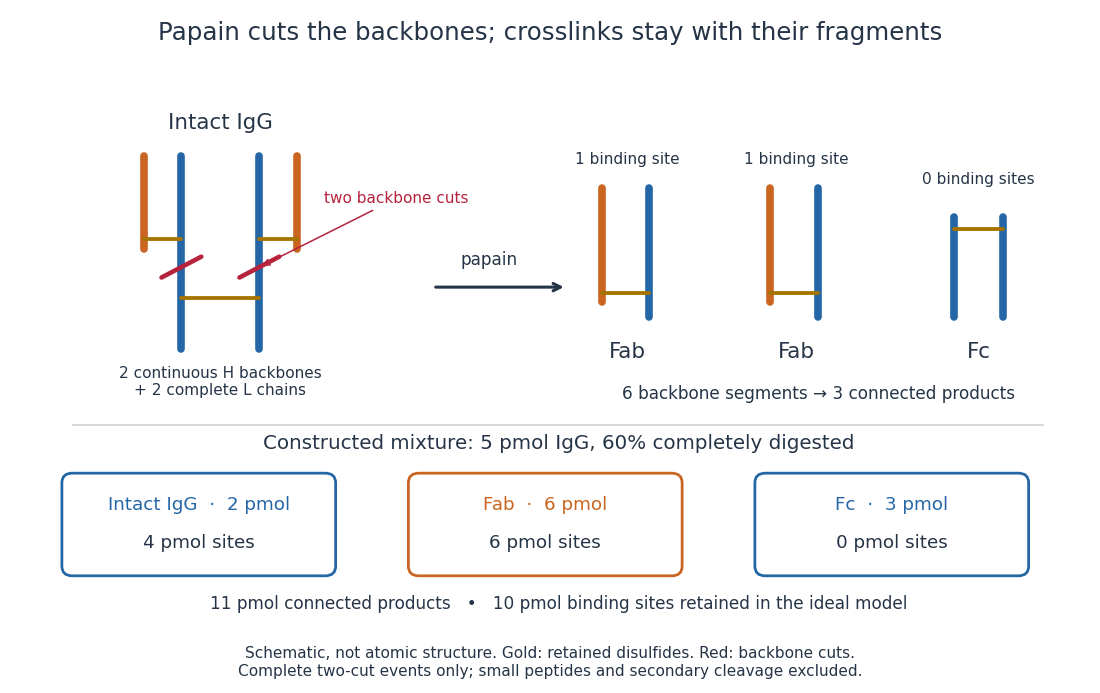
Two backbone cuts give two Fab fragments and one Fc fragment
. Original schematic of ideal limited Papain digestion of IgG, with cuts distinguished from retained protein disulfide bonds. The lower panel counts products for a constructed partial-digestion example, not a measured digest. Small released peptides, incomplete cleavage of one arm and secondary cleavage are excluded from that model. Details.A connectivity argument explains the three products. Treat each continuous backbone segment as a graph vertex, and retained interchain disulfide bonds as edges. After the two stipulated cuts, six backbone segments remain: two complete immunoglobulin light chains, two immunoglobulin heavy chain arm segments and two immunoglobulin heavy chain stem segments. Each light chain remains attached to its own arm segment, producing two separate Fab fragments. The two stem segments remain attached to each other, producing one Fc fragment. Thus six backbone segments form three connected components of a graph, not six independently released products. Removing crosslinks instead, while keeping each backbone intact, would leave four chain components in this simplified covalent-connectivity model.
For a constructed mixture, start with of intact IgG and stipulate that undergoes the complete two-cut event while the rest remains intact. Count amount of substance of each product:The total amount of separately connected products becomes , although the starting amount was . Each digested IgG replaces one connected assembly with three. The antibody binding site inventory is conserved in this model:The factor two counts sites per intact IgG, not extra immunoglobulin light chains per Fab fragment. Fragment counts, backbone-segment counts and antibody binding site counts must be kept distinct. A real digest's retained binding would additionally depend on preservation of the paratopes.
The historical functional test was more subtle than asking whether a fragment still formed a visible precipitate. Rodney Robert Porter's earlier rabbit anti-ovalbumin preparation was digested with papain powder. The resulting fragment did not precipitate ovalbumin itself, but specifically inhibited ovalbumin precipitation with undigested antiserum. The intact-antiserum reaction supplied the positive comparison: failure to precipitate alone did not mean failure to recognize the antigen.[ref]
Separation and Isolation of Fractions of Rabbit Gamma-Globulin containing the Antibody and Antigenic Combining Sites by Rodney Robert Porter. Rodney R. Porter, Separation and Isolation of Fractions of Rabbit Gamma-Globulin containing the Antibody and Antigenic Combining Sites, 1958, opening paragraph: earlier papain-powder digest and inhibition of precipitation
The inference is that binding and assembly of a precipitating network are different abilities. A one-site Fab fragment can occupy an epitope without providing the two-arm bridge available to intact IgG. The inhibition readout supports retained recognition under the tested conditions; it does not locate individual contacts or show that every papain-generated product binds. This is the conceptual benefit of fragmenting an antibody: one can ask which functions survive loss of a structural connection.
The mass fractal dimension relates the particle count or mass in a self-similar aggregate to its spatial size. For primary particle radius and aggregate radius of gyration , a common convention is , with a nonuniversal prefactor . In three dimensions the mean occupied fraction scales as . A smaller therefore describes a more tenuous large cluster; a compact constant-density object has . The scaling applies between the primary-particle and aggregate scales, not at all distances.
If is a real-valued function and an integrable function, its Fourier transform has Hermitian symmetry: . The value at negative frequency is the complex conjugate of the value at positive frequency.
For real , integrate around a rectangle of height . Its top-edge value is times the bottom-edge value, and the only enclosed simple pole is , with residue . The vertical-edge integrals vanish as their real parts tend to positive and negative infinity. The residue theorem gives , proving the stated Fourier transform identity. This is an example of a function reproducing its shape under a Fourier transform, up to rescaling.
For on and zero outside, the angular-frequency Fourier transform follows by writing the cosine as two complex exponentials. Combining fractions gives . The apparent singularities at are removable, with value . If , jumps at the endpoints give an oscillatory envelope. If , the function is continuous at the endpoints but its first derivative jumps, giving an envelope. This is an explicit instance of Fourier decay from a derivative jump.
For the Fourier transform convention , Fourier inversion at gives . Thus transforming twice reflects the argument and multiplies by . The identity holds directly on the Schwartz space, and extends to the L2 space and to tempered distributions. It lets an already known transform pair be used in reverse without another integration.
With Fourier transform convention , differentiation under the integral gives , proving the displayed identity. For example it applies when all for are absolutely integrable, or in the tempered distribution sense. It is the dual counterpart of the Fourier transform of a derivative.
With the Fourier transform convention , the inverse Fourier transform is the displayed linear operator. The integral is defined directly for an integrable function . The Fourier inversion theorem ensures under its hypotheses, in particular for Schwartz functions, and for integrable and at continuity points of . The operation also extends to tempered distributions; the normalization and sign depend on the chosen Fourier transform convention.
For , periodically extend and from with period . Their Fourier series areand, away from odd integers,The first identity follows by integration of on , using the antiderivativeFor the second identity, integration by parts and show that its sine coefficient is times the first series' cosine coefficient. This avoids assuming that a Fourier series can always be differentiated term by term. The periodic hyperbolic cosine is continuous, so its series converges to it everywhere. The periodic hyperbolic sine has a jump discontinuity at each odd integer: the Dirichlet-Jordan convergence theorem gives the average of its two limiting values, namely zero, there. Both identities hold in the sense of mean-square convergence, which suffices for Parseval's identity.
For a period- Fourier series written as , where , translating the function by to rotates each pair of Fourier coefficients:The constant coefficient is unchanged. These formulas follow by the sine and cosine subtraction identities. In the complex Fourier series, the same statement is . An integer-period translation changes no Fourier coefficient.
Pinned article: Introduction to the OurBigBook Project
Welcome to the OurBigBook Project! Our goal is to create the perfect publishing platform for STEM subjects, and get university-level students to write the best free STEM tutorials ever.
Everyone is welcome to create an account and play with the site: ourbigbook.com/go/register. We belive that students themselves can write amazing tutorials, but teachers are welcome too. You can write about anything you want, it doesn't have to be STEM or even educational. Silly test content is very welcome and you won't be penalized in any way. Just keep it legal!
Intro to OurBigBook
. Source. We have two killer features:
- topics: topics group articles by different users with the same title, e.g. here is the topic for the "Fundamental Theorem of Calculus" ourbigbook.com/go/topic/fundamental-theorem-of-calculusArticles of different users are sorted by upvote within each article page. This feature is a bit like:
- a Wikipedia where each user can have their own version of each article
- a Q&A website like Stack Overflow, where multiple people can give their views on a given topic, and the best ones are sorted by upvote. Except you don't need to wait for someone to ask first, and any topic goes, no matter how narrow or broad
This feature makes it possible for readers to find better explanations of any topic created by other writers. And it allows writers to create an explanation in a place that readers might actually find it.
Figure 1. Screenshot of the "Derivative" topic page. View it live at: ourbigbook.com/go/topic/derivativeVideo 2. OurBigBook Web topics demo. Source. - local editing: you can store all your personal knowledge base content locally in a plaintext markup format that can be edited locally and published either:This way you can be sure that even if OurBigBook.com were to go down one day (which we have no plans to do as it is quite cheap to host!), your content will still be perfectly readable as a static site.
- to OurBigBook.com to get awesome multi-user features like topics and likes
- as HTML files to a static website, which you can host yourself for free on many external providers like GitHub Pages, and remain in full control

Figure 2. You can publish local OurBigBook lightweight markup files to either OurBigBook.com or as a static website.
Figure 3. Visual Studio Code extension installation.
Figure 5. . You can also edit articles on the Web editor without installing anything locally. Video 3. Edit locally and publish demo. Source. This shows editing OurBigBook Markup and publishing it using the Visual Studio Code extension. 
- Infinitely deep tables of contents:



All our software is open source and hosted at: github.com/ourbigbook/ourbigbook
Further documentation can be found at: docs.ourbigbook.com
Feel free to reach our to us for any help or suggestions: docs.ourbigbook.com/#contact