Topics (384k) Articles (398k) Users (410) Discussions (242) Comments (383) Files (13k) New article

In cisternal maturation, a cargo-containing Golgi cisterna changes from early to later identity as its resident proteins change; retrieval of resident enzymes toward earlier compartments helps maintain Golgi apparatus polarity. In the contrasting stable-compartment model, cargo moves between persistent Golgi cisternae in transport vesicles. These mechanisms need not be mutually exclusive.[ref]
Transport from the ER through the Golgi Apparatus. Molecular Biology of the Cell, 4th edition by Bruce Alberts and others; Transport Through the Golgi Apparatus May Occur by Vesicular Transport or Cisternal Maturation, Figure 13-30 and concluding comparison
The distinction is between following cargo and following its container. A cargo label encountered first in an early processing environment and later in a late one is compatible with either changing containers or a container changing identity. Finding transport vesicles nearby does not by itself establish which cargo they carry or their direction of travel. Testing cisternal maturation therefore requires evidence about compartment identity and continuity as well as cargo position; a single mechanism should not be assumed for every cargo and biological cell.
The trans-Golgi network is the sorting and export region at the trans side of the Golgi apparatus. Onward traffic can supply the cell membrane, secretory granules, or the lysosome route.[ref]
The Golgi Apparatus. The Cell: A Molecular Approach, 2nd edition by Geoffrey M. Cooper; Protein Sorting and Export from the Golgi Apparatus, Figure 9.27 and lysosomal targeting discussion
Processing and sorting answer different questions. In a constructed example, two cargo proteins could receive the same carbohydrate modification yet carry different targeting information and leave in different transport vesicles. Conversely, two chemically different cargo proteins could share a destination. A processing readout alone therefore cannot establish the final address; an experiment must also identify cargo location or delivery. Return traffic and retention likewise matter: the Golgi apparatus is a working compartment, not merely a one-way queue that empties all of its enzymes into outgoing carriers.
Golgi cargo processing includes enzyme-mediated remodeling of attached oligosaccharides. Glycosylation can involve addition of sugars, while processing can also remove them. Different Golgi apparatus regions have different processing enzymes; their substrate requirements constrain the order of possible chemical reactions.[ref]
Transport from the ER through the Golgi Apparatus. Molecular Biology of the Cell, 4th edition by Bruce Alberts and others; Oligosaccharide Chains Are Processed in the Golgi Apparatus; The Golgi Cisternae Are Organized as a Series of Processing Compartments, Figure 13-28
An original model makes the importance of ordering explicit. Write a toy carbohydrate chain as , read with its terminal symbol on the right. Define a trimming function that removes a terminal , and an extension function that adds only when the terminal symbol is . In every other case the corresponding function leaves the chain unchanged. ThenIn particular, but : the two functions do not commute. Each result follows by inspecting the terminal symbol before applying the stipulated rule. These symbols are artificial labels, rather than a natural oligosaccharide sequence or measured enzyme pathway. The example explains why “two processing steps occurred” does not determine the product unless their order and substrate conditions are also specified. In the Golgi apparatus, spatial organization can help arrange successive opportunities for processing.
A Golgi cisterna is a flattened membrane-enclosed sac. Stacking several sacs does not make their interiors one open space: membrane separates Golgi lumen from intervening cytosol.[ref]
The Golgi Apparatus. The Cell: A Molecular Approach, 2nd edition by Geoffrey M. Cooper; Organization of the Golgi, Figure 9.22: membrane-enclosed cisternae
The final substrate-level phosphorylation in glycolysis provides a useful experimental handle: pyruvate kinase transfers a phosphate group from phosphoenolpyruvate to ADP, producing pyruvate and ATP. Adding lactate dehydrogenase couples each pyruvate formed to consumption of one NADH:These equations select free ionic forms consistently: phosphoenolpyruvate has charge , ADP , ATP , and pyruvate and lactate each ; NAD+ has one more positive charge than NADH. Each line conserves charge. Cancelling pyruvate gives one NADH consumed per ATP formed in this coupled system. A whole-pathway NADH measurement has a different meaning, because the earlier glycolysis redox step produces NADH.
The published An Optimized Enzyme-Coupled Spectrophotometric Method for Measuring Pyruvate Kinase Kinetics reports recombinant pyruvate kinase prepared in Escherichia coli, purified by chromatography and size-exclusion chromatography. UV-transparent microplate wells contained ADP, phosphoenolpyruvate, NADH, lactate dehydrogenase and a buffer solution with magnesium ions. An Epoch plate reader used spectrophotometry to follow absorbance at every five to ten seconds for one minute at . Its Figure 2 presents , increasing as NADH is consumed. Heat-inactivated pyruvate kinase gave minimal background; a validated active preparation was the positive control. These comparisons support an enzyme-dependent readout in the prepared system, rather than a whole-biological cell glycolysis measurement.[ref]
The same report uses for optical path length in Procedure B.2.i, but approximately in Data analysis §3. An absolute conversion requires the actual path length and sufficient coupling enzyme activity; no measured ATP rate is inferred here.[ref]
An Optimized Enzyme-Coupled Spectrophotometric Method for Measuring Pyruvate Kinase Kinetics by Saurabh Upadhyay. Procedure B.2.i; Data analysis §3; General notes, items 4 and 6: path-length inconsistency and linear-range conditions
For an original dimensional example, stipulate a blank-corrected absorbance decline , a calibrated path length and a chosen calibration coefficient . These are invented teaching inputs, not the protocol's measurements or its quoted coefficient. The Beer-Lambert law givesIn a stipulated reaction volume, this is of NADH consumed and, conditionally, of ATP formed. The conditional inference requires rapid pyruvate consumption by the coupling enzyme, no other NADH-consuming chemical reactions, and a linear, correctly calibrated optical response. The readout measures this last glycolysis step; it cannot establish the full two-net-ATP-per-glucose balance by itself.
In the payoff stage of glycolysis, oxidation of glyceraldehyde 3-phosphate is coupled to reduction of NAD+. Each NADH carries a two-electron reducing equivalent. The formal half-chemical equationmakes the electron count explicit: two NADH per glucose carry four electrons. This is redox bookkeeping, not a claim that free electrons travel through the chemical solution or that NADH is itself ATP.
Fermentation can return NADH to NAD+ by reducing an organic substrate; reduction of pyruvate to lactate is one example. In aerobic cellular respiration, reducing equivalents reach an electron transport chain, reducing molecular oxygen. Other forms of cellular respiration use other electron acceptors, so absence of oxygen does not uniquely imply fermentation.[ref]
Biology 2e by Mary Ann Clark and others. §7.2, step 6 and its NAD+ regeneration paragraph; §7.5, opening comparison of fermentation and anaerobic respiration, Lactic Acid Fermentation and Figure 7.16 caption
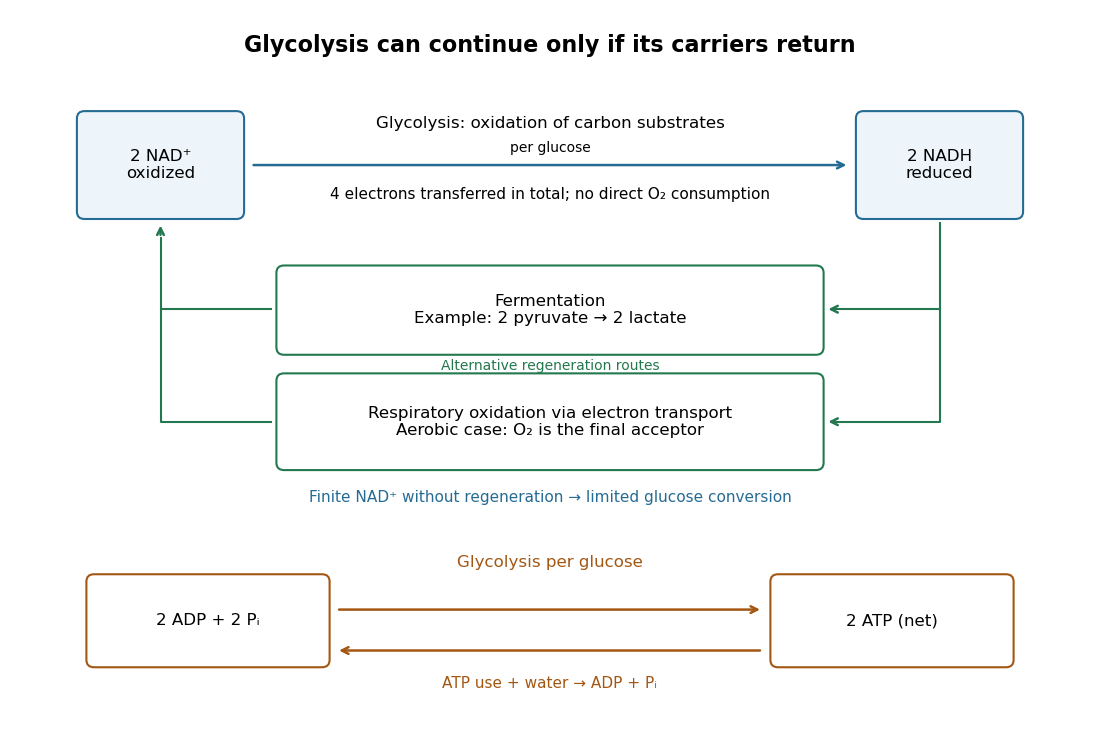
The need for NAD+ regeneration follows from a finite-pool argument. In a hypothetical closed preparation with of initially oxidized NAD+ and no regeneration, at most of glucose can complete the two NAD+-consuming conversions per glucose. This is an upper bound even with excess glucose, not a predicted stopping time: other limitations can stop the preparation earlier. With an intact fixed nicotinamide adenine dinucleotide pool and no side reactions, converting NAD+ into NADH preserves their sum but depletes the usable oxidized form.
ATP recycling imposes a second condition. Glycolysis needs some initial ATP for investment and consumes two net ADP and two inorganic phosphate per completed glucose. In a closed ideal preparation with only of initial ADP, no other source of ADP, and enough initial ATP and inorganic phosphate, at most of glucose can finish. This bound follows from the net ADP consumption, even though investment temporarily produces additional ADP. Initial investment also means that adequate final inventories alone cannot guarantee the route can start.
For continued operation at fixed carrier inventories, other chemical reactions must match the two net ATP formed per glucose with ATP use that restores ADP and inorganic phosphate, or exchange must supply those reactants. ATP hydrolysis coupled to cellular work is one route. Thus glycolysis can sustain useful energy coupling while neither its ATP inventory nor its NADH inventory grows indefinitely; matter cycles while glucose supplies fresh chemical free energy.
Follow one glucose through canonical glycolysis, with no diversion of intermediates into other metabolic pathways. The investment stage uses two ATP to prepare the six-carbon substrate. Cleavage and rearrangement provide two glyceraldehyde 3-phosphate molecules, each containing three carbon chemical atoms. Each then yields one three-carbon pyruvate, one NADH, and two ATP in the payoff stage.[ref]
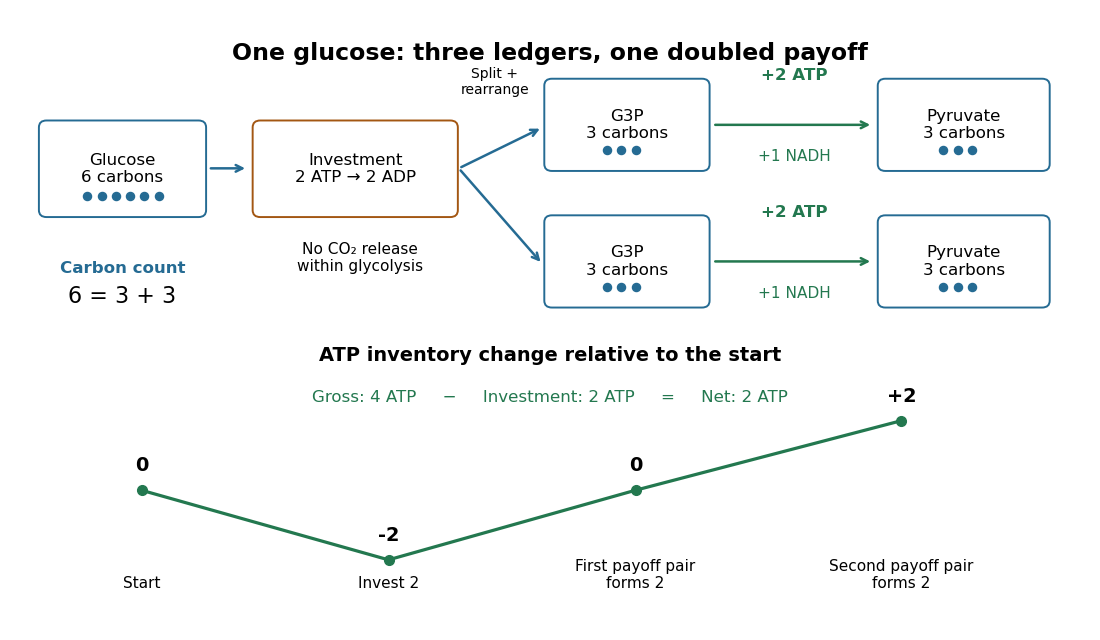
The material check is : all six carbon chemical atoms remain in the two pyruvates. No carbon dioxide has been released within this boundary. In the ATP ledger, each three-carbon route contains two ATP-forming transfers, soThe first pair of payoff transfers only restores the initial ATP inventory; the second pair creates the net gain. Four newly formed ATP is therefore compatible with only two additional ATP remaining.
For an original scaled example, stipulate complete conversion of of glucose. The initial of carbon chemical atoms becomes of pyruvate, still containing of carbon chemical atoms. The pathway spends of ATP, forms of ATP, and adds to the ATP inventory before any other ATP use. It also reduces of NAD+. These are calculated ideal amounts, not observed yields; side routes or incomplete conversion change the outcome.
A common biochemical net chemical equation isHere is inorganic phosphate. The names group biochemical protonation and metal-binding states; the displayed proton and water terms use a common shorthand rather than a unique specification of every chemical species. The robust ledger records two net ADP-to-ATP conversions and two NAD+-to-NADH conversions. Summing the individual chemical equations cancels two invested ATP against four formed ATP and cancels the internal substrates, giving those coefficients.
Pinned article: Introduction to the OurBigBook Project
Welcome to the OurBigBook Project! Our goal is to create the perfect publishing platform for STEM subjects, and get university-level students to write the best free STEM tutorials ever.
Everyone is welcome to create an account and play with the site: ourbigbook.com/go/register. We belive that students themselves can write amazing tutorials, but teachers are welcome too. You can write about anything you want, it doesn't have to be STEM or even educational. Silly test content is very welcome and you won't be penalized in any way. Just keep it legal!
Intro to OurBigBook
. Source. We have two killer features:
- topics: topics group articles by different users with the same title, e.g. here is the topic for the "Fundamental Theorem of Calculus" ourbigbook.com/go/topic/fundamental-theorem-of-calculusArticles of different users are sorted by upvote within each article page. This feature is a bit like:
- a Wikipedia where each user can have their own version of each article
- a Q&A website like Stack Overflow, where multiple people can give their views on a given topic, and the best ones are sorted by upvote. Except you don't need to wait for someone to ask first, and any topic goes, no matter how narrow or broad
This feature makes it possible for readers to find better explanations of any topic created by other writers. And it allows writers to create an explanation in a place that readers might actually find it.
Figure 1. Screenshot of the "Derivative" topic page. View it live at: ourbigbook.com/go/topic/derivativeVideo 2. OurBigBook Web topics demo. Source. - local editing: you can store all your personal knowledge base content locally in a plaintext markup format that can be edited locally and published either:This way you can be sure that even if OurBigBook.com were to go down one day (which we have no plans to do as it is quite cheap to host!), your content will still be perfectly readable as a static site.
- to OurBigBook.com to get awesome multi-user features like topics and likes
- as HTML files to a static website, which you can host yourself for free on many external providers like GitHub Pages, and remain in full control

Figure 2. You can publish local OurBigBook lightweight markup files to either OurBigBook.com or as a static website.
Figure 3. Visual Studio Code extension installation.
Figure 5. . You can also edit articles on the Web editor without installing anything locally. Video 3. Edit locally and publish demo. Source. This shows editing OurBigBook Markup and publishing it using the Visual Studio Code extension. 
- Infinitely deep tables of contents:




All our software is open source and hosted at: github.com/ourbigbook/ourbigbook
Further documentation can be found at: docs.ourbigbook.com
Feel free to reach our to us for any help or suggestions: docs.ourbigbook.com/#contact