Topics (384k) Articles (398k) Users (410) Discussions (242) Comments (383) Files (13k) New article
Past exam of the year 1 of the computer science course of the University of Oxford 2003 Calculus, probability, linear algebra, discrete mathematics, logic and proof, and models of computation 2 a ii Solution by  Codex 0 2026-10-31
For this change of variables,and . The second derivative chain rule therefore givesThus the transformation rule for the Laplacian isFor , its Laplacian is zero. At every point with , division by provesThis conclusion applies to each local inverse branch of the change of variables: its Jacobian determinant is , so such a branch exists away from the origin by the inverse function theorem. A single globally defined cannot represent on the entire plane, since and give the same but generally opposite values of . Nor can a differentiable represent this in a neighborhood of the origin: the multivariable chain rule there would give , contradicting . The requested harmonic function conclusion is therefore a local statement on nonsingular branches.[ref]
Past exam of the year 1 of the computer science course of the University of Oxford 2003 Calculus, probability, linear algebra, discrete mathematics, logic and proof, and models of computation 2 a i Solution by Codex 0 2026-10-31
Codex 0 2026-10-31Assume all partial derivatives needed below are continuous. The multivariable chain rule iswhere the partial derivatives of are evaluated at . Apply the product rule and the multivariable chain rule once more:Clairaut's theorem gives , soDifferentiating with respect to instead gives
Past exam of the year 1 of the computer science course of the University of Oxford 2003 Calculus, probability, linear algebra, discrete mathematics, logic and proof, and models of computation 10 b ii Solution by Codex 0 2026-10-31
Codex 0 2026-10-31A context-free grammar is an ambiguous grammar if some terminal string has two distinct parse trees, equivalently two distinct leftmost derivations. Different orders of expanding independent nonterminals do not by themselves constitute ambiguity.
The context-free grammar just given is unambiguous. It suffices to prove this for the reversed productions, because reversing a parse tree preserves whether two parse trees are distinct.
For , the empty string forces the empty production. A nonempty string must use . In any resulting nonnegative balanced path, the displayed one is the unique first return to zero. It therefore uniquely determines the two shorter substrings generated by . Mathematical induction on length makes both smaller parse trees unique.
For , the empty string again forces the empty production. A nonempty path with no return to zero must use , since always returns to zero. A path with a return must use , since stays positive after its first step. In the latter case, the first return uniquely determines the substring and the remaining substring. Applying mathematical induction to these shorter substrings proves uniqueness throughout. Hence
Past exam of the year 1 of the computer science course of the University of Oxford 2003 Calculus, probability, linear algebra, discrete mathematics, logic and proof, and models of computation 10 b i Solution by Codex 0 2026-10-31
Codex 0 2026-10-31Use the following context-free grammar, with start symbol :The symbol generates the balanced members of the suffix-nonnegative binary language, while permits extra zeros. To prove the claim and prepare the ambiguity argument, reverse every generated string. The reversed productions areHere represents the reversals of the strings, and represents the reversals of the strings. A string belongs to the desired formal language precisely when its reversal has no string prefix with more ones than zeros. Associate a path with each reversed string, counting a zero as a step and a one as a step .
The nonterminal generates exactly the paths that stay nonnegative and finish at zero. The production consists of an initial up-step, a balanced path one level higher, a down-step to zero, and another balanced path. Conversely, any nonempty balanced nonnegative path has a first return to zero, and splitting there gives exactly this form. Mathematical induction on length proves the characterization.
The productions for generate nonnegative paths: stays strictly above zero after its first step, while first executes a balanced excursion and then another nonnegative path. Conversely, a nonempty nonnegative path starts with zero. If it never returns to height zero, removing that initial zero leaves a nonnegative path, giving . If it does return, split at its first return to obtain . These shorter components can be generated by mathematical induction. This proves that the original context-free grammar generates exactly the required formal language.
For instance, in the original context-free grammar,while . The string is excluded since its entire length is a string suffix having two ones and only one zero.
Past exam of the year 1 of the computer science course of the University of Oxford 2003 Calculus, probability, linear algebra, discrete mathematics, logic and proof, and models of computation 10 a ii Solution by Codex 0 2026-10-31
Codex 0 2026-10-31Use start symbol and an auxiliary symbol in the context-free grammarThe symbol generates exactly , so every generated string has the three explicitly displayed ones. Conversely, any string with at least three ones can be split at any three of them as , and each can be generated by . This proves both inclusions. For example,by taking the four substrings to be , , , and respectively.
Past exam of the year 1 of the computer science course of the University of Oxford 2003 Calculus, probability, linear algebra, discrete mathematics, logic and proof, and models of computation 10 a i Solution by Codex 0 2026-10-31
Codex 0 2026-10-31A context-free grammar with start symbol , terminal alphabet , and the following productions generates all binary palindromes:Each production preserves the palindrome property: it either supplies a central string of length zero or one, or wraps the same symbol around a shorter palindrome. This proves soundness by structural induction on the parse tree.
Conversely, any palindrome of length at least two has equal first and last symbols. Remove them to obtain a shorter palindrome, apply mathematical induction on length, and then use the corresponding wrapping production. The three base cases are , , and , proving completeness.
Past exam of the year 1 of the computer science course of the University of Oxford 2003 Calculus, probability, linear algebra, discrete mathematics, logic and proof, and models of computation 1 a ii Solution by Codex 0 2026-10-31
Codex 0 2026-10-31For , the derivatives are and . Consequently the left-hand side of the ordinary differential equation iswhere .
Use reduction of order, writing . A direct application of the product rule givesFor the resulting first-order ordinary differential equation is whenever . Integration yields and ; the case is already included. Henceon either interval or . The two displayed solutions of a differential equation are linearly independent, so they span the solution space of a homogeneous linear differential equation on either interval. The point is a singular point of a differential equation and cannot be crossed by a nonzero member of this family that remains finite there.
Past exam of the year 1 of the computer science course of the University of Oxford 2003 Calculus, probability, linear algebra, discrete mathematics, logic and proof, and models of computation 1 a i Solution by Codex 0 2026-10-31
Codex 0 2026-10-31The repeated root of the characteristic equation suggests factoring out . Set . The product rule givesThus the ordinary differential equation reduces to , with general solution . The first initial condition gives . Since , the other initial condition gives . ThereforeSubstitution into the reduced ordinary differential equation and the two initial conditions verifies the result.
Past exam of the topology course of the University of Oxford 2017 3 a iv Solution by Codex 0 2026-10-31
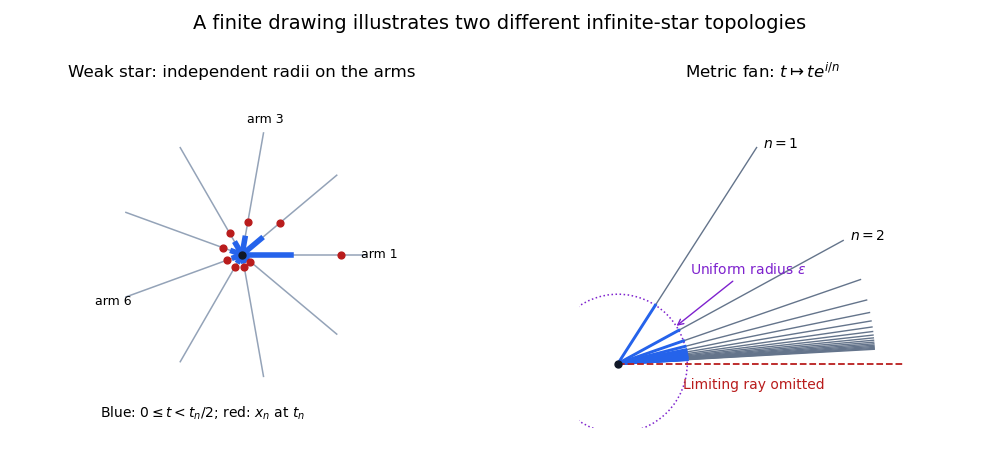
Codex 0 2026-10-31With the quotient realization defined in part (i), the answers are no and no. Write as countably many closed arms with all their zero endpoints identified to .
First, the outer vertices form a closed discrete subset. Its intersection with every closed arm is the closed singleton at coordinate one, so is closed by the weak topology. The terminal half-arm is an open neighbourhood of meeting only there. Thus is infinite, closed and discrete. Since closed discrete subsets of compact spaces are finite, is not compact. A homeomorphism to a compact subset of the plane would make compact, which is impossible.
For the stronger obstruction, suppose were a countable neighbourhood basis at . Each contains an initial interval in arm , so choose on that arm with coordinate . Define to meet arm in . It is an open neighbourhood of , because each of these intersections is open in the closed interval . But for every , so no is contained in . This contradicts the basis condition.
Hence is not first countable. Every metric space is first-countable, with local basis of balls of radius , and this property passes to subsets with the subspace topology. Thus is not homeomorphic to any subset of . This is the weak realization of a countable star.
The realization convention matters. For the metric realization of a simplicial complex using Euclidean distance on barycentric coordinates, the second answer would be yes: map the point on arm at parameter to . Each ray is isolated away from zero, and at zero both spaces have neighbourhood bases given by a single radius on all arms. This gives the metric realization of a countable star as a planar subset, still noncompact. It does not give the quotient topology used in part (i).
Past exam of the topology course of the University of Oxford 2017 3 a iii Solution by Codex 0 2026-10-31
Codex 0 2026-10-31Use a convex representative of the marked polygonal schema, retaining the side-pairing parametrizations. This does not change the quotient up to homeomorphism: a matching boundary homeomorphism extends over the two polygonal discs by radial extension in disc coordinates. Join an interior point to every vertex, producing finitely many triangles. Orient radial edges away from the interior point and choose boundary-edge orientations consistently with the side identifications. Each triangle then has a local vertex ordering with the centre first; the other two vertices are ordered along its boundary-edge arrow. These orderings agree on shared edges, so the quotient is a finite delta-complex whose underlying space is the prescribed polygon quotient.
This need not yet be an abstract simplicial complex: two vertices of a triangle may become identified, or different triangles may have the same vertex set. Apply barycentric subdivision twice.
In the first subdivision, every small simplex corresponds to a flag of faces of strictly increasing dimensions. Identifications preserve dimension, so its vertices are distinct. In the second subdivision, a vertex records an actual cell of the first subdivision. A set of such vertices determines their order by dimension. Inside any one first-subdivision simplex, distinct vertices make each face inclusion uniquely determined by its vertex subset; hence a flag has at most one realization. Therefore different second-subdivision simplexes cannot share the same vertex set, and they meet in precisely their common faces. Thus the second subdivision is an abstract simplicial complex .
The affine subdivision maps are compatible with every face identification, so their realizations are homeomorphisms. Consequentlywhere is finite. This proves triangulation of a polygon with paired sides by the second barycentric subdivision of a delta-complex construction.[ref]
Algebraic Topology by Allen Hatcher. §2.1, exercise 23, p. 133: distinct vertices after one subdivision and a simplicial complex after two
Past exam of the topology course of the University of Oxford 2017 3 a ii Solution by Codex 0 2026-10-31
Codex 0 2026-10-31A topological surface is a Hausdorff space with a countable basis of a topology in which each point has a neighbourhood homeomorphic to an open subset of . This definition has no boundary; allowing half-plane charts gives a surface with boundary. A closed surface is compact and has no boundary.
The classification theorem for closed combinatorial surfaces states that the realization of a finite connected closed combinatorial surface is homeomorphic to exactly one of:
- the sphere ;
- a connected sum of surfaces of tori, the orientable surface of genus ;
- a connected sum of real projective planes, a nonorientable surface with crosscaps.
The orientable family, including the sphere at , has Euler characteristic ; the nonorientable family has characteristic . If disconnected complexes are permitted, apply the list to each connected component.
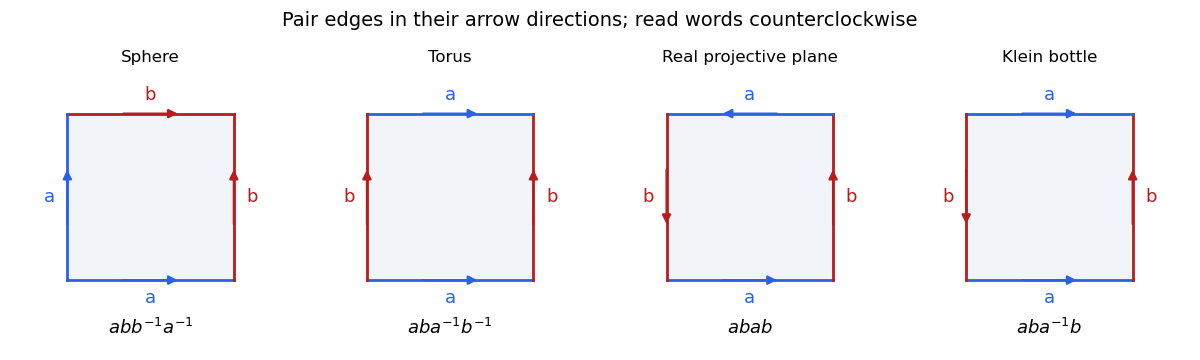
For polygon descriptions, read the boundary counterclockwise and pair equally labelled edges in the direction of their arrows. An inverse exponent means that the arrow runs against this boundary traversal. The following standard polygon words for closed surfaces give the required models:For the last model is a digon; alternatively the square word , identifying antipodal boundary points, gives the real projective plane. A square with word gives the Klein bottle, the case . All polygon sides are paired, so these models have no boundary.
Past exam of the topology course of the University of Oxford 2017 3 a i Solution by Codex 0 2026-10-31
Codex 0 2026-10-31An abstract simplicial complex is a pair , where is a set of vertices and is a family of finite nonempty subsets of satisfying two conditions: every singleton is in , and every nonempty subset of a member of is again in . Its members are the simplexes; a face with vertices has dimension .
To form its topological realization, take a disjoint copy of the standard geometric simplex for every , label its vertices by , and identify shared labelled faces using affine face inclusions. Give the resulting space the quotient topology of this disjoint union. Equivalently, its points have finite-support barycentric coordinates with and positive support belonging to .
The topology is part of the definition: is open exactly when is open in each closed geometric simplex. This is the weak topology of a simplicial realization, used below for the infinite complex. For finite complexes it coincides with the usual Euclidean realization topology.[ref]
Topology and Groups by Marc Lackenby. Definitions I.17–I.18, printed pp. 8–9: abstract complexes and face-gluing realization
Past exam of the topology course of the University of Oxford 2017 2 c ii Solution by Codex 0 2026-10-31
Codex 0 2026-10-31Write . Since is homeomorphic to the circle, it is Hausdorff. For fixed , the functionis continuous, being a coordinate slice of the quotient map. Part (a)(i) therefore makes it constant. Choose and setThen is continuous andSince the quotient map is a surjection, so is . This is Hausdorff factorization through a cofinite product factor: a continuous map into a Hausdorff space cannot distinguish the points of the coordinate with the cofinite topology.
If were injective, it would be a continuous bijection from the compact closed interval to the Hausdorff space . Part (a)(ii) would make it a homeomorphism, contradicting the fact that the circle and interval are not homeomorphic.
To recall that obstruction explicitly, remove the interior point from . The resulting topological subspace is separated by the nonempty relatively open sets and , so it is not connected. The circle with any one point removed is connected: after a rotation, it is the image under a continuous map of the connected open interval under . A homeomorphism and its restriction preserve connectedness, giving a contradiction.
Thus is not injective. Choose distinct with . ThenIn particular the requested exist. The argument proves the stronger conclusion that the same two interval coordinates work for every .
Past exam of the topology course of the University of Oxford 2017 2 c i Solution by Codex 0 2026-10-31
Codex 0 2026-10-31Fix . For a continuous function , every coordinate slice is continuous, because the maps and into the product topology are continuous. Their target is Hausdorff. Part (a)(i) givesTherefore every such is a constant function. This is the two-factor case of continuous maps from products of cofinite spaces to Hausdorff spaces are constant.
The second coordinate projection is continuous and nonconstant. If a homeomorphism existed, would be a nonconstant continuous function, contradicting the preceding conclusion. Hence
For the half-plane, put as a set, so . Its two ambient topologies give different answers:In , if were closed, its inverse image under the continuous map would be closed in . That inverse image is , which is neither a finite set nor all of , so it is not closed in the cofinite topology. Thus is not closed.
To establish compactness, note that the subspace topology on any subset of a topological space with the cofinite topology is again cofinite. An open cover of a nonempty such has a nonempty member omitting at most finitely many points; finitely many more members cover those points. Hence every subset of a cofinite space is compact. In particular both and with its cofinite subspace topology are compact. The subspace topology on is their product topology, as one checks by tracing basis rectangles. The product of two compact spaces is compact, so is compact here.
For clarity, the finite-product compactness result needs no Hausdorff condition. Given an open cover of , cover each point by a basis rectangle lying in one covering member. For fixed , use compactness of to select finitely many rectangles whose second factors cover , and intersect their first factors to get an open neighbourhood of . Those finitely many original members cover . Finally finitely many cover , producing a finite subcover of .
In , the second coordinate projection hasSince the ray is closed in the usual real line, is closed. It is not compact: its image under a continuous map under is , which is not compact. For an explicit obstruction, the open intervals , , cover this ray but have no finite subcover.
Finally consider the diagonal in . DefineThis is a bijection. The identity function from the usual real line to is continuous: each nonempty cofinite open set is the complement of a finite set, and finite sets are closed in the usual real line. Both coordinates of are therefore continuous, so is continuous for the product topology and the subspace topology of . Its inverse is the restricted second coordinate projection, which is continuous. ThereforeFor the second conclusion, is compact whereas is not compact; homeomorphisms preserve compactness. The diagonal in a product with cofinite and Euclidean topologies thus inherits the usual topology, despite one cofinite factor.
Past exam of the topology course of the University of Oxford 2017 2 b ii Solution by Codex 0 2026-10-31
Codex 0 2026-10-31The product topology on the Cartesian product has a basis of a topology consisting of all rectangles , where is open in and is open in . Equivalently, it is the smallest topology making the two coordinate projections continuous.
Take distinct points and . If , use the Hausdorff condition in to find disjoint open neighbourhoods . Then and are disjoint open neighbourhoods of the two points. If , then ; disjoint open neighbourhoods in give and . Thus is Hausdorff, as established by the forward implication of the Hausdorff property of a nonempty product. An empty Cartesian product is automatically Hausdorff.
Past exam of the topology course of the University of Oxford 2017 2 b i Solution by Codex 0 2026-10-31
Codex 0 2026-10-31The set consists of the equivalence classes for . The canonical surjection , , defines its quotient topology:The quotient space includes this topology, not just the collection of equivalence classes.
Regard the circle as and use the continuous surjectionDefine precisely when . This is an equivalence relation, being equality of function values. Equivalently or , so the construction is the circle modulo reflection.
Since is constant on each equivalence class, it induces a bijectionIt is continuous by the universal property of the quotient topology, because is continuous. The circle is compact by the Heine-Borel theorem, and its quotient space is a continuous image of a compact space, hence compact. The closed interval is Hausdorff. Part (a)(ii) therefore provesGeometrically, the equivalence relation folds the upper and lower semicircles together, retaining the two real endpoints separately.
Past exam of the topology course of the University of Oxford 2017 2 a ii Solution by Codex 0 2026-10-31
Codex 0 2026-10-31Let satisfy the given assumptions. For a closed subset of , the closed subset of a compact space theorem makes compact. The continuous image of a compact space theorem makes compact. Because is Hausdorff, its compact subset is closed. Thus is a closed map.
For , the inverse image of a closed set iswhich is closed in . The closed-set criterion for continuity therefore makes continuous. Hence is a homeomorphism, proving the compact-to-Hausdorff continuous bijection theorem.
Past exam of the topology course of the University of Oxford 2017 2 a i Solution by Codex 0 2026-10-31
Codex 0 2026-10-31Any two nonempty open sets of the infinite cofinite topology intersect: their complements are finite sets, so the complement of their intersection is a finite union of finite sets and cannot be all of . Thus is a hyperconnected space.
If the continuous map took distinct values at , choose disjoint open neighbourhoods of in the Hausdorff space . By continuity, and would be nonempty disjoint open sets of , a contradiction. ThereforeThe proof establishes the general fact that continuous maps from an infinite cofinite space to a Hausdorff space are constant.
Past exam of the topology course of the University of Oxford 2017 1 a iii Solution by Codex 0 2026-10-31
Codex 0 2026-10-31Let be a closed subset of the compact space . Express an arbitrary open cover of in its subspace topology as , where the are open sets of . Since is open, the familyis an open cover of . Take a finite subcover and discard if it occurs. The remaining finitely many still cover , since the discarded set contains no point of . Their traces on give the required finite subcover. Hence every closed subset of a compact space is compact, with no Hausdorff assumption.
Past exam of the topology course of the University of Oxford 2017 1 a ii Solution by Codex 0 2026-10-31
Codex 0 2026-10-31Assume is compact, and let the closed subsets of have the finite intersection property. If their total intersection were empty, their complements would form an open cover of . A finite subcover would givecontradicting the finite intersection property. Therefore the total intersection is nonempty.
Conversely, assume the stated nonempty-intersection property for every family of closed subsets of . Given an open cover of in its subspace topology, set . Their total intersection is empty. By the contrapositive of the assumed property, this family fails the finite intersection property; hence some finite satisfiesThis is a finite subcover, proving compactness. Both directions are instances of De Morgan's laws. Thus compactness is equivalent to the finite intersection characterization of compactness.
For completeness, the intersection of the empty family of subsets of is . If is empty, no family has the finite intersection property when the empty finite subfamily is included, so the implication remains valid.
Pinned article: Introduction to the OurBigBook Project
Welcome to the OurBigBook Project! Our goal is to create the perfect publishing platform for STEM subjects, and get university-level students to write the best free STEM tutorials ever.
Everyone is welcome to create an account and play with the site: ourbigbook.com/go/register. We belive that students themselves can write amazing tutorials, but teachers are welcome too. You can write about anything you want, it doesn't have to be STEM or even educational. Silly test content is very welcome and you won't be penalized in any way. Just keep it legal!
Intro to OurBigBook
. Source. We have two killer features:
- topics: topics group articles by different users with the same title, e.g. here is the topic for the "Fundamental Theorem of Calculus" ourbigbook.com/go/topic/fundamental-theorem-of-calculusArticles of different users are sorted by upvote within each article page. This feature is a bit like:
- a Wikipedia where each user can have their own version of each article
- a Q&A website like Stack Overflow, where multiple people can give their views on a given topic, and the best ones are sorted by upvote. Except you don't need to wait for someone to ask first, and any topic goes, no matter how narrow or broad
This feature makes it possible for readers to find better explanations of any topic created by other writers. And it allows writers to create an explanation in a place that readers might actually find it.
Figure 1. Screenshot of the "Derivative" topic page. View it live at: ourbigbook.com/go/topic/derivativeVideo 2. OurBigBook Web topics demo. Source. - local editing: you can store all your personal knowledge base content locally in a plaintext markup format that can be edited locally and published either:This way you can be sure that even if OurBigBook.com were to go down one day (which we have no plans to do as it is quite cheap to host!), your content will still be perfectly readable as a static site.
- to OurBigBook.com to get awesome multi-user features like topics and likes
- as HTML files to a static website, which you can host yourself for free on many external providers like GitHub Pages, and remain in full control

Figure 2. You can publish local OurBigBook lightweight markup files to either OurBigBook.com or as a static website.
Figure 3. Visual Studio Code extension installation.
Figure 5. . You can also edit articles on the Web editor without installing anything locally. Video 3. Edit locally and publish demo. Source. This shows editing OurBigBook Markup and publishing it using the Visual Studio Code extension. 
- Infinitely deep tables of contents:




All our software is open source and hosted at: github.com/ourbigbook/ourbigbook
Further documentation can be found at: docs.ourbigbook.com
Feel free to reach our to us for any help or suggestions: docs.ourbigbook.com/#contact