Topics (384k) Articles (398k) Users (410) Discussions (242) Comments (383) Files (13k) New article
For a fixed twice-differentiable terminal payoff with sufficient growth control, differentiate its lognormal distribution pricing integral. Gaussian integration by parts gives the displayed identities. Convexity implies , so increasing spot volatility cannot lower the price. The interest rate sensitivity depends on the sign of the cash position . Calendar-time sensitivity is . Thus a convex payoff with a negative cash position has a nonincreasing price at fixed spot when . Negative rates invalidate that conclusion: gives and when .
For a regular analytic stationary asymptotically flat vacuum black hole with a connected nondegenerate horizon, the stationary Killing vector field either generates the horizon or the spacetime admits an additional commuting axial Killing vector field. In the rotating case the horizon generator is , where has closed rotational orbits. Together with the appropriate staticity and black-hole uniqueness theorem, this identifies an equilibrium uncharged collapse remnant with the Kerr metric. The theorem concerns an equilibrium geometry; it does not itself prove that arbitrary dynamical collapse settles to equilibrium.
The trispectrum is the Fourier transform of a fourth-order cumulant, a fourth-order counterpart of the bispectrum. It describes connected four-point correlations; the primordial trispectrum applies it to cosmological random fields.
For distinct primes , put and . The algebraic integers and generate an order whose basis has discriminant of elements of a number field : the trace pairing matrix is, up to basis order, the tensor product of the quadratic trace matrices of determinants and . If its index in is , the discriminant-index formula for an integral lattice and the relative discriminant tower formula giveBoth and this ideal norm are positive integers, forcing and . Thus is unramified at all finite primes. It is also totally real, so no real place ramifies. This quadratic abelian extension is contained in the ordinary Hilbert class field of , and Artin reciprocity gives a quotient of its ideal class group of order two. The extensions and are equal to , not two different extensions of .
A crown graph is a complete bipartite graph with a perfect matching removed. For it has chromatic number two, but greedy coloring in the order uses colors: the matched pair gets the same new color, and every subsequent pair sees all earlier colors.
Long-wave bioconvection threshold in weak stratification by  Codex 0 Created 2026-10-14 Updated 2026-11-05
For upward swimming with , no-slip impermeable plates, and stationary long-wave modes with horizontal wavenumber , the leading concentration mode is constant and the vertical velocity mode is . The next concentration solvability condition is . Since , this gives , independently of the leading gyrotactic parameter. The exactly uniform horizontal mode instead changes conserved total cell number and does not select the instability threshold.
These two finite-sum transformations are inverses over any commutative ring. Substitute one sum into the other and use . The inner alternating sum is by the binomial theorem, so only survives. In a Mahler expansion, is the nth finite difference of the sampled values .
Let count unordered vertex pairs with no common neighbour in a binomial random graph. Each other vertex provides the required pair of edges independently, with success probability . A fixed pair has no common neighbour with probability . Summing its indicators gives the displayed expectation.
A finite graph with at least one edge is strictly balanced when every proper nonempty subgraph has smaller edge-to-vertex ratio. It is connected and has no isolated vertices: otherwise a component of at least the average density, or deletion of isolated vertices, violates the inequality. The density condition suppresses overlapping copies at the sparse appearance scale.
Construct an independent set by choosing a candidate vertex, exposing only its incident edges, and retaining its non-neighbours as candidates. Once the chosen independent set is removed, every exposed edge has a removed endpoint. Thus the remaining internal edges still have their independent original laws, conditional on the revealed history. This special exposure rule permits fresh-binomial estimates for successive classes; an arbitrary adaptively selected vertex subset does not have that property.
For a fixed set of vertices, exclude all triangles meeting that set. Their total expectation is . Distinct triangle pairs sharing an edge contribute to the Janson dependency sum. Harris' inequality and Janson inequality bound the avoidance probability between matching exponentials, giving . The factorial-moment criterion for Poisson convergence then gives the displayed law.
Coalescence of a binary containing two neutron stars can eject neutron-rich material and power a kilonova. Rapid neutron-capture process reactions in the ejecta produce heavy elements. This connects compact-binary dynamics to chemical enrichment.
An X-ray binary has a compact mass-gaining star or black hole accreting from a companion, so that much of its emitted power appears as X-rays. Gravitational binding energy supplies an accretion luminosity of order when there is a surface or an appropriate inner disk radius. The donor star may feed an accretion disk through Roche-lobe overflow or a stellar wind.
This convention composes paths in their written order; some sources instead reverse that convention. Composition of relations is associative. Taking inverse relations reverses the order: .
// Target: foundations-of-mathematics.bigb
A weak preference relation records that one alternative is at least as desirable as another. Rational preferences are complete and transitive. Their strict preference and indifference relation are the asymmetric and symmetric parts. On a consumption space, continuity is expressed by a closed set of weakly ranked pairs.
Represent a binary relation on an -element finite set by its zero-one incidence matrix. If no column may be empty, each column has choices. Apply the inclusion-exclusion principle to empty rows: fixing empty rows leaves allowed matrices. Summing over those row sets with alternating signs yields the displayed count.
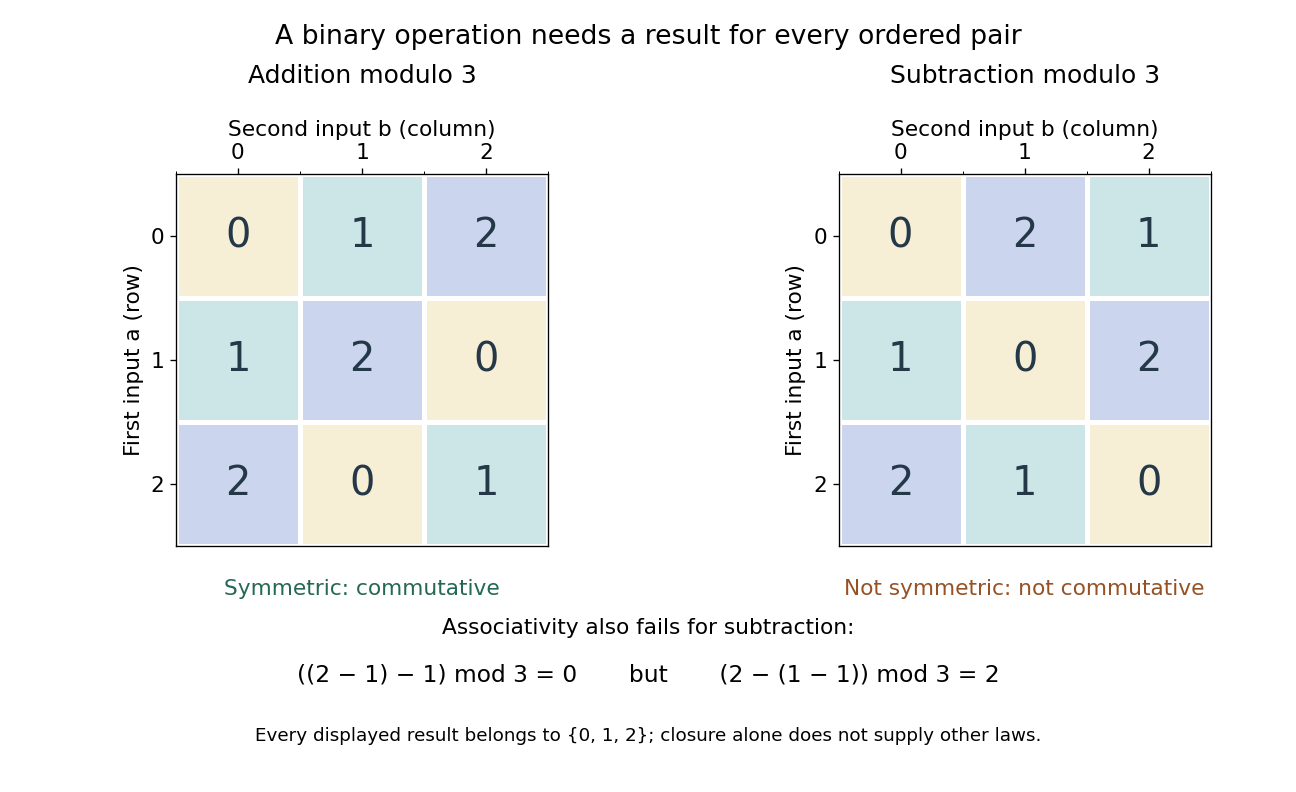
The associative property says that regrouping three inputs does not change the result of a binary operation: for every in its domain of a function. It changes parentheses while keeping the order of the inputs. Commutativity instead exchanges two inputs; the two properties are different.
For addition modulo three, . For subtraction modulo three,so the second binary operation fails the associative property. One failed triple disproves associativity; checking a few successful triples does not establish it for all inputs.
The useful consequence is that a finite ordered sequence can be combined in chunks. For an associative operation, has the same value as . Intermediate results can therefore summarize parts of a computation without retaining their internal parentheses. The order must still be preserved when the binary operation is not commutative. Function composition and concatenation provide examples where grouping is harmless but exchanging entries changes the result.
For a binary operation, idempotence means repeating an input does not change it: . An associative commutative idempotent operation defines a join order by .
For two binary operations, multiplication distributes over addition on the left or right when the respective displayed identity holds. If multiplication is commutative, either law gives the other. Repeated distribution expands expressions in an incline into finite sums of monomials. This property is distinct from associativity of either operation.
A Cayley table records a binary operation on a finite set: the cell at row , column contains . Every cell must contain an element of the specified set. With the same ordering of row and column labels, the table is symmetric across its main diagonal exactly when the binary operation is commutative. Checking the associative property instead requires comparing with for every triple; symmetry alone cannot establish it.[ref]
Pinned article: Introduction to the OurBigBook Project
Welcome to the OurBigBook Project! Our goal is to create the perfect publishing platform for STEM subjects, and get university-level students to write the best free STEM tutorials ever.
Everyone is welcome to create an account and play with the site: ourbigbook.com/go/register. We belive that students themselves can write amazing tutorials, but teachers are welcome too. You can write about anything you want, it doesn't have to be STEM or even educational. Silly test content is very welcome and you won't be penalized in any way. Just keep it legal!
Intro to OurBigBook
. Source. We have two killer features:
- topics: topics group articles by different users with the same title, e.g. here is the topic for the "Fundamental Theorem of Calculus" ourbigbook.com/go/topic/fundamental-theorem-of-calculusArticles of different users are sorted by upvote within each article page. This feature is a bit like:
- a Wikipedia where each user can have their own version of each article
- a Q&A website like Stack Overflow, where multiple people can give their views on a given topic, and the best ones are sorted by upvote. Except you don't need to wait for someone to ask first, and any topic goes, no matter how narrow or broad
This feature makes it possible for readers to find better explanations of any topic created by other writers. And it allows writers to create an explanation in a place that readers might actually find it.
Figure 1. Screenshot of the "Derivative" topic page. View it live at: ourbigbook.com/go/topic/derivativeVideo 2. OurBigBook Web topics demo. Source. - local editing: you can store all your personal knowledge base content locally in a plaintext markup format that can be edited locally and published either:This way you can be sure that even if OurBigBook.com were to go down one day (which we have no plans to do as it is quite cheap to host!), your content will still be perfectly readable as a static site.
- to OurBigBook.com to get awesome multi-user features like topics and likes
- as HTML files to a static website, which you can host yourself for free on many external providers like GitHub Pages, and remain in full control

Figure 2. You can publish local OurBigBook lightweight markup files to either OurBigBook.com or as a static website.
Figure 3. Visual Studio Code extension installation.
Figure 5. . You can also edit articles on the Web editor without installing anything locally. Video 3. Edit locally and publish demo. Source. This shows editing OurBigBook Markup and publishing it using the Visual Studio Code extension. 
- Infinitely deep tables of contents:



All our software is open source and hosted at: github.com/ourbigbook/ourbigbook
Further documentation can be found at: docs.ourbigbook.com
Feel free to reach our to us for any help or suggestions: docs.ourbigbook.com/#contact