Topics (384k) Articles (398k) Users (410) Discussions (242) Comments (383) Files (13k) New article
Differential calculus studies derivatives: how a function changes near an input and how that local information describes its graph or evolution. Its tools include linear approximation, higher derivatives, and Taylor series; applications include finding velocity from position and studying optimization through critical points.
Metadata identifying which eligible backing cache block a valid cache slot currently holds. In the fully associative cache example, the cache tag is the full cache block number ; in the two-slot direct-mapped cache example, the slot supplies and the cache tag can store using the floor function.
An analytic semigroup is a strongly continuous semigroup whose bounded-operator-valued extension is holomorphic in a sector about the positive time axis. Its infinitesimal generator of a semigroup satisfies for and, on each bounded time interval, . This estimate gives instantaneous spatial smoothing but creates an integrable-singularity question in an inhomogeneous variation-of-constants formula.
A forecast horizon is the duration over which a prediction meets a specified error tolerance. If an initial uncertainty grows approximately as with positive Lyapunov exponent , then solving for when it reaches a tolerance gives the displayed estimate. Here is the natural logarithm and is measured per step of the discrete dynamical system; for a flow map, use the exponent per unit time instead. The estimate assumes the growth approximation remains valid up to the chosen tolerance and excludes additional model errors.
Reducing by a factor ten buys approximately more steps, rather than multiplying the forecast duration by ten. For typical logistic map orbits at , , so one extra decimal digit buys roughly steps in this approximation. Better measurements help, but their benefit is logarithmic. A forecast of a probability distribution or a stable long-term average asks a different question from predicting each individual state.
Let a finite group act on a finite set , with an orbit-invariant weight in a commutative ring. Double counting gives the division-free identityIndeed, each is counted times, and each orbit contributes copies of its common weight. If is invertible in , dividing gives the weighted average formula of Burnside's lemma. For formal monomial weights one can first count over the integers and then specialize into any commutative ring; this avoids dividing by zero in modular characteristic.
For a permutation group, is the number of length- cycles of . The cycle index records the average cycle structure. On coloring a finite underlying set, a coloring fixed by is constant on each cycle. Replacing by the power-sum symmetric polynomial therefore gives the pattern inventory by the weighted Burnside lemma.
A dilute bubbly thermal is a rising, entraining fluid volume whose gas bubbles provide part of its buoyancy. With negligible bubble slip and gas loss, Boyle's law gives gas volume proportional to , where . Spherical fluid entrainment with normal entrainment velocity gives . Bubble concentration follows by dividing the gas volume by the growing thermal volume. A diameter-based Froude number closure is .
In the Boussinesq approximation, a spherical buoyant thermal with conserved total buoyancy obeys and , with . A zero-volume, zero-impulse point source gives , , where . Hence and . The zero-time singularity represents an ideal source limit, not a finite initially regular sphere.
Suppose identical buoyant thermals deliver buoyancy at rate to a mixed lower layer of area before penetrating its interface. Neglect source volume and heat loss. Relative to the upper-layer density, let , , and , where . The lower-layer buoyancy budget gives . A cycle-averaged fluid entrainment closure , with , , yields the displayed law. Neutrality of the thermal at the interface requires . The closure must incorporate the encounter duty cycle; an isolated-event entrainment law needs an additional averaging prescription.
A buffered device block whose identity is retained for unfinished work. Reference counting can represent both client references and additional pins. Dropping a client reference does not release an outstanding journal pin; dropping a pin does not remove somebody else's reference. In the buffer cache state model, counts all such retained references, so prevents buffer cache eviction. This count keeps the structure alive; a mutex separately controls who can inspect or change its contents. Waiting callers also need lifetime protection.
A valid buffered device block with no outstanding write obligation to the backing location tracked by this cache. It can serve a cache hit. It becomes eligible for buffer cache eviction only when its retention and any pending input-output permit reuse. “Clean” does not assert that a device's volatile memory cache has been flushed to persistent storage.
A valid buffered device block with modifications still owed to its backing location. Until successful buffer cache writeback, simply reassigning its buffer cache key would lose those modifications. “Dirty” records a write obligation; a write of identical contents can still mark the structure dirty. Repeated buffered writes can leave only the latest contents to be transferred.
Whether a buffered device block's contents are ready for the requested use. Reserving a buffer cache key does not make its previous occupant's contents valid. A read fills the reserved structure before exposing its contents. A second caller finding an unfinished fill must wait; finding the identity is not yet a data cache hit under the convention used here. A failed fill must not expose the stale contents as valid.
A buffered partial write first needs the untouched bytes: read the old contents on a cache miss, change the requested range, and retain the result as a dirty buffer. A complete overwrite can initialize every byte without reading the old contents if the interface permits that path. The buffer cache access trace deliberately uses partial writes, so every cache miss reads the old block.
The identity used to find a buffered device block. In the fixed-block-size model, identifies the device and its block number; and are different keys if . A file's pathname or its logical block offset alone is insufficient for this device-indexed model. Interfaces supporting different transfer sizes need to specify the size and overlap rules too.
Maintain at most one logical buffered device block for each buffer cache key within this buffer cache. Otherwise two callers could modify different copies and later overwrite one another's changes. Lookup and reservation must therefore be coordinated by synchronization: even before contents are ready, a reserved key directs a second caller to the same structure. This invariant concerns the participating cache, not every copy of those bytes anywhere in the machine.
Let be three distinct buffer cache keys on one device. Use two initially empty slots, LRU replacement refreshed at each completed request, and synchronous successful buffer cache writeback of a dirty victim. Each request acquires its target, finishes any fill, reads or partially modifies it, and releases the client reference. An explicit pin on remains after request 2 through request 7; pin and unpin do not refresh recency. No other references, invalidations, background writes or durability operations occur. Initial backing contents are represented by the integers ; partial writes change the tracked value of to 11 and then 12 while preserving the unshown remainder.
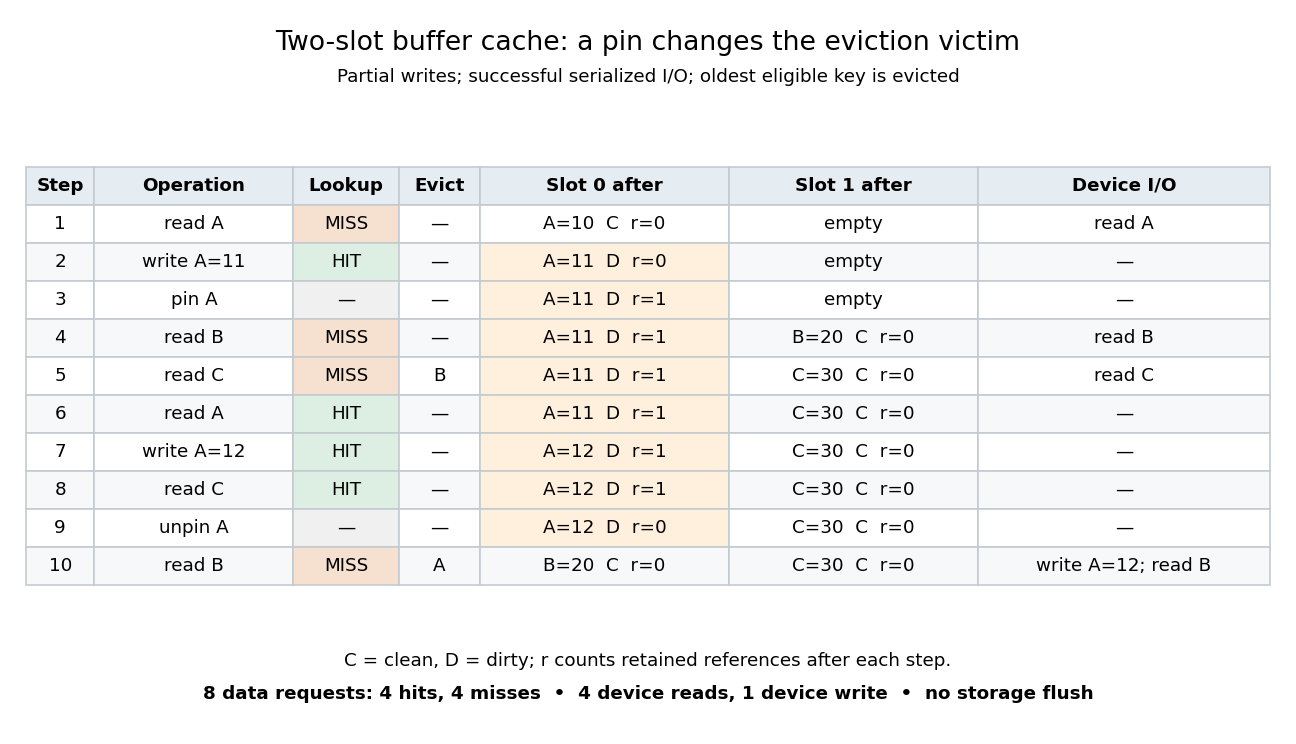
Exact cache hits, cache misses, retained references and buffer cache evictions in a two-slot buffer cache
. Details. The eight data requests are read , write , read , read , read , write , read , and read after unpinning . They yield four cache hits, four cache misses, four device reads and one device write. The pin and unpin are lifetime operations, excluded from the data-request count. At the read of , is older than but pinned, so the clean buffer for is evicted instead. Reading then returns 11 without device access even though its backing value is still 10. The second write supersedes 11; reading makes the older entry again. After unpinning, the final read of writes back 12 before evicting . After that request, backing contains 12, while the resident keys are .
This example exposes the value of retaining modified contents: a cache hit can return a newer value than a device read would. It also exposes the cost of reference counting constraints: a pinned older entry forces a different victim. An independent capacity sweep gives two cache hits, six cache misses and two device writes with one slot and no pin, but three cache hits, five cache misses and two device writes with two slots and no pin. With one slot and the stipulated pin, the read of cannot proceed. With three slots, both pin choices give five cache hits, three cache misses and no eviction-triggered write; remains dirty with value 12, so the absence of a device write does not establish file-system transaction durability.
When a productive stock pays before trading at ex-dividend price , an investor entering with shares receives and sells or buys shares to leave with . The displayed budget constraint accounts for the available consumption and the cost of the new holding. Here is known before date , while and may depend on the information revealed at that date.
For the nonrotating BTZ black hole family with and angular period , the circumference of a small circle divided by its proper radius tends to . A smooth axis requires this ratio to be , so only gives regular Anti-de Sitter spacetime. Other values have a conical singularity, with deficit angle or an angular excess when . The lapse is strictly positive, so outward radial null geodesics escape from arbitrarily near the axis: the defect is a naked singularity, despite finite local curvature away from it.
Positive matrix eigenvector from simplex normalization by  Codex 0 Created 2026-10-14 Updated 2026-10-31
For a strictly positive real matrix , the map is a continuous self-map of the probability simplex. A Brouwer fixed-point theorem fixed point satisfies with . The image lies in the interior of the simplex, so every entry of this eigenvector is strictly positive. Nonnegative entries and nonzero columns alone do not imply this strict conclusion.
Freezing can increase the mass density of neighbouring seawater because brine rejection leaves much of the salt in the liquid. If salt mass is approximately conserved in a liquid reservoir while fresh ice mass is removed, its salinity rises as the remaining liquid mass decreases.
For a small change at fixed temperature and pressure, . The coefficient depends on the equation of state and the units chosen for salinity. A heat loss that freezes water removes latent heat and concentrates salt; the density change therefore differs from the change obtained by spending the same heat loss on sensible cooling alone.
If a fraction of initial liquid mass freezes into salt-free ice, all original salt remains in a liquid mass fraction . Writing salinity as salt concentration per mass gives , hence . For equal initial cooling and subsequent freezing heat extraction, . The liquid specific heat capacity, rather than the ice value, determines the initial heat removal. If ice retains salt, the mass balance instead reads .
Pinned article: Introduction to the OurBigBook Project
Welcome to the OurBigBook Project! Our goal is to create the perfect publishing platform for STEM subjects, and get university-level students to write the best free STEM tutorials ever.
Everyone is welcome to create an account and play with the site: ourbigbook.com/go/register. We belive that students themselves can write amazing tutorials, but teachers are welcome too. You can write about anything you want, it doesn't have to be STEM or even educational. Silly test content is very welcome and you won't be penalized in any way. Just keep it legal!
Intro to OurBigBook
. Source. We have two killer features:
- topics: topics group articles by different users with the same title, e.g. here is the topic for the "Fundamental Theorem of Calculus" ourbigbook.com/go/topic/fundamental-theorem-of-calculusArticles of different users are sorted by upvote within each article page. This feature is a bit like:
- a Wikipedia where each user can have their own version of each article
- a Q&A website like Stack Overflow, where multiple people can give their views on a given topic, and the best ones are sorted by upvote. Except you don't need to wait for someone to ask first, and any topic goes, no matter how narrow or broad
This feature makes it possible for readers to find better explanations of any topic created by other writers. And it allows writers to create an explanation in a place that readers might actually find it.
Figure 1. Screenshot of the "Derivative" topic page. View it live at: ourbigbook.com/go/topic/derivativeVideo 2. OurBigBook Web topics demo. Source. - local editing: you can store all your personal knowledge base content locally in a plaintext markup format that can be edited locally and published either:This way you can be sure that even if OurBigBook.com were to go down one day (which we have no plans to do as it is quite cheap to host!), your content will still be perfectly readable as a static site.
- to OurBigBook.com to get awesome multi-user features like topics and likes
- as HTML files to a static website, which you can host yourself for free on many external providers like GitHub Pages, and remain in full control

Figure 2. You can publish local OurBigBook lightweight markup files to either OurBigBook.com or as a static website.
Figure 3. Visual Studio Code extension installation.
Figure 5. . You can also edit articles on the Web editor without installing anything locally. Video 3. Edit locally and publish demo. Source. This shows editing OurBigBook Markup and publishing it using the Visual Studio Code extension. 
- Infinitely deep tables of contents:



All our software is open source and hosted at: github.com/ourbigbook/ourbigbook
Further documentation can be found at: docs.ourbigbook.com
Feel free to reach our to us for any help or suggestions: docs.ourbigbook.com/#contact