Topics (384k) Articles (398k) Users (410) Discussions (242) Comments (383) Files (13k) New article

The mass deficit of a bound atomic nucleus relative to its separated protons and neutrons. If their rest masses are and , the atomic nucleus has rest mass , and the positive nuclear binding energy is , thenwith the speed of light. Releasing energy when the nucleons bind reduces the rest mass of the bound system without changing the exact count . A neutral atomic mass also includes electron rest masses, reduced by the energy required to separate those bound electrons. Consequently is not the definition of the nuclear mass defect: the reference unit and constituent rest masses must also be accounted for.
The unified atomic mass unit and dalton are names for the same mass unit:where the carbon-12 chemical atom is free, at rest, and in its nuclear and electronic ground state. Its conversion to SI mass units is determined experimentally. See The International System of Units (SI), ninth edition, SI Brochure (Table 8, footnote (f), printed p. 146: dalton and unified atomic mass unit).
A Hurwitz stable matrix has all eigenvalues strictly in the open left half-plane. For , this is equivalent to for every initial vector. Jordan blocks contribute polynomial factors times , which decay exactly when their eigenvalues have negative real part. Translating an affine equilibrium reduces its attractivity to this same condition.
For , differentiation gives . A uniform negative-definiteness bound with yields exponential contraction by direct integration of this differential inequality. This is a sufficient criterion for asymptotic stability, stronger than requiring all eigenvalues of to have negative real parts. A merely semidefinite symmetric part needs additional analysis.
An equilibrium point is quasi-asymptotically stable when some neighborhood of initial conditions has forward solutions converging to it. This attraction condition alone does not include Lyapunov stability. Asymptotic stability requires both attraction and Lyapunov stability. A positive Lyapunov function with nonpositive derivative and no nonstationary invariant trajectory in its zero-derivative set proves both when its sufficiently small sublevel sets are compact and forward invariant.
In A Mathematical Theory of Communication by Claude Shannon (1948, section 7), Claude Shannon explains that the common symbol counts in a long independent message make its negative logarithmic probability approximately the message length times the source entropy. Theorem 3 separates an exceptional collection of small total probability from messages with this normalized information cost; Theorem 4 relates the number needed to accumulate a fixed probability to the entropy. The finite-state source setting matters to the historical statement.[ref]
Choose one of two regimes once, with equal probability: a source of independent and identically distributed random variables with one-bit probability , or one with one-bit probability . Keep the chosen regime forever. The resulting source is a strictly stationary process, because shifting a block does not change either component law. It is not an ergodic stationary process: its limiting empirical frequency identifies the regime.
The source's information rate isConditioning on the single regime bit changes any block's information entropy by at most one bit, so dividing by the block length proves this rate. However, the limiting realized information content per symbol is approximately in the first regime and one in the second. The alternative component's likelihood ratio decays exponentially along a typical path from the chosen component, at a rate given by the positive relative entropy between the two Bernoulli distributions. The mixture therefore has two possible pathwise limits, not one limit equal to the averaged information rate.
Take an IID random variable source of bits with . Its binary entropy isA word of length containing ones has probability . Its information content per symbol isThus weakly typical sequences for this biased source have near . With tolerance bits per symbol, the exact condition isFor , this includes exactly . There are words with each count: a type class with that many possible orderings. Summing the counts and their probability masses givesThese are fewer than one percent of the possible words, yet they carry nearly 64 percent of the probability. The most likely individual word is all zeros, with probability ; it is outside this typical set. No contradiction is involved: the type classes near ten ones each contain many more individual words.
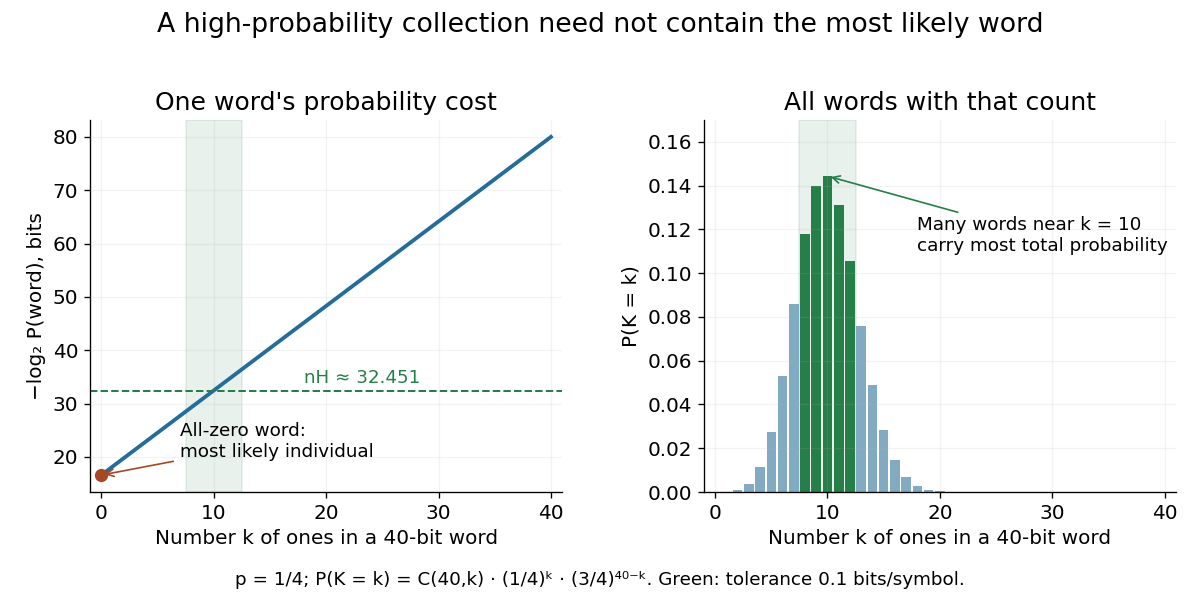
The most likely individual word differs from the counts carrying most probability
. The left plot gives the information content of one word with each number of ones. The right includes the binomial coefficient counting every such word, giving the exact binomial distribution of the count. Both use , ; the green band marks the typical set with tolerance bits per symbol. Details.The cocenter of a finite-dimensional algebra is the quotient by the vector subspace spanned by additive commutators ; this subspace need not be an ideal. For a group algebra, its basis is indexed by conjugacy classes: every commutator of basis elements is a difference of conjugates, and every difference of conjugates is a commutator. For , off-diagonal matrix units and show that the quotient is one-dimensional, identified by the trace.
A complex associative algebra with a conjugate-linear involution satisfying the displayed product-reversal identities. An operator algebra closed under the Hilbert-space adjoint is a star-algebra. A C-star algebra additionally has a complete norm with .
An associative algebra with a two-sided multiplicative identity. For a subalgebra of bounded operators, the term unital here means that it contains the identity of the represented Hilbert space.
An algebra involution on a complex associative algebra is a conjugate-linear map satisfying and . It fixes the identity when one exists. A star algebra is an algebra equipped with such a map. These algebraic identities do not themselves impose norm continuity or the C-star identity.
An Ore extension uses a unital endomorphism of and a -derivation , satisfying . Its elements have unique expressions and multiplication is determined by the displayed relation. Applying the relation to shows why the endomorphism and derivation conditions are exactly the compatibility conditions for associativity. A differential Ore extension has . Adjoining ordinary partial derivatives successively to a polynomial ring gives the ordered-monomial construction of a Weyl algebra.
A primitive ideal of a unital associative algebra is the annihilator of a module for a nonzero simple module. Every maximal proper two-sided ideal is primitive: its quotient is a simple ring, and any simple module over that quotient has zero annihilator there. In a unital Banach algebra, a simple module can be realized as for a maximal left ideal; this ideal is closed, making the representation a bounded algebraically irreducible action on a Banach space.
To prove a property of all elements of a partially ordered set satisfying the ascending chain condition, assume a counterexample exists and take a maximal counterexample. All strictly larger elements satisfy the property, allowing an inductive contradiction. Applied to ideals, this often replaces induction on a numerical size.
If is a commutative algebra of finite dimension over a field , every prime ideal is maximal and . Indeed, the quotient by a prime is a finite-dimensional integral domain. Multiplication by any nonzero element is an injective linear endomorphism, hence surjective, so the quotient is a field. Distinct maximal ideals are pairwise comaximal. For any finite list , construct and for by multiplying elements in congruent to one modulo . These give a surjection . Each factor has positive -dimension, so , excluding an infinite list.
For a field of characteristic , the exact sequence , together with additive normal-basis acyclicity, gives . Consequently every central finite embedding problem with group homomorphism kernel has a continuous weak solution: its pulled-back two-cocycle is a coboundary, whose correcting one-cochain supplies the lift. Over , independent Artin–Schreier classes , with prime to , allow the lift to be twisted by characters so that inertia maps onto the group homomorphism kernel as well as onto the original quotient. Induction through central order- quotients therefore realizes every finite p-group as the Galois group of a totally ramified extension with residue field .
The characteristic admittance of an arterial wave relates the volumetric flow rate of a travelling arterial pressure wave to its pressure. For forward and backward amplitudes, and . It is the reciprocal of characteristic pressure-to-flow impedance, and should not be confused with the reciprocal hydraulic resistance of a steadily resistive segment.
For time dependence and a segment of length , let . Adding the forward and backward arterial pressure waves gives the displayed upstream-to-downstream matrix. The flow orientation is downstream at both ends. At a junction, pressure is continuous and incoming volumetric flow rates balance outgoing ones.
A hydraulic resistance imposes . Combining this with forward and backward arterial pressure waves, and , gives the displayed reflection coefficient. A matched load has no reflected pressure wave, while a closed end has reflection coefficient one. At a network junction the combined downstream input admittance replaces .
Pinned article: Introduction to the OurBigBook Project
Welcome to the OurBigBook Project! Our goal is to create the perfect publishing platform for STEM subjects, and get university-level students to write the best free STEM tutorials ever.
Everyone is welcome to create an account and play with the site: ourbigbook.com/go/register. We belive that students themselves can write amazing tutorials, but teachers are welcome too. You can write about anything you want, it doesn't have to be STEM or even educational. Silly test content is very welcome and you won't be penalized in any way. Just keep it legal!
Intro to OurBigBook
. Source. We have two killer features:
- topics: topics group articles by different users with the same title, e.g. here is the topic for the "Fundamental Theorem of Calculus" ourbigbook.com/go/topic/fundamental-theorem-of-calculusArticles of different users are sorted by upvote within each article page. This feature is a bit like:
- a Wikipedia where each user can have their own version of each article
- a Q&A website like Stack Overflow, where multiple people can give their views on a given topic, and the best ones are sorted by upvote. Except you don't need to wait for someone to ask first, and any topic goes, no matter how narrow or broad
This feature makes it possible for readers to find better explanations of any topic created by other writers. And it allows writers to create an explanation in a place that readers might actually find it.
Figure 1. Screenshot of the "Derivative" topic page. View it live at: ourbigbook.com/go/topic/derivativeVideo 2. OurBigBook Web topics demo. Source. - local editing: you can store all your personal knowledge base content locally in a plaintext markup format that can be edited locally and published either:This way you can be sure that even if OurBigBook.com were to go down one day (which we have no plans to do as it is quite cheap to host!), your content will still be perfectly readable as a static site.
- to OurBigBook.com to get awesome multi-user features like topics and likes
- as HTML files to a static website, which you can host yourself for free on many external providers like GitHub Pages, and remain in full control

Figure 2. You can publish local OurBigBook lightweight markup files to either OurBigBook.com or as a static website.
Figure 3. Visual Studio Code extension installation.
Figure 5. . You can also edit articles on the Web editor without installing anything locally. Video 3. Edit locally and publish demo. Source. This shows editing OurBigBook Markup and publishing it using the Visual Studio Code extension. 
- Infinitely deep tables of contents:



All our software is open source and hosted at: github.com/ourbigbook/ourbigbook
Further documentation can be found at: docs.ourbigbook.com
Feel free to reach our to us for any help or suggestions: docs.ourbigbook.com/#contact