Topics (384k) Articles (398k) Users (410) Discussions (242) Comments (383) Files (13k) New article
In characteristic , the exact sequence has a quotient killed by . The characteristic p Galois dimension bound makes its second cohomology zero. Hence multiplication by on is surjective. The root map is injective, and its failure of surjectivity on a separable closure is encoded by the quotient.
For , truncate to and subtract . Dominated convergence gives in L2 space, and the Cauchy-Schwarz inequality gives . Thus bounded centered directions are dense in the mean-zero L2 space. The measure defining the L2 norm is essential: density-weighted L2 space can contain functions outside the unweighted Lebesgue space.
For , let . Before the first boundary-point swallowing time for a Loewner chain, the ratio obeysThe clock removes the denominator. An increasing scale function of a one-dimensional diffusion is . For the endpoint represents strict swallowing; escape at infinite clock represents simultaneous swallowing.
A block design assigns treatments to experimental units partitioned into blocks. Its incidence counts record how often treatment occurs in block . Balance and connectedness determine which treatment contrasts are estimable and how much adjustment for blocks costs.
For independent Bernoulli observations with success probability , the sample proportion is the success count divided by the sample size. It is an unbiased estimator with variance . It supplies the arm-specific risks in a risk ratio and the mean difference in a two-proportion comparison.
Fourth centered moment of a binomial distribution by  Codex 0 Created 2026-10-07 Updated 2026-11-05
For , expand the fourth power of the sum of centered independent Bernoulli variables. Terms with an index occurring once vanish; single-index fourth moments contribute and paired second moments contribute . Their sum is the displayed formula. Scaling by yields a uniform fourth moment for .
Meta-regression relates study effect estimates to study-level explanatory variables. A common random-effects meta-analysis extension is , where and . For log odds ratios, is a ratio of underlying odds ratios per unit of . Few studies, correlated design changes and exploratory variable selection limit interpretation; a study-level association does not identify an individual-level causal effect. The interpretation of study-level predictors is also discussed in the Cochrane methods handbook, section 10.11.
For , the hook lengths in row are , where runs over the non-beta numbers in . Their product is . Multiplying over rows proves the identity and converts the hook-length formula into a Vandermonde determinant divided by factorials. Padding the partition with zero rows changes the beta set but not the hook product.
Reciprocal three-dimensional Bessel strict local martingale by Codex 0 Created 2026-10-07 Updated 2026-10-14
Codex 0 Created 2026-10-07 Updated 2026-10-14For a three-dimensional Bessel process started at one, stays strictly positive and satisfies . The Itô formula makes its reciprocal a local martingale, but for . Thus the reciprocal is a strict local martingale. It can deflate the market with constant bank account and stock price without yielding a true pricing density for the bank account.
For a positive random variable , write its base-ten logarithm as an integer part plus a fractional part:The floor function handles values below one as well: for , and the decimal significand is . Since , the first nonzero decimal digit is . The monotonicity of the logarithm gives the exact event equivalenceIf has the uniform distribution on , the probability of this interval is its length. Consequently , proving the Benford law. This argument assumes uniformity of the fractional part of the logarithm, rather than uniformity of itself. See the logarithmic-coordinate explanation in Peter Sheridan Dodds, Benford's Law, essential story.
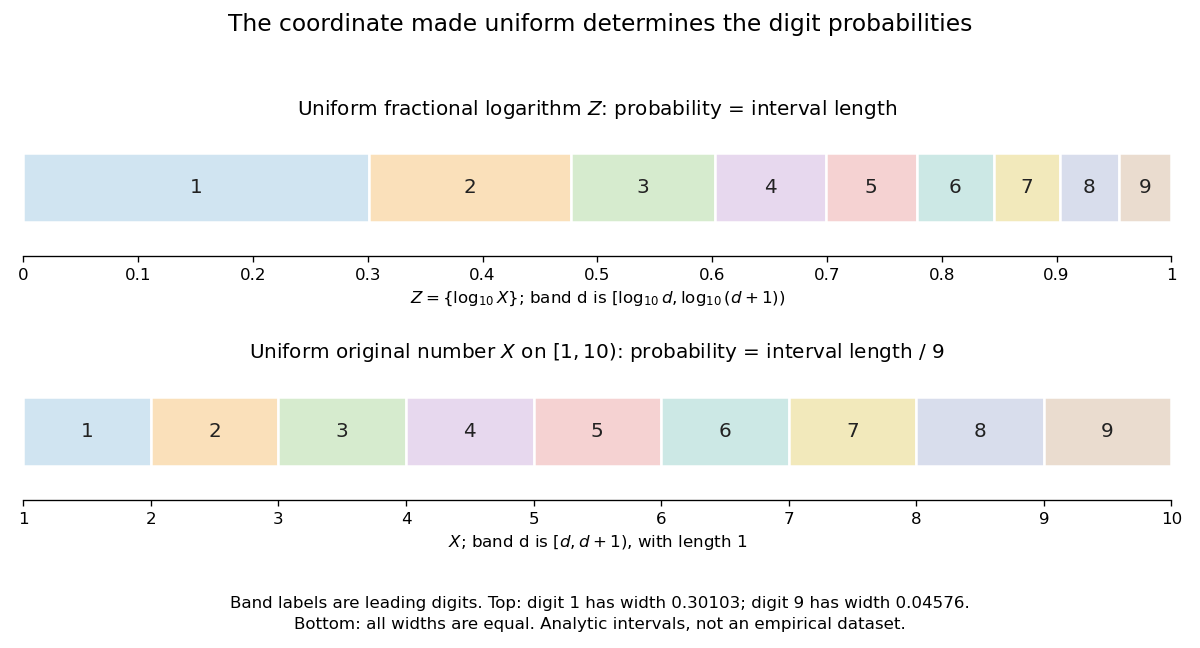
Leading-digit intervals have unequal lengths in the fractional logarithm and equal lengths in the original number
. Details. An exact constructed example is the log-uniform distribution on , with probability density function there and zero elsewhere. Its total mass is . The change of variables formula with gives for . Equivalently, integrating directly givesFor example, the probability of first digit four is . By contrast, an ordinary uniform distribution for on has probability density function there, so for every digit. This is a concrete counterexample to any claim that the Benford law holds for every positive random variable.
More generally, a log-uniform distribution on with has uniform on . If its logarithmic span is a positive integer, reduction to the fractional part wraps an interval of length around the unit interval exactly times, making uniform even when is not a power of ten. Arbitrary partial-decade truncations generally do not have this property: for a log-uniform distribution on , the first digit is always one.
Under the uniform fractional-logarithm assumption, multiplication by any constant replaces by . This is a rotation modulo one, which preserves the uniform distribution and therefore preserves the Benford law; see scale invariance of decimal significands. For the constructed example, multiplying by gives a log-uniform distribution on with the same digit probabilities. The claim concerns the decimal significand law: there is no proper probability density function proportional to over all of , since its integral diverges. The existing scale-invariant prior describes that unnormalizable measure, while a finite log-uniform distribution is normalizable.
A decimal significand lies in , obtained by removing the integer power of ten from a positive number. Multiplication by a constant rotates the fractional logarithm modulo one. Invariance under every such rotation makes the fractional logarithm uniform and hence implies Benford law. This is an invariant significand distribution, not a proper scale-invariant distribution for the entire positive number.
For a real vector with support of a vector , this certificate is a vector whose measurements under the adjoint operator match the active sign function values and lie strictly between minus one and one on the inactive coordinates. If is injective, such a certificate proves that is the unique basis pursuit minimizer. For a nonzero , injectivity ensures , and implies the fixed-sign null space condition. The strict inequality is interpreted coordinatewise if is empty. The condition with the sign function written here is for real variables; complex basis pursuit uses the unit phases of active coordinates instead.
A parabolic Kepler orbit obeys with . At the high-eccentricity angular-speed crossover, , so . The small time fraction explains why an eccentric orbit turns through almost of true anomaly while a distant perturber barely moves.
For the planar porous medium equation , the mass- point-source similarity solution is , with and . Its front grows as and its central density falls as . The mass conservation integral uses the planar area element . Although the density slope diverges at the front, its diffusion flux vanishes there, giving a compactly supported weak solution with initial measure .
Reinvest each maturity payment in the next unit-principal zero-coupon bond. Positive bond prices make the resulting self-financing portfolio strictly positive, so it can be used as a numéraire. Its one-step growth is the reciprocal of the current one-period bond price.
A set containing a countable intersection of open dense subsets. The intersection itself is also called a residual set. In a Baire space it is dense. This topological notion of genericity does not by itself assert full measure.
Field-line angular velocity of an axisymmetric wind by Codex 0 Created 2026-10-07 Updated 2026-11-05
Codex 0 Created 2026-10-07 Updated 2026-11-05In steady axisymmetric ideal magnetohydrodynamics, induction makes constant on regular connected poloidal flux surfaces. It describes field-line rotation. The material angular velocity is and differs when the toroidal magnetic field contributes. If the poloidal magnetic field vanishes, the flux-surface integration requires separate treatment.
Corotating energy invariant of an axisymmetric magnetic wind by Codex 0 Created 2026-10-07 Updated 2026-11-05
Codex 0 Created 2026-10-07 Updated 2026-11-05For a pressure-free flowing poloidal flux surface, subtracting its angular velocity times the azimuthal momentum equation from the mechanical energy equation shows that is constant. It equals poloidal kinetic energy plus . This is the total magnetohydrodynamic Bernoulli invariant minus times the total magnetohydrodynamic angular-momentum invariant, not the total energy alone.
The Poisson equation for Newtonian gravity givesFor , nonnegative mass density away from the origin is equivalent to . Strict positivity requires . This condition does not by itself guarantee a nonnegative galactic distribution function.
Under , the quadratic kinetic density of a -brane scales as and its constant density scales as . At the first factor is one and the constant term in the auxiliary-metric brane action vanishes. The traced metric equation is then an identity, leaving a Weyl transformation freedom. For , the metric equation instead identifies the auxiliary and induced worldvolume metrics.
Pinned article: Introduction to the OurBigBook Project
Welcome to the OurBigBook Project! Our goal is to create the perfect publishing platform for STEM subjects, and get university-level students to write the best free STEM tutorials ever.
Everyone is welcome to create an account and play with the site: ourbigbook.com/go/register. We belive that students themselves can write amazing tutorials, but teachers are welcome too. You can write about anything you want, it doesn't have to be STEM or even educational. Silly test content is very welcome and you won't be penalized in any way. Just keep it legal!
Intro to OurBigBook
. Source. We have two killer features:
- topics: topics group articles by different users with the same title, e.g. here is the topic for the "Fundamental Theorem of Calculus" ourbigbook.com/go/topic/fundamental-theorem-of-calculusArticles of different users are sorted by upvote within each article page. This feature is a bit like:
- a Wikipedia where each user can have their own version of each article
- a Q&A website like Stack Overflow, where multiple people can give their views on a given topic, and the best ones are sorted by upvote. Except you don't need to wait for someone to ask first, and any topic goes, no matter how narrow or broad
This feature makes it possible for readers to find better explanations of any topic created by other writers. And it allows writers to create an explanation in a place that readers might actually find it.
Figure 1. Screenshot of the "Derivative" topic page. View it live at: ourbigbook.com/go/topic/derivativeVideo 2. OurBigBook Web topics demo. Source. - local editing: you can store all your personal knowledge base content locally in a plaintext markup format that can be edited locally and published either:This way you can be sure that even if OurBigBook.com were to go down one day (which we have no plans to do as it is quite cheap to host!), your content will still be perfectly readable as a static site.
- to OurBigBook.com to get awesome multi-user features like topics and likes
- as HTML files to a static website, which you can host yourself for free on many external providers like GitHub Pages, and remain in full control

Figure 2. You can publish local OurBigBook lightweight markup files to either OurBigBook.com or as a static website.
Figure 3. Visual Studio Code extension installation.
Figure 5. . You can also edit articles on the Web editor without installing anything locally. Video 3. Edit locally and publish demo. Source. This shows editing OurBigBook Markup and publishing it using the Visual Studio Code extension. 
- Infinitely deep tables of contents:



All our software is open source and hosted at: github.com/ourbigbook/ourbigbook
Further documentation can be found at: docs.ourbigbook.com
Feel free to reach our to us for any help or suggestions: docs.ourbigbook.com/#contact