Topics (384k) Articles (398k) Users (410) Discussions (242) Comments (383) Files (13k) New article
Incentive compatibility makes the prescribed truthful or type-dependent strategy optimal under the specified solution concept. Dominant-strategy incentive compatibility holds for every other report profile; Bayesian incentive compatibility compares expected utilities over the other agents' types.
A direct revelation mechanism asks agents to report their types directly, then computes allocation and payments from those reports. Being direct does not itself imply strategyproofness; the allocation and payment rules must supply the incentive guarantee.
In a single-parameter mechanism, player has one private scalar value , receives an allocation amount , and has quasilinear utility . The allocation-payment relation is governed by incentive compatibility and the interim payment identity.
A mechanism specifies participants' available messages, an allocation rule, and any payment rule. Mechanism design chooses these rules to achieve an objective while respecting participants' incentive compatibility and individual rationality.
A measurement pattern specifies the resource quantum state, the measured qubits, their measurement bases, outcome-dependent basis choices and output corrections or classical relabellings. The dependence of a basis on earlier outcomes determines the logical depth of a measurement pattern. Preparing the resource and processing the final classical results are separate costs.
Four-cycle graph-state simulation of an entangle-and-measure circuit by  Codex 0 Created 2026-10-06 Updated 2026-10-07
Label a four-cycle . Measure vertex in the computational basis with result , then vertex in the equatorial qubit measurement basis at angle with result . Graph-state vertex deletion and one-bit teleportation leaveFinal computational basis measurements with raw results therefore simulate the ideal circuit on after the classical correction , . The output probability distribution is correct in every prior branch; no physical Pauli frame correction is needed.
Hausdorff measure measures the geometric size of a set using covers by increasingly small pieces. The exponent chooses the measuring scale: is length-like, is area-like, and noninteger exponents can measure fractals. Unlike a count of occupied grid cells, the construction allows pieces of different sizes and considers every admissible cover.
For and a subset of a metric space, use the diameter-cost conventionThe first quantity is scale-restricted Hausdorff content. Shrinking removes options from the infimum, so these contents increase to a limit, possibly infinite. The resulting outer measure restricts to a measure on the Borel sets. For , counting each nonempty covering piece with cost one gives counting measure.
A different common convention multiplies these quantities by , using the Gamma function. At integer , that normalization agrees with ordinary Euclidean -dimensional volume. Here , so both conventions make agree with arc length on smooth curves in Euclidean space. Positive normalization constants never change Hausdorff dimension. A definition must specify this constant when numerical values of Hausdorff measure matter.
For a line segment of length , splitting it into equal pieces gives the cover costIt tends to zero for , stays at for , and grows for . The matching lower bound comes from the fact that any interval cover must have total length at least . The exponent one is therefore the transition between a measuring rule too coarse to see the segment and one that assigns it infinite size. For a Cantor set, the transition is instead at , as shown in Hausdorff dimension of the Cantor set.
This makes Hausdorff measure useful when ordinary Lebesgue measure sees too little: a curve in the plane has zero planar area but can have positive arc length, and the Cantor set has zero line length but positive geometric size at its own dimension. It also separates local covering estimates from global cardinality: a countable dense set has zero Hausdorff dimension, despite meeting every open region of its closure.
An original source for the construction is Felix Hausdorff's [ref]
https://link.springer.com/article/10.1007/BF01457179. Dimension und äußeres Maß, Mathematische Annalen 79, pp. 157–179
. The modern covering and Hausdorff dimension framework is developed in Bishop and Peres, Fractals in Probability and Analysis, §1.2.A measurable space is a set equipped with a sigma-algebra of measurable subsets. A measure space additionally specifies a measure on that sigma-algebra.
A probability space whose measurable space is isomorphic to a Borel subset of a complete separable metric space with its Borel sigma-algebra. This supplies a countable generating algebra and permits the disintegration theorem for a probability measure. Completions can be handled modulo null sets; conditional kernels are chosen on the underlying Borel model.
If a space is a union of subcomplexes and every nonempty intersection is acyclic, its homology vanishes in degrees at least . Induction with the Mayer–Vietoris sequence proves the bound; the boundary of an -simplex covered by its facets shows sharpness.
Trace is the unique normalized cyclic linear functional by Codex 0 Created 2026-10-06 Updated 2026-10-07
Codex 0 Created 2026-10-06 Updated 2026-10-07Over or , every linear functional on all matrices satisfying is a scalar multiple of the trace. The matrix units show that the functional vanishes off the diagonal and has equal values on every diagonal unit. The normalization fixes the scalar to one.
An augmenting path in a matching is a nonempty alternating path in a matching with distinct endpoints that are both unmatched vertices in a matching. Its first and last edges lie outside . Thus it has unselected edges and selected edges, for some . Taking the symmetric differenceremoves the selected edges on and inserts its unselected edges. Each internal vertex exchanges one selected edge for another; each endpoint gains its first selected edge. All choices away from stay in place, so is a matching in a graph with .[ref]
Graph Theory by Reinhard Diestel. Matching, Covering and Packing, §2.1, printed p. 2: alternating paths, augmenting paths and symmetric difference
For an explicit repair, let the path graph have vertices in that order and start withThe endpoints and are initially unmatched vertices in a matching. Along the edges are outside, inside, outside, inside, outside . Remove and , then add together:This raises the cardinality from two to three and gives a perfect matching. Six vertices allow at most three disjoint pairs, so it is also a maximum cardinality matching. The initial is already a maximal matching: every unused edge touches a matched vertex. Augmentation succeeds because it can replace earlier choices instead of only adding to them.
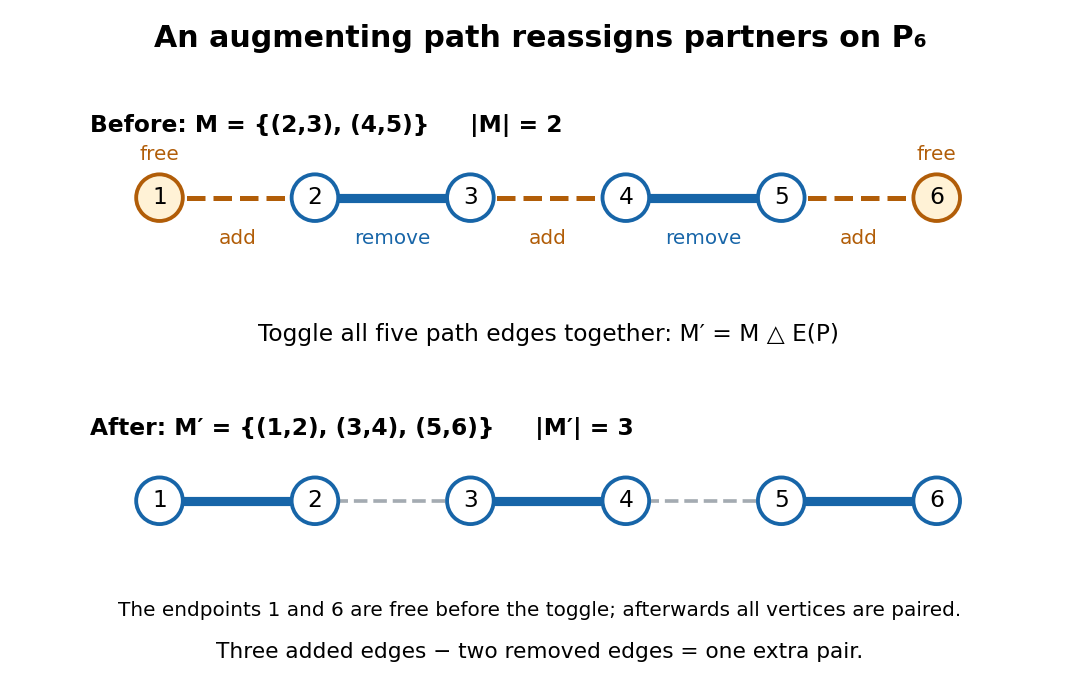
The augmenting path in a matching on P₆ replaces two selected edges by three using symmetric difference
. Details. One unused edge joining two unmatched vertices in a matching is the shortest possible augmenting path in a matching. Longer augmenting paths in a matching reassign several partners, explaining why a stalled greedy matching need not be optimal. For edge benefits , the change in total benefit iswhich need not be positive even though the cardinality increases. A maximum-weight matching therefore needs a different optimality test. In an assignment equality graph an augmenting path in a matching moves toward a perfect matching while preserving zero reduced costs on matched edges; this is the setting used by the Hungarian algorithm.
If is invertible, the divergence constraint of a massive two-form field makes and independent. It gives and . All independent components obey the Klein-Gordon equation. Their count is .
When is invertible, divergence determines components with a plus index from . The trace constraint fixes the trace of . The remaining transverse group representations are a symmetric traceless square, a vector representation, and a scalar.
A martingale difference sequence is an adapted sequence of integrable random variables , , with . Its partial sums are a martingale, and martingale increments give such sequences. If the differences are square-integrable, they are uncorrelated random variables: for , conditioning on gives .
Once a nonnegative martingale hits zero, it stays zero almost surely. Conditional expectation on gives ; nonnegativity forces the next value to vanish there. A countable intersection makes these assertions simultaneous for all times, proving absorption at the first zero.
Martingale increments obstruct finite convergence by Codex 0 Created 2026-10-06 Updated 2026-10-14
Codex 0 Created 2026-10-06 Updated 2026-10-14If a real sequence converges finitely, its successive increments tend to zero. A martingale whose increments stay bounded away from zero on every sample path cannot have a finite almost-sure limit, regardless of its zero conditional mean increments.
Characterization of a martingale by bounded continuous-time stopped expectations by Codex 0 Created 2026-10-06 Updated 2026-11-05
Codex 0 Created 2026-10-06 Updated 2026-11-05Let be an integrable adapted càdlàg process under the usual conditions for a filtration. Then is a martingale if and only if is integrable and for every bounded stopping time .
The forward implication is the optional stopping theorem. Conversely, fix deterministic and , and use the stopping time . Comparing with gives . Since this holds for every such , it is the defining conditional expectation identity of a martingale. The converse uses only integrable adapted coordinates; the stated path assumptions justify the forward assertion at all bounded random times.
A martingale can diverge to almost surely when its increments are finite but not uniformly bounded. For independent Bernoulli random variables with ,has centered integrable increments. The First Borel-Cantelli lemma makes the rare negative jumps occur only finitely often, after which every increment equals one. The expectation remains zero at every finite time despite this pathwise divergence.
Pinned article: Introduction to the OurBigBook Project
Welcome to the OurBigBook Project! Our goal is to create the perfect publishing platform for STEM subjects, and get university-level students to write the best free STEM tutorials ever.
Everyone is welcome to create an account and play with the site: ourbigbook.com/go/register. We belive that students themselves can write amazing tutorials, but teachers are welcome too. You can write about anything you want, it doesn't have to be STEM or even educational. Silly test content is very welcome and you won't be penalized in any way. Just keep it legal!
Intro to OurBigBook
. Source. We have two killer features:
- topics: topics group articles by different users with the same title, e.g. here is the topic for the "Fundamental Theorem of Calculus" ourbigbook.com/go/topic/fundamental-theorem-of-calculusArticles of different users are sorted by upvote within each article page. This feature is a bit like:
- a Wikipedia where each user can have their own version of each article
- a Q&A website like Stack Overflow, where multiple people can give their views on a given topic, and the best ones are sorted by upvote. Except you don't need to wait for someone to ask first, and any topic goes, no matter how narrow or broad
This feature makes it possible for readers to find better explanations of any topic created by other writers. And it allows writers to create an explanation in a place that readers might actually find it.
Figure 1. Screenshot of the "Derivative" topic page. View it live at: ourbigbook.com/go/topic/derivativeVideo 2. OurBigBook Web topics demo. Source. - local editing: you can store all your personal knowledge base content locally in a plaintext markup format that can be edited locally and published either:This way you can be sure that even if OurBigBook.com were to go down one day (which we have no plans to do as it is quite cheap to host!), your content will still be perfectly readable as a static site.
- to OurBigBook.com to get awesome multi-user features like topics and likes
- as HTML files to a static website, which you can host yourself for free on many external providers like GitHub Pages, and remain in full control

Figure 2. You can publish local OurBigBook lightweight markup files to either OurBigBook.com or as a static website.
Figure 3. Visual Studio Code extension installation.
Figure 5. . You can also edit articles on the Web editor without installing anything locally. Video 3. Edit locally and publish demo. Source. This shows editing OurBigBook Markup and publishing it using the Visual Studio Code extension. 
- Infinitely deep tables of contents:



All our software is open source and hosted at: github.com/ourbigbook/ourbigbook
Further documentation can be found at: docs.ourbigbook.com
Feel free to reach our to us for any help or suggestions: docs.ourbigbook.com/#contact