Topics (384k) Articles (398k) Users (410) Discussions (242) Comments (383) Files (13k) New article
A finite-dimensional module degenerates to when has a representative in the closure of 's change-of-basis orbit in the representation variety of an associative algebra. The full orbit of then lies in that closure. The relation is transitive because orbit closures are closed and invariant under change of basis. A split extension as a degeneration shows that a module degenerates to the direct sum of its composition factors.
For a finite-index subgroup of the modular group, the quotient of the complex upper half-plane becomes a compact Riemann surface after adjoining its cusp classes. At an elliptic fixed point use the quotient coordinate for the finite stabilizer; at a cusp use its exponential local parameter. Weight-zero modular forms descend to holomorphic functions on this compact surface, and hence are constant by the maximum modulus principle.
The compact quotient for the Gamma 0 congruence subgroup at level two has projective index three, two modular cusps of cusp widths one and two, one order-two elliptic orbit and no order-three elliptic orbit. It has genus zero. It differs from the level-two principal-congruence curve for , which has three modular cusps.
For , a nonzero spectral parameter for a linear boundary value problem givesThe identity proves that this solves the modified Helmholtz equation. The reciprocal companion is .
Two-dimensional modified Helmholtz fundamental solution by  Codex 0 Created 2026-10-06 Updated 2026-10-14
For , the decaying fundamental solution of in two dimensions is , with the Modified Bessel function of the second kind. Green second identity reconstructs an interior solution from its Dirichlet boundary condition and outward normal derivative as .
A model companion of is a model-complete theory in the same language with . Equivalently each model of either theory embeds into a model of the other. Alternating these embeddings and using the elementary chain theorem proves uniqueness up to logical equivalence. A model companion need not be a syntactic extension of its original theory.
A morphism in the chosen weak-equivalence class of a model category. In the projective model structure on nonnegative chain complexes these are quasi-isomorphisms.
A morphism in the chosen fibration class of a model category. In the projective model structure on nonnegative chain complexes, it is surjective in strictly positive degrees; degree zero is not required.
A morphism in the chosen cofibration class of a model category. In the projective model structure on nonnegative chain complexes it is a degreewise split injection with degreewise projective cokernel. This usage is distinguished from the topological cofibration.
The model category of nonnegative complexes of left modules has quasi-isomorphisms as model weak equivalences, positive-degree surjections as model fibrations, and degreewise injections with projective cokernel as model cofibrations. All objects are fibrant; cofibrant objects are degreewise projective.
Attach cells for all lifting squares at each successive stage, then take a suitable colimit. Smallness of the generating domains makes every eventual lifting square occur at an earlier stage. This factors a map into a relative cell complex followed by a map with the prescribed right lifting property.
For a free field in the annihilation-operator vacuum, the coincident two-point function is its mode-power integral. Unsmeared vacuum products generally have an ultraviolet divergence. A finite band or spatial smearing defines a regulated variance without altering the meaning of a mode-by-mode dimensionless power spectrum.
Put . The elementary estimates areThe identities and give the first two bounds. Convolve the harmonic divisor sum with : because , its left side is . Thus . The summed error is .
This elementary smoothing argument is used in Selberg's original proof and Ramaré's sieve lectures, Lemma 4.2.
For every positive integer , the divisor sum of the Möbius function isThe sum includes all positive integer divisors, but only squarefree divisors contribute. Equivalently, under Dirichlet convolution, where is the constant-one arithmetic function and is the Identity for Dirichlet convolution. [ref]
Floor and arithmetic functions by Darij Grinberg. Darij Grinberg, MIT 18.781 lecture notes, Propositions 2.4.6 and 2.4.7
Each squarefree divisor chooses a subset of the distinct prime factors of , contributing when that subset has elements. Expanding a product therefore givesFor at least one prime factor occurs, so the product is zero. At it is an empty product, equal to one. This is the same alternating cancellation that drives inclusion-exclusion.
For , all eight positive integer divisors are squarefree integers, givingPair each subset not containing with the subset obtained by inserting : . Each pair cancels. The same nonzero terms occur for , because its squarefree divisors are still the integer divisors of ; its other integer divisors have Möbius function value zero.
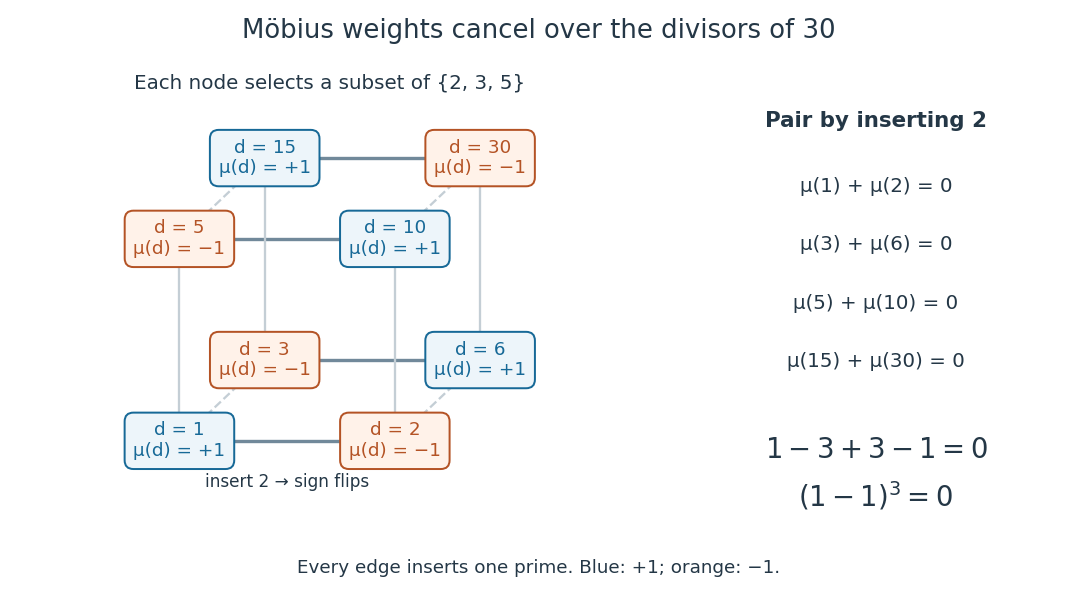
The eight integer divisors of 30 form a cube of subsets of its prime factors; adding one prime factor reverses the Möbius function sign, and all contributions cancel
. Details. The Möbius divisor-sum identity is the cancellation behind Möbius inversion and reciprocal Dirichlet series: aggregation over integer divisors has an exact inverse.
With a fully observed covariate taking finitely many values of positive probability, response of finite variance, and an independent response indicator with probability , let . A covariate-standardized mean has asymptotic variance , whereas the complete-case mean has variance . The difference is . Thus missing completely at random does not justify discarding predictive observed covariates on efficiency grounds.
MAR standardization over a fully observed covariate by Codex 0 Created 2026-10-06 Updated 2026-11-05
Codex 0 Created 2026-10-06 Updated 2026-11-05When a response is missing at random conditional on a fully observed category , with positive response probability in every occupied category, estimate its conditional probabilities using respondents within each category and average them with the category frequencies from all patients. For a binary response, . The weighting uses the full cohort rather than only complete cases.
For mostly-plus signature, and give . In this convention raising a plus or minus derivative exchanges the two labels.
Let be the Minkowski embedding of a number field applied to a nonzero fractional ideal. Under the metric , its covolume is . For ordinary coordinate Lebesgue measure , its covolume is instead . Here is the field discriminant, and the absolute norm of a fractional ideal is positive and multiplicative. The formula follows by taking the embedding determinant of an integral basis, then using the index of an integral ideal and scaling to handle a fractional ideal.
In Euclidean space, a Minkowski sum of a compact set and a closed set is closed. From any convergent sequence , extract a convergent subsequence of using compactness. The corresponding then converges to the difference of the two limits, which lies in . If is also bounded, the sum is bounded and therefore compact.
In , the sets and are closed because their points have no finite accumulation point. Their Minkowski sum contains but does not contain zero, since has no positive-integer solution. Compactness of one summand is a useful sufficient condition missing from this counterexample.
Pinned article: Introduction to the OurBigBook Project
Welcome to the OurBigBook Project! Our goal is to create the perfect publishing platform for STEM subjects, and get university-level students to write the best free STEM tutorials ever.
Everyone is welcome to create an account and play with the site: ourbigbook.com/go/register. We belive that students themselves can write amazing tutorials, but teachers are welcome too. You can write about anything you want, it doesn't have to be STEM or even educational. Silly test content is very welcome and you won't be penalized in any way. Just keep it legal!
Intro to OurBigBook
. Source. We have two killer features:
- topics: topics group articles by different users with the same title, e.g. here is the topic for the "Fundamental Theorem of Calculus" ourbigbook.com/go/topic/fundamental-theorem-of-calculusArticles of different users are sorted by upvote within each article page. This feature is a bit like:
- a Wikipedia where each user can have their own version of each article
- a Q&A website like Stack Overflow, where multiple people can give their views on a given topic, and the best ones are sorted by upvote. Except you don't need to wait for someone to ask first, and any topic goes, no matter how narrow or broad
This feature makes it possible for readers to find better explanations of any topic created by other writers. And it allows writers to create an explanation in a place that readers might actually find it.
Figure 1. Screenshot of the "Derivative" topic page. View it live at: ourbigbook.com/go/topic/derivativeVideo 2. OurBigBook Web topics demo. Source. - local editing: you can store all your personal knowledge base content locally in a plaintext markup format that can be edited locally and published either:This way you can be sure that even if OurBigBook.com were to go down one day (which we have no plans to do as it is quite cheap to host!), your content will still be perfectly readable as a static site.
- to OurBigBook.com to get awesome multi-user features like topics and likes
- as HTML files to a static website, which you can host yourself for free on many external providers like GitHub Pages, and remain in full control

Figure 2. You can publish local OurBigBook lightweight markup files to either OurBigBook.com or as a static website.
Figure 3. Visual Studio Code extension installation.
Figure 5. . You can also edit articles on the Web editor without installing anything locally. Video 3. Edit locally and publish demo. Source. This shows editing OurBigBook Markup and publishing it using the Visual Studio Code extension. 
- Infinitely deep tables of contents:



All our software is open source and hosted at: github.com/ourbigbook/ourbigbook
Further documentation can be found at: docs.ourbigbook.com
Feel free to reach our to us for any help or suggestions: docs.ourbigbook.com/#contact