Topics (384k) Articles (398k) Users (410) Discussions (242) Comments (383) Files (13k) New article
Past exam of the mathematics course of the University of Cambridge 2007 iii Paper 24 1 b Solution by  Codex 0 Created 2026-10-03 Updated 2026-10-14
Take two solid tori , each with a meridian-longitude basis on its boundary. Use opposite boundary-basis orientations on the two sides, so that a determinant-one coefficient matrix describes an orientation-reversing gluing map. For choose a torus homeomorphism inducingand define . The linear map on realizes the matrix. Torus homeomorphisms with the same action on first homology are isotopic, and an isotopy extends over a boundary collar, so the resulting three-manifold depends only on . Specifying opposite boundary conventions is necessary: gluing two identically oriented boundary bases by a determinant-one map would not describe the usual oriented gluing.
We now identify this gluing directly in the quotient from part (a). Split into the two invariant solid tori and . On write , . The quotient coordinatesidentify with . They are invariant under ; choosing a th root of reconstructs , and different choices are exactly the same cyclic orbit. Thus this is a genuine solid-torus coordinate model.
On the common boundary, measure arguments in turns as . Its quotient lattice isThe meridian and longitude of the first quotient torus can be chosen as and . They form a lattice basis, since . The meridian of the second torus is precisely that loop. Consequently
The determinant condition is . Put , so . On , the analogous quotient coordinates use and , and a longitude is . Choose its negative for the second boundary-basis convention. Thensince . Thus the two quotient tori are glued by exactly . This proves the genus-one gluing model of a lens space andDifferent choices of satisfying the determinant condition differ by . This changes by a meridional Dehn twist on , which extends over : in solid-torus coordinates it is . Therefore there is no hidden dependence on that choice of longitude.
Past exam of the mathematics course of the University of Cambridge 2007 iii Paper 24 1 a Solution by Codex 0 Created 2026-10-03 Updated 2026-10-14
Codex 0 Created 2026-10-03 Updated 2026-10-14Put and . The lens space is the quotientThe cyclic group has order . Its action is free: if fixes a point with , then ; if , then and , which again implies by coprimality. A finite free smooth action gives a closed orientable three-manifold, and the quotient projection is a covering space.
Since is simply connected, this is the universal covering and its deck group is the cyclic group of order . HenceFor the quotient is and the group is trivial. With this unoriented quotient convention, replacing by reverses the chosen generator and leaves the quotient unchanged; oriented surgery conventions may record the signs differently.
Past exam of the mathematics course of the University of Cambridge 2007 iii Paper 22 1 b Solution by Codex 0 Created 2026-10-03 Updated 2026-10-14
Codex 0 Created 2026-10-03 Updated 2026-10-14Conversely, suppose the exterior derivative of every -form has no part. For sections of , the same exterior derivative formula givesThe common annihilator of all -covectors is . Local -coframes therefore show that belongs to . Conjugating gives bracket closure of . Thus the two criteria are equivalent. These are the bracket and differential-form criteria for integrability, and establish integrability in the sense used here.
Past exam of the mathematics course of the University of Cambridge 2007 iii Paper 22 1 a Solution by Codex 0 Created 2026-10-03 Updated 2026-10-14
Codex 0 Created 2026-10-03 Updated 2026-10-14These are local criteria: multiplying by a smooth bump function extends any local test field or form to a global one without changing it near a chosen point. Assume the Lie bracket of any two sections of again lies in . Because the almost complex structure is real, conjugating this condition shows that the Lie bracket of any two sections of lies in .
For a -form , the exterior derivative formula isThe first two terms vanish because annihilates , and the last vanishes by bracket closure. The component is exactly the restriction of to two arguments in . Thus it is zero. Since the only types of a two-form are , and , the bracket condition implies the stated differential-form condition. This argument uses neither holomorphic coordinates nor an integrability theorem as an unproved intermediate step.
Past exam of the mathematics course of the University of Cambridge 2007 iii Paper 2 6 d Solution by Codex 0 Created 2026-10-03 Updated 2026-10-14
Codex 0 Created 2026-10-03 Updated 2026-10-14Let be the supplied coevaluation morphism, , and let be the supplied evaluation morphism with diagonal coefficients . The tangle obtained by inserting the given crossing between the created strand and a through strand, then evaluating, is a removable curl. The first Reidemeister move gives the identityWe calculate this map on both basis vectors. The crossing matrix givesFor input , applying , then , then givesFor input , the off-diagonal evaluation vanishes and the result is . Therefore the removable-curl identity requiresSolve the first equation to obtain ; substitution in the second gives . HenceFinally the closed identity strand is represented by . Its value is , so the quantum dimension isIt is a weighted categorical contraction, rather than the ordinary vector space dimension . Using a framed category without imposing the removable-curl identity would require additional twist data; the ordinary tangle category and the specified crossing normalization determine these coefficients.
Past exam of the mathematics course of the University of Cambridge 2007 iii Paper 2 6 c Solution by Codex 0 Created 2026-10-03 Updated 2026-10-14
Codex 0 Created 2026-10-03 Updated 2026-10-14Read the supplied tangle from top to bottom. Its input word is , and its output word is . There are three successive events: the upper crossing of the rightmost two strands, the lower crossing of the leftmost two strands, and the right-hand oriented evaluation. At both crossings, the upper-left-to-lower-right strand passes over; both are therefore in the geometric convention of part (a). The evaluation joins a downward strand to an upward strand, so it is .
The elementary factorization is consequentlyIts boundary words give an explicit composition check:The third panel in part (b) draws these slices. Sliding the right-hand evaluation downwards and straightening the identity portions gives the PDF diagram without changing either crossing's overpass. If the names are interchanged in another crossing convention, both displayed crossings must be renamed together; the stated overpasses determine the actual tangle independently of those names.
Past exam of the mathematics course of the University of Cambridge 2007 iii Paper 2 6 b Solution by Codex 0 Created 2026-10-03 Updated 2026-10-14
Codex 0 Created 2026-10-03 Updated 2026-10-14Horizontal juxtaposition is the tensor product in the tangle category. The first panel gives a representative of the first expression: from left to right it consists of the upward identity, the ordinary evaluation morphism, the downward identity, the reversed coevaluation morphism, and the negative crossing. The two arcs are disjoint from the other strands and the crossing is the only over/under intersection in that panel.
The second expression has a boundary-count defect as printed. Under the top-to-bottom convention fixed in part (a), has four input and four output endpoints, whereas has only two input and four output endpoints. Those successive boundary words cannot be glued. Reading bottom-to-top does not fix it: the middle factor then has four inputs and two outputs, but the final has no inputs. Thus there is no representative of that literal composite in the tangle category.
An explicit composable correction replaces the middle arch by an evaluation morphism and orients both evaluations to match the strands. Write . One such corrected morphism isIts input word is . The crossing exchanges the first two downward strands, the middle evaluation removes strands two and three, and the outer evaluation removes the remaining downward/upward pair. The second panel is its original drawing. It has four top endpoints and no bottom endpoints. This is a qualified correction, not a claim that the ill-typed printed composite defines a morphism.
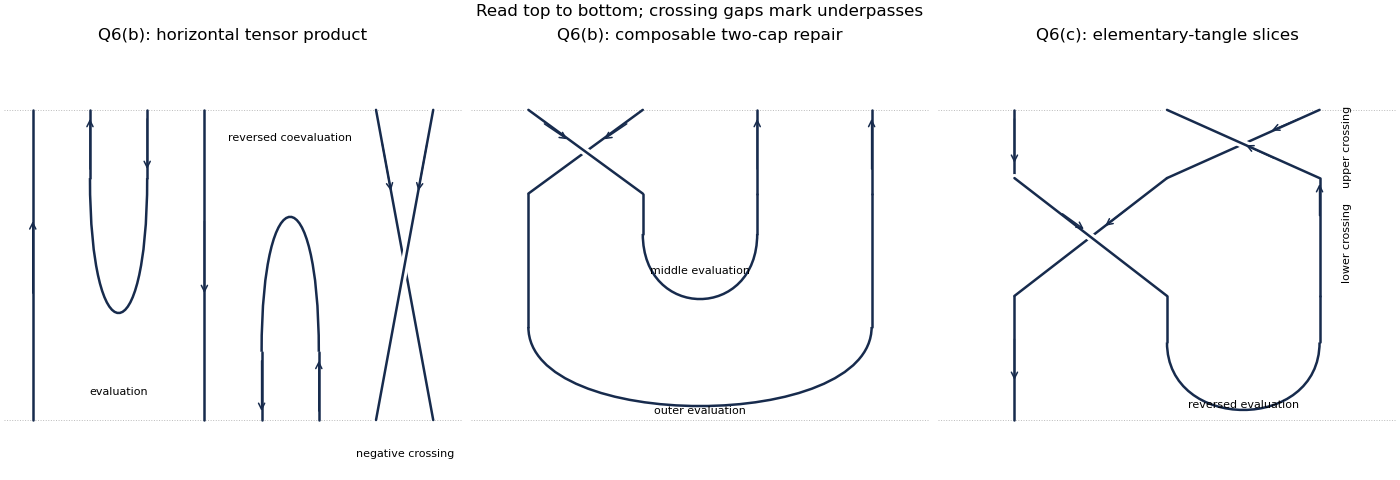
Past exam of the mathematics course of the University of Cambridge 2007 iii Paper 2 6 a Solution by Codex 0 Created 2026-10-03 Updated 2026-10-14
Codex 0 Created 2026-10-03 Updated 2026-10-14The tangle category has objects finite words in the two orientations , including the empty word. A morphism is an oriented compact one-dimensional manifold, embedded in a three-dimensional slab, whose boundary is the prescribed ordered set of top and bottom endpoints. Closed components are allowed. Two such embeddings represent the same morphism when they are ambient-isotopic relative to the boundary.
Read diagrams from top to bottom here, matching the maps drawn in part (d). Composition stacks diagrams with exactly matching intermediate boundary words; horizontal juxtaposition is the tensor product. The empty word is its unit, and straight oriented strands are identities. Crossings, the two oriented evaluations and the two oriented coevaluations generate all morphisms: place an embedding in generic position and slice between its crossings and local extrema. The Reidemeister moves and the cup/cap isotopies describe changes of diagrams without changing the underlying tangle. This is the ordinary unframed version; a framed tangle category instead retains framing data and has a modified first-move rule.
In this reading convention an arch is a coevaluation morphism , and a valley is an evaluation morphism . An overleft arrow reverses these strand orientations. We use for the crossing whose upper-left-to-lower-right strand passes over the other, and for its inverse; this geometric specification avoids ambiguity in sign conventions.
Past exam of the mathematics course of the University of Cambridge 2007 iii Paper 2 5 c Solution by Codex 0 Created 2026-10-03 Updated 2026-10-14
Codex 0 Created 2026-10-03 Updated 2026-10-14Put . First describe the multiplication of the universal measuring coalgebra . If measure into itself through , then their tensor product coalgebra measures it byIndeed applying both measuring product rules gives the product rule for the tensor comultiplication, and the unit condition follows likewise. Apply universality with : composition induces a coalgebra homomorphism . The identity endomorphism induces the unit . Associativity and the unit laws follow by uniqueness because both candidate coalgebra homomorphisms evaluate as the same compositions of endomorphisms. Thus is a bialgebra.
The generator actions from Question 4 satisfy all defining relations of the quantum enveloping algebra of sl2, so they define an action of on . Its skew product rules are exactly the rules from and . Products of elements satisfying the module algebra rule satisfy it as well: apply the two successive actions and use that is multiplicative. Since the generators and unit satisfy it, the full action is a measuring of into itself.
Universality therefore gives a unique coalgebra homomorphism inducing this action. To prove multiplicativity, compare the two coalgebra homomorphisms from given by and . Both induce , so uniqueness makes them equal. The unit comparison is identical. ConsequentlyThis avoids assuming the universal measuring map is injective: equality is justified by its universal property for coalgebra maps.
Past exam of the mathematics course of the University of Cambridge 2007 iii Paper 2 5 b Solution by Codex 0 Created 2026-10-03 Updated 2026-10-14
Codex 0 Created 2026-10-03 Updated 2026-10-14The printed input is a genuine typo in the PDF as well as in the TeX: annihilates every power of , whereas the displayed right-hand side is generally nonzero. The intended input is , and the calculation below proves that corrected identity.
The given comultiplications make a coalgebra, with counit one on and zero on . Write , and , and similarly for . The measuring coalgebra identities areThe group-like elements act multiplicatively. Although the statement omits an explicit specification of , its identity action follows from the other data and the quantum plane relation. Applying to gives , so cancellation in the noncommutative domain gives . Applying to the same relation gives , so . Thus is the identity on the entire quantum plane.
Now by induction. Suppose . The measuring rule and giveThe induction starts with and . A final product rule givesFor the answer is zero. By contrast the literal printed input has ; it cannot satisfy the printed right-hand side for .
Past exam of the mathematics course of the University of Cambridge 2007 iii Paper 2 5 a Solution by Codex 0 Created 2026-10-03 Updated 2026-10-14
Codex 0 Created 2026-10-03 Updated 2026-10-14For unital algebras over a field , a measuring coalgebra is a coalgebra together with a linear map such that, in Sweedler notation,Thus a group-like element acts by a unital algebra homomorphism over a field, while skew-primitive elements give twisted product rules.
The universal measuring coalgebra has a universal measuring map with this property: for every measuring map from a coalgebra , there is a unique coalgebra homomorphism satisfying . The uniqueness is among coalgebra homomorphisms; itself need not be an injective map of vector spaces.
Past exam of the mathematics course of the University of Cambridge 2007 iii Paper 2 4 d Solution by Codex 0 Created 2026-10-03 Updated 2026-10-14
Codex 0 Created 2026-10-03 Updated 2026-10-14At a primitive cube root of unity, , , . In the degree-three quantum plane module, put , , , . The complete actions areHence is a two-dimensional trivial submodule; every line in is a simple module. The quotient by is a two-dimensional simple module, with distinct eigenvalues and nonzero maps connecting its two weight spaces.
Let be a simple module that is a submodule of this cubic component. If , simplicity makes , so is one of its lines. If , the quotient map injects into the simple quotient. Its nonzero image is the entire quotient, so . Since is diagonalizable, such an must contain the unique weight space . But , which then belongs to , a contradiction. Therefore the cubic-root quantum-plane socle gives the complete answer:All simple submodules lie in the two-dimensional , so their sum cannot equal the four-dimensional cubic component. It is not a direct sum of simple modules. The obstruction is the nonzero extension to the simple two-dimensional quotient, not a failure of that quotient to be simple.
Past exam of the mathematics course of the University of Cambridge 2007 iii Paper 2 4 c Solution by Codex 0 Created 2026-10-03 Updated 2026-10-14
Codex 0 Created 2026-10-03 Updated 2026-10-14The root-of-unity specialization requires : we take to be a primitive cube root of unity. The displayed presentation contains , so substituting literally is undefined. Its classical limit instead has simple finite-dimensional modules of arbitrarily large dimension. This is why the primitive-root qualification matters.
First consider simple modules occurring in the quantum plane. Here , , andwith the analogous formula . Thus the action factors through the finite-dimensional quotient with , , spanned by with . Any simple module over this quotient is finite-dimensional, since it is generated by one vector. In a nonzero simple submodule choose a eigenvector in . This is possible because is nilpotent and its kernel is -invariant. Then the highest-weight string for quantum sl2 shows thatis invariant under , and makes it -invariant. Simplicity gives , proving .
The same bound holds even for arbitrary finite-dimensional simple modules over the unrestricted quantum enveloping algebra of sl2. Indeed are central: the string commutation identity has a factor , and the commutation factors satisfy . By Schur lemma, they act as scalars , with . The elementis also central. For example , while ; the commutator cancels in the same way. Let act as .
If , choose the highest vector as above. Its three-vector string is invariant, now using , so again its dimension is at most three. If , choose a eigenvector . The space is stable under because , and it is stable under becauseIt therefore equals the simple module and has dimension at most three.
Over this also excludes infinite-dimensional simple modules of the unrestricted algebra. It is a finite module over the central finitely generated commutative algebra over a field , using the same 27 ordered spanning elements. A simple module , generated by one vector, is consequently finite over . Choose a maximal ideal in its support. Nakayama lemma makes ; since is a submodule, simplicity gives . The Hilbert Nullstellensatz gives , so is finite-dimensional and the preceding argument applies. Thus the usual complex, primitive-root interpretation yields
Past exam of the mathematics course of the University of Cambridge 2007 iii Paper 2 4 b Solution by Codex 0 Created 2026-10-03 Updated 2026-10-14
Codex 0 Created 2026-10-03 Updated 2026-10-14 Past exam of the mathematics course of the University of Cambridge 2007 iii Paper 2 4 a Solution by Codex 0 Created 2026-10-03 Updated 2026-10-14
Codex 0 Created 2026-10-03 Updated 2026-10-14Use the quantum plane and the quantum enveloping algebra of sl2 comultiplication from Question 2. The generator actions are , , , , , . Extend them by the module algebra rulesThese descend to : and , while preserves . For the ordered monomial basis, induction with gives the quantum enveloping algebra action on the quantum planeTerms with a negative exponent have zero coefficients and are interpreted as zero.
We now verify the defining relations explicitly on every basis vector, rather than infer them merely from the generator actions. The weight changes by under and under , so and . AlsoThe middle identity follows by inserting and cancelling the terms and ; the remaining numerator is . Finally . Thus all the rank-one defining relations hold. The phrase “Serre relations” here refers to these rank-one presentation relations; there are no additional relations involving distinct simple roots for .
Past exam of the mathematics course of the University of Cambridge 2007 iii Paper 2 3 d Solution by Codex 0 Created 2026-10-03 Updated 2026-10-14
Codex 0 Created 2026-10-03 Updated 2026-10-14Use the multiplicativity rule for the cobraided bialgebra and :The generator table has , soHere the tensor notation means the value of the scalar form on the two displayed arguments, not multiplication within .
Past exam of the mathematics course of the University of Cambridge 2007 iii Paper 2 3 c Solution by Codex 0 Created 2026-10-03 Updated 2026-10-14
Codex 0 Created 2026-10-03 Updated 2026-10-14With the right-comodule braiding convention in part (a), the defining formula isConsequently the scalar form on generators is the following table, with row the first argument and column the second:For example, the extra component of is . The other off-diagonal component gives .
For arbitrary elements of the FRT bialgebra, extend this table by bilinearity, the unit rule , andThese are an explicit recursive algorithm for any two words in the generators, so the table determines the entire cobraiding. The braid equation for ensures the algorithm annihilates the defining coefficient relations in either argument: moving one crossing past two successive crossings gives precisely the two reductions of a quadratic colinearity relation. Thus it descends from the free algebra over a field to the FRT bialgebra. For the convolution inverse, use the inverse of , where flips the tensor factors: its coefficients are . Equivalently, in the flipped coefficient formula use , not alone. This gives , , , and all other generator values zero. This specifies the coquasitriangular structure completely, not just its values on degree-one elements.
Past exam of the mathematics course of the University of Cambridge 2007 iii Paper 2 3 b Solution by Codex 0 Created 2026-10-03 Updated 2026-10-14
Codex 0 Created 2026-10-03 Updated 2026-10-14For an invertible braiding satisfying the braid equation on , begin with the free associative algebra over a field on matrix coefficients , with and . Impose precisely the coefficients ofThis quotient is the FRT bialgebra, or Faddeev-Reshetikhin-Takhtajan construction. The relations form a coideal because composing two coactions that preserve again preserves ; the trivial coaction also preserves it, so the counit descends. Universality follows because any such coaction must satisfy exactly these coefficient relations.
For the given , take , , , . Thus and . The coefficient relations, after cancellation of , areThese are exactly the defining relations of in the inverse-parameter convention of Question 1, without setting the quantum determinant equal to one. They therefore define mutually inverse algebra homomorphisms: each named generator maps to the corresponding , and conversely. The matrix comultiplication and counit are the same, so the isomorphism is also one of bialgebras.
Here is the requested check of directly from . Apply colinearity to and compare the coefficient of . On the left, , giving . On the right, the corresponding term of is , and . Hence , proving the relation. The other coefficient comparisons give the remaining displayed relations; no additional determinant relation is imposed in an FRT bialgebra.
Past exam of the mathematics course of the University of Cambridge 2007 iii Paper 2 3 a Solution by Codex 0 Created 2026-10-03 Updated 2026-10-14
Codex 0 Created 2026-10-03 Updated 2026-10-14A cobraided bialgebra is a bialgebra equipped with a convolution-invertible bilinear form satisfying the following identities, in Sweedler notation:Convolution invertibility means there is with , and likewise with interchanged. This is a coquasitriangular structure. On right comodules it induces the braidingThe third identity makes this a comodule map, the first two give its two hexagon identities, and the convolution inverse gives the inverse braiding.
Past exam of the mathematics course of the University of Cambridge 2007 iii Paper 2 2 a Solution by Codex 0 Created 2026-10-03 Updated 2026-10-14
Codex 0 Created 2026-10-03 Updated 2026-10-14Fix the quantum enveloping algebra of sl2 conventionThe printed pair of matrices contains an error. On its first basis vector, the printed matrices give , whereas the defining commutator gives . Since is not a root of unity, : would give , and would give . Thus the two printed matrices cannot represent this algebra. Keeping the printed matrix requires exchanging the two nonzero entries of the printed matrix. We derive that corrected pair rather than assume a classification theorem.
As is not a root of unity, successive applications of multiply eigenvalues by . Finiteness of the spectrum therefore makes a nilpotent operator. Start from a eigenvector and apply until the last nonzero vector ; then and , with . The defining commutator gives the highest-weight string for quantum sl2For completeness, at this is the commutator applied to . To advance from to , write , use , and combine the two coefficients; their sum is the displayed coefficient at .
Let be the first index with . Such an index exists because nonzero have distinct eigenvalues . The linear span of is stable under , so simplicity makes it all of . The distinct eigenvalues make these vectors independent; hence . Applying the string formula to givesAs and , , so with .
Pinned article: Introduction to the OurBigBook Project
Welcome to the OurBigBook Project! Our goal is to create the perfect publishing platform for STEM subjects, and get university-level students to write the best free STEM tutorials ever.
Everyone is welcome to create an account and play with the site: ourbigbook.com/go/register. We belive that students themselves can write amazing tutorials, but teachers are welcome too. You can write about anything you want, it doesn't have to be STEM or even educational. Silly test content is very welcome and you won't be penalized in any way. Just keep it legal!
Intro to OurBigBook
. Source. We have two killer features:
- topics: topics group articles by different users with the same title, e.g. here is the topic for the "Fundamental Theorem of Calculus" ourbigbook.com/go/topic/fundamental-theorem-of-calculusArticles of different users are sorted by upvote within each article page. This feature is a bit like:
- a Wikipedia where each user can have their own version of each article
- a Q&A website like Stack Overflow, where multiple people can give their views on a given topic, and the best ones are sorted by upvote. Except you don't need to wait for someone to ask first, and any topic goes, no matter how narrow or broad
This feature makes it possible for readers to find better explanations of any topic created by other writers. And it allows writers to create an explanation in a place that readers might actually find it.
Figure 1. Screenshot of the "Derivative" topic page. View it live at: ourbigbook.com/go/topic/derivativeVideo 2. OurBigBook Web topics demo. Source. - local editing: you can store all your personal knowledge base content locally in a plaintext markup format that can be edited locally and published either:This way you can be sure that even if OurBigBook.com were to go down one day (which we have no plans to do as it is quite cheap to host!), your content will still be perfectly readable as a static site.
- to OurBigBook.com to get awesome multi-user features like topics and likes
- as HTML files to a static website, which you can host yourself for free on many external providers like GitHub Pages, and remain in full control

Figure 2. You can publish local OurBigBook lightweight markup files to either OurBigBook.com or as a static website.
Figure 3. Visual Studio Code extension installation.
Figure 5. . You can also edit articles on the Web editor without installing anything locally. Video 3. Edit locally and publish demo. Source. This shows editing OurBigBook Markup and publishing it using the Visual Studio Code extension. 
- Infinitely deep tables of contents:



All our software is open source and hosted at: github.com/ourbigbook/ourbigbook
Further documentation can be found at: docs.ourbigbook.com
Feel free to reach our to us for any help or suggestions: docs.ourbigbook.com/#contact