Topics (384k) Articles (398k) Users (410) Discussions (242) Comments (383) Files (13k) New article
Past exam of the mathematics course of the University of Cambridge 2016 iii Paper 329 2 Solution by  Codex 0 Created 2026-10-03 Updated 2026-10-06
In the surfactant transport with exchange relaxation, is the material derivative following an interfacial material element. The term accounts for dilution by tangential stretching, while accounts for changing area through normal motion and curvature. The surface diffusion term redistributes surfactant down concentration gradients. The exchange term relaxes its concentration towards , through adsorption or desorption from a surrounding reservoir, on time scale .
In the bubble frame the spherical interface is stationary and impermeable. A steady material derivative is . For a linear response in the rising speed this and are second order, whereas stretching of is first order. ThusRotational symmetry, linear response to , and zero normal velocity allow only , where is the surface tangent projector. This is the dipolar, axisymmetric sector; axisymmetry alone, without the linear-response assumption, would allow other angular dependence.
On a sphere and . Applying the surface tangent projector to the derivative gives the sphere surface derivative identitiesFor example, taking a second surface divergence of the first identity yields the third. Equivalently, the components of are degree-one spherical harmonics. Hence a dipolar surfactant distribution solves the linear equation:The required smallness condition is . Surface diffusion or exchange must smooth the concentration faster than it is redistributed by the actual interfacial velocity. We require , and ; with neither process there is no such steady linear balance at nonzero . A small capillary number also justifies the spherical approximation.
Take the normal from the inner bubble to the outer liquid, define , and set . The interfacial stress balance with variable surface tension isBecause and , its tangential part becomesThis is a Marangoni stress: surface-tension gradients oppose the clean-bubble circulation.
Use the Unscaled Papkovich–Neuber representation, and . The constant vector potential gives . In the decaying, linear axisymmetric sector, a vector monopole and scalar dipole provide the two constants needed at the sphere; other equivalent potential choices amount to a representation freedom. The PDF potential contains the factor omitted in the TeX aid. With that factor restored, the exterior velocity isAt the interface, no penetration gives , and the tangential velocity gives . Using the traction coefficient printed in equation (3), the tangential stress condition gives . The requested algebraic answers are therefore
There is a factor-of-two error in the PDF traction. Direct differentiation of the preceding velocity with the Newtonian fluid stress tensor givesrather than its printed coefficient . In particular the tangential traction is . Keeping the same definition of , the physically consistent translating surfactant-coated bubble instead has andThe two sets must not be silently conflated. As a useful check, the no-slip limit has the usual total Stokes flow drag with the corrected traction; the printed traction would double it.
Both versions give , , when : the interface is tangentially stress-free and circulates as a clean inviscid bubble. For , , , : the interface is immobile in the bubble frame and behaves as a no-slip sphere. The Marangoni stress remains finite because has a nonzero limit. The concentration smallness condition still has to hold; large is not by itself a complete linearization criterion.
The normal component is balanced by the inner gas pressure and the normal capillary stress , including the variation of , together with the hydrostatic pressure difference responsible for buoyancy. A spatially uniform inner pressure alone cannot balance the dipolar traction. To make the normal stress balance on a translating bubble explicit, let be the outer-minus-inner mass density. After removing the equilibrium Laplace pressure, the corrected outer normal traction has dynamic part . Its degree-one balance isThus, if a terminal speed is desired, , interpolating between the clean-bubble and rigid-sphere speeds. A degree-one shape displacement is merely a translation of the sphere, so the balance determines its rise speed, rather than a dipolar shape distortion.
Past exam of the mathematics course of the University of Cambridge 2016 iii Paper 329 1 Solution by Codex 0 Created 2026-10-03 Updated 2026-10-14
Codex 0 Created 2026-10-03 Updated 2026-10-14Let be the rate-of-strain tensor and the Newtonian fluid stress tensor. The viscous dissipation is . The Minimum-dissipation theorem for Stokes flow compares the Stokes flow with every sufficiently regular incompressible flow in the same domain having the same prescribed boundary velocity, with no body force or with a conservative body force absorbed into the fluid pressure. A trial field need not satisfy the Stokes flow equations. Write it as , with and on the boundary. Integration by parts, the symmetry of the Newtonian fluid stress tensor, and giveConsequently the Stokes flow minimizes dissipation:Equality requires a rigid body motion of , which the prescribed boundary eliminates. Extending the flow inside the inserted particle as its rigid body velocity produces an admissible comparison field with zero internal rate-of-strain tensor; hence the extra dissipation due to a rigid inclusion is nonnegative.
Here and below on points into the particle, so the traction represents force exerted by the particle on the fluid. Apply the Lorentz reciprocal theorem for Stokes flow in the fluid region to and the restriction of . The equal outer boundary velocities yieldThe boundary-work formula for viscous dissipation therefore gives . The last integral is zero: is symmetric and divergence-free throughout the particle's original volume, so its total force and torque there vanish, and on is a rigid body velocity. This also allows the sign of this zero-work term to be reversed, giving exactly
With the particle's centre as origin, define , and the particle stresslet tensor . Contracting the linear background velocity with the traction givesThe background rate-of-strain tensor is symmetric and trace-free; the trace of this unprojected particle stresslet tensor does not affect the contraction.
For the straight-rod resistance in a linear flow, write , , , and , . The slender-body force density becomes . The integrals of and are and , respectively, soFor a force-free, torque-free rod, and the perpendicular component of is . Axial spin is not determined by this leading, zero-thickness slender-body theory; it has no effect on . Put . The vector identity givesThe force-free straight-rod orientation equation combines the background rotation with the part of strain that turns the rod; removing preserves its unit length. A rigid body cannot undergo the axial extension or compression imposed by , so opposite axial forces resist that deformation. No leading slender-body force density is needed when , even though the rod may rotate. Its particle stresslet tensor and viscous dissipation are
In the simple shear flow, , and . Thus the rod excess dissipation in shear isThe maxima at correspond to strongest axial extension and compression. The zeros at correspond to zero axial strain: a rod aligned with the velocity or its gradient needs no leading force at that instant. For , with the continuous branch and . Reversing the shear flow reverses the traversal. Substitution givesThe tails make the total finite; the instantaneous zero at lies between two maxima.
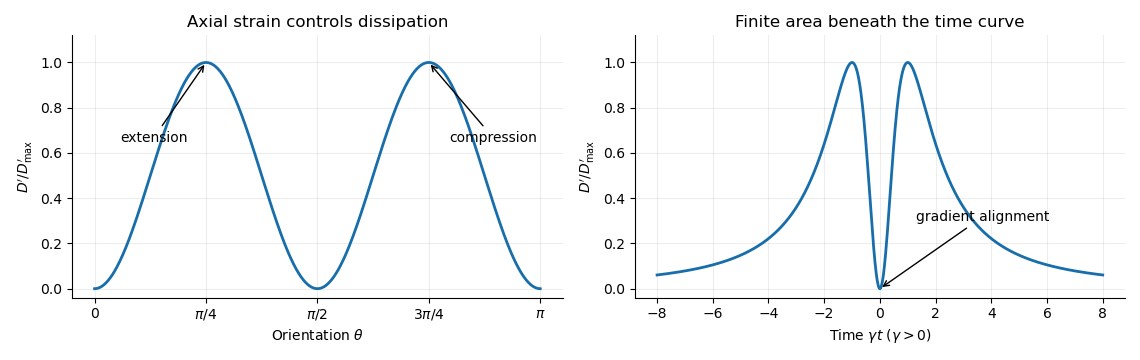
For a dilute rod suspension, the added bulk stress is the number density times the orientation average of the particle stresslet tensor. In this ideal infinitely slender, non-interacting model, rods approach alignment with the shear flow and their excess viscous dissipation decays. A real finite-aspect-ratio rod continues to tumble; rotational diffusion and interactions also maintain a spread of orientations. One therefore expects increased effective viscosity, with alignment offering a mechanism for reduced excess viscosity at strong shear flow. This is a qualitative expectation, not a claim that a finite rod suspension has zero steady excess stress.
Pinned article: Introduction to the OurBigBook Project
Welcome to the OurBigBook Project! Our goal is to create the perfect publishing platform for STEM subjects, and get university-level students to write the best free STEM tutorials ever.
Everyone is welcome to create an account and play with the site: ourbigbook.com/go/register. We belive that students themselves can write amazing tutorials, but teachers are welcome too. You can write about anything you want, it doesn't have to be STEM or even educational. Silly test content is very welcome and you won't be penalized in any way. Just keep it legal!
Intro to OurBigBook
. Source. We have two killer features:
- topics: topics group articles by different users with the same title, e.g. here is the topic for the "Fundamental Theorem of Calculus" ourbigbook.com/go/topic/fundamental-theorem-of-calculusArticles of different users are sorted by upvote within each article page. This feature is a bit like:
- a Wikipedia where each user can have their own version of each article
- a Q&A website like Stack Overflow, where multiple people can give their views on a given topic, and the best ones are sorted by upvote. Except you don't need to wait for someone to ask first, and any topic goes, no matter how narrow or broad
This feature makes it possible for readers to find better explanations of any topic created by other writers. And it allows writers to create an explanation in a place that readers might actually find it.
Figure 1. Screenshot of the "Derivative" topic page. View it live at: ourbigbook.com/go/topic/derivativeVideo 2. OurBigBook Web topics demo. Source. - local editing: you can store all your personal knowledge base content locally in a plaintext markup format that can be edited locally and published either:This way you can be sure that even if OurBigBook.com were to go down one day (which we have no plans to do as it is quite cheap to host!), your content will still be perfectly readable as a static site.
- to OurBigBook.com to get awesome multi-user features like topics and likes
- as HTML files to a static website, which you can host yourself for free on many external providers like GitHub Pages, and remain in full control

Figure 2. You can publish local OurBigBook lightweight markup files to either OurBigBook.com or as a static website.
Figure 3. Visual Studio Code extension installation.
Figure 5. . You can also edit articles on the Web editor without installing anything locally. Video 3. Edit locally and publish demo. Source. This shows editing OurBigBook Markup and publishing it using the Visual Studio Code extension. 
- Infinitely deep tables of contents:



All our software is open source and hosted at: github.com/ourbigbook/ourbigbook
Further documentation can be found at: docs.ourbigbook.com
Feel free to reach our to us for any help or suggestions: docs.ourbigbook.com/#contact