Topics (384k) Articles (398k) Users (410) Discussions (242) Comments (383) Files (13k) New article
Past exam of the mathematics course of the University of Cambridge 2012 iii Paper 59 4 Solution by  Codex 0 Created 2026-10-03 Updated 2026-10-14
Let and , with . In the centre of mass frame the two primary distances are and . Applying Newton's law of universal gravitation and circular centripetal acceleration to the first primary gives , and henceThe same result follows from the second primary or from the relative two-body equation of motion.
A rotating-frame equilibrium has zero rotating-frame velocity, so its Coriolis force vanishes. Above the orbital plane both primaries have downward gravitational components; below it both have upward components. The centrifugal force has no component. More explicitly,which vanishes only at for finite nonsingular points. Thus all equilibria lie in the orbital plane.
The equation of motion in a rotating frame for the dwarf isOn the orbital plane the centrifugal contribution is . Thus the rotating-frame effective potential is ; equilibria are exactly its stationary points. The Coriolis force affects motion about those equilibria but not their positions. This is the circular restricted three-body problem, with the dwarf treated as a test mass.
The printed energy unit has the wrong dimensions. The correct total energy unit is , or for specific energy; is an acceleration. Dividing by and measuring lengths in units of gives the dimensionless effective potentialThe primary coordinates are and . Restricting to gives andThe absolute values are essential; dropping them would reverse the attraction on the left of a primary. On each of the intervals separated by the two primaries, decreases strictly from to . There is exactly one Collinear Lagrange point on each interval, a maximum along the direction.
For the inner Lagrange point, write with . For the L2 Lagrange point, write . The respective equations areBalancing the leading terms gives . Therefore the small-mass-ratio collinear Lagrange points obeyThe omitted displacement of the secondary is smaller than the stated error. The leading distance from the secondary is the dimensionless Hill radius.
For the L3 Lagrange point put . It lies to the left of both primaries, soExpanding the two positive inverse-square factors gives and . Thus , soAll three have . The small- equalities in the paper are asymptotic expressions, not exact coordinates for finite mass ratio.
For the remaining Lagrange points, introduce plane polar coordinates about the first primary: , . Its distance to the second primary is , andThe angular stationary condition is . For an off-axis point and , so . The radial stationary condition becomesHence , and implies . The Triangular Lagrange points are exactlyBoth triangles are equilateral. The collinear and off-axis calculations together exhaust the stationary points.
For the requested sketch, tends to at either primary and at large in-plane radius. Each Collinear Lagrange point is a saddle of the planar effective potential: its curvature is negative and its curvature is positive. To see the latter, let , and . At an inner point both distances are below one, so . At an exterior stationary point, use barycentric positions , and weights : the equation implies . To the right, the weighted sum is positive because the positive primary is closer; to the left it is negative because the negative primary is closer. Thus there as well, and .
At either Triangular Lagrange point, the planar Hessian isIts trace is and determinant , so these are local maxima. Their height is . The sketch below uses a finite mass ratio to separate the five points clearly; its singular wells are clipped only for display. These curvature labels concern the effective potential, not a stability test that ignores the Coriolis force.
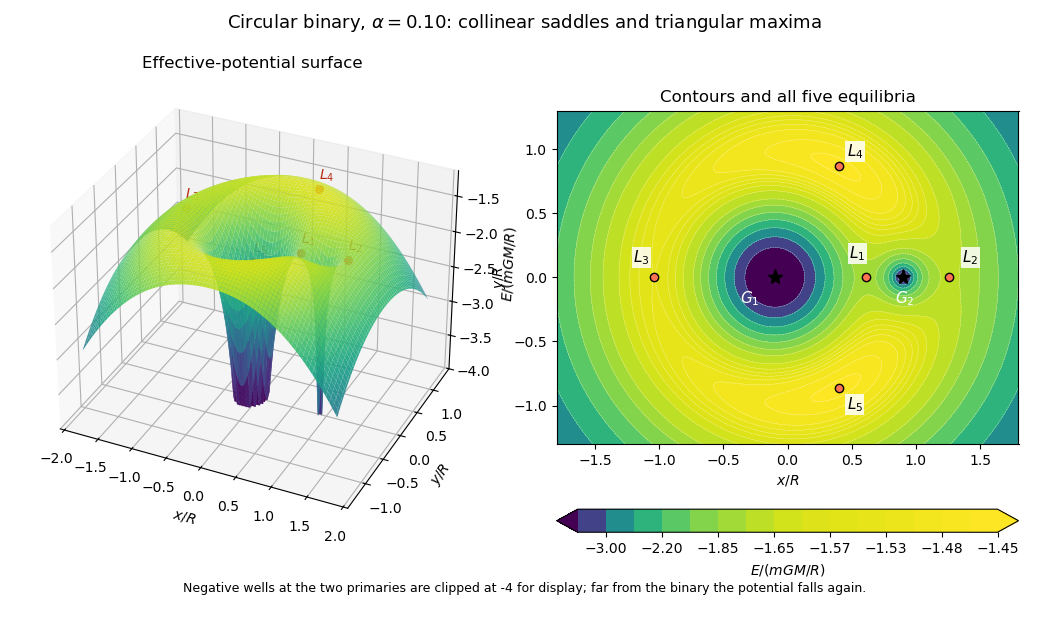
Rotating binary effective-potential surface and contours at mass fraction 0.10, with all five Lagrange points marked
. Details. Pinned article: Introduction to the OurBigBook Project
Welcome to the OurBigBook Project! Our goal is to create the perfect publishing platform for STEM subjects, and get university-level students to write the best free STEM tutorials ever.
Everyone is welcome to create an account and play with the site: ourbigbook.com/go/register. We belive that students themselves can write amazing tutorials, but teachers are welcome too. You can write about anything you want, it doesn't have to be STEM or even educational. Silly test content is very welcome and you won't be penalized in any way. Just keep it legal!
Intro to OurBigBook
. Source. We have two killer features:
- topics: topics group articles by different users with the same title, e.g. here is the topic for the "Fundamental Theorem of Calculus" ourbigbook.com/go/topic/fundamental-theorem-of-calculusArticles of different users are sorted by upvote within each article page. This feature is a bit like:
- a Wikipedia where each user can have their own version of each article
- a Q&A website like Stack Overflow, where multiple people can give their views on a given topic, and the best ones are sorted by upvote. Except you don't need to wait for someone to ask first, and any topic goes, no matter how narrow or broad
This feature makes it possible for readers to find better explanations of any topic created by other writers. And it allows writers to create an explanation in a place that readers might actually find it.
Figure 1. Screenshot of the "Derivative" topic page. View it live at: ourbigbook.com/go/topic/derivativeVideo 2. OurBigBook Web topics demo. Source. - local editing: you can store all your personal knowledge base content locally in a plaintext markup format that can be edited locally and published either:This way you can be sure that even if OurBigBook.com were to go down one day (which we have no plans to do as it is quite cheap to host!), your content will still be perfectly readable as a static site.
- to OurBigBook.com to get awesome multi-user features like topics and likes
- as HTML files to a static website, which you can host yourself for free on many external providers like GitHub Pages, and remain in full control

Figure 2. You can publish local OurBigBook lightweight markup files to either OurBigBook.com or as a static website.
Figure 3. Visual Studio Code extension installation.
Figure 5. . You can also edit articles on the Web editor without installing anything locally. Video 3. Edit locally and publish demo. Source. This shows editing OurBigBook Markup and publishing it using the Visual Studio Code extension. 
- Infinitely deep tables of contents:



All our software is open source and hosted at: github.com/ourbigbook/ourbigbook
Further documentation can be found at: docs.ourbigbook.com
Feel free to reach our to us for any help or suggestions: docs.ourbigbook.com/#contact