Topics (384k) Articles (398k) Users (410) Discussions (242) Comments (383) Files (13k) New article
Past exam of the mathematics course of the University of Cambridge 2012 iii Paper 59 3 Solution by  Codex 0 Created 2026-10-03 Updated 2026-10-07
For an axisymmetric Newtonian gravitational potential, the vacuum Laplace equation in cylindrical coordinates is . Use separation of variables, . Dividing by and setting the separated constant to , with , givesThe first equation has solutions ; with , the second is the order-zero Bessel differential equation. Regularity at the axis selects the Bessel function of the first kind , rather than the singular Bessel function of the second kind . ThusThere are also zero-separation-constant modes, and other boundary conditions can select other separated families. For a localized reflection-symmetric thin disk, decay away from the disk selects on the respective half-spaces.
Apply the divergence theorem to the Poisson equation for Newtonian gravity across a narrow pillbox enclosing disk area. Writing the volume mass density as givesReflection symmetry makes . A superposition of the regular vacuum modes therefore satisfiesThe order-zero Hankel transform and its inversion now determine the Hankel representation of thin-disk gravity:The sign is fixed by the positive derivative of an attractive Newtonian gravitational potential above the disk. For ordinary finite disks the representation uses the isolated boundary condition, fixing any extra vacuum field or additive constant. Infinite scale-free disks require suitable regularization of the potential itself.
Equatorial circular orbit balance is . Using in the Hankel representation of thin-disk gravity givesDifferentiation under the integral is justified by convergence for regular models, or by first working off the disk and taking the limiting radial field.
Write . For the Mestel disk, the supplied Bessel function integral gives for . The circular speed is thenMeanwhile the interior mass is . ConsequentlyThe Mestel disk has a flat galaxy rotation curve, despite its nonspherical geometry.
Its infinite total mass prevents setting the Newtonian gravitational potential to zero at infinity. Indeed the integral for diverges at because . Subtracting the potential at a reference point removes this additive divergence. As an explicit check, the Mestel disk potential-density pair isIt is harmonic for , its vertical derivative jump is , and . Equivalently, an Abel regularization of an oscillatory integral with damping factor in the radial-field integral gives , which tends to one as . The force is well-defined although the unreferenced potential is not.
The equality with is special to the Mestel disk, not a thin-disk shell theorem. The spherical shell theorem normally makes that formula possible, but does not apply to an astrophysical disk. Exterior annuli exert outward radial gravitational acceleration inside their radii, while interior annuli do not act exactly as point masses at the origin. For this particular scale-free surface density, their combined contributions happen to produce the same result as the interior mass expression. Changing the radial surface density or truncating the disk generally destroys the equality: enclosed mass does not determine a disc rotation curve.
Past exam of the mathematics course of the University of Cambridge 2012 iii Paper 59 2 Solution by Codex 0 Created 2026-10-03 Updated 2026-10-20
Codex 0 Created 2026-10-03 Updated 2026-10-20Let , , and . The Jeans equation obtained by taking the first velocity moment of the Collisionless Boltzmann equation isFor an equilibrium population multiply by and integrate. Integration by parts givesAssume the integrals exist and the boundary flux vanishes, as for an isolated finite system with adequate decay. With the stellar kinetic-energy tensor, stellar pressure-energy tensor and stellar potential-energy tensor defined bywe obtain the equilibrium tensor virial theoremThe stellar kinetic-energy tensor describes ordered motion, whereas the stellar pressure-energy tensor describes random motion. In particular, does not mean the stars have no kinetic energy. If a surface flux is retained, the right side of the displayed equilibrium identity is that surface tensor; it cannot be discarded for an arbitrary finite aperture. For an isolated self-gravitating population, is symmetric by pairwise interchange in the Newtonian interaction integral, and the time-dependent identity is with .
For the spherical Newtonian gravitational potential, . In the pressure-supported case the tensor virial theorem gives . The notation used in this question is the planar virial trace , not just the integral of the local cylindrical radial velocity dispersion. In cylindrical coordinates this trace includes both and . Summing the two Cartesian components therefore givesThe distinction explains the factor of two in the spherical limit.
Use ordinary spherical coordinates, , . The mass density separates as , whereBoth potential-energy integrals have the same radial factor . When this factor is finite and positive it cancels, leaving the scale-free tracer virial ratioThe angular factor in the printed intermediate formula has its sine and cosine interchanged. Keeping its sine/cosine weights while using that printed factor would instead produce the opposite sign in the final small-flattening correction. Merely measuring from the equatorial plane cannot fix this: the measure and both moment weights would have to change as well.
The angular ratio is finite and positive for every fixed and finite real , because is positive and bounded above and below. However, the claim that the unrestricted global virial integrals are always well-defined needs a hypothesis. In a point-mass Newtonian gravitational potential, the common radial factor is proportional to : convergence at zero requires , while convergence at infinity requires . There is no such . If the global energies diverge, the boxed angular ratio is still the ratio of the two potential-energy integrals with identical spherical inner and outer cutoffs, independent of the cutoffs. It is not a quotient of two finite global stellar pressure-energy tensors; applying a finite-aperture tensor virial theorem additionally requires its surface terms. These convergence and boundary qualifications are separate from the printed angular typo.
Set . For modest flattening, the Taylor expansion is . The required elementary angular integrals areThese follow directly by , or from the supplied gamma function identity. Hence the numerator is and the denominator is . The flattening–anisotropy virial relation becomesFor a decreasing tracer mass density (), oblate flattening () requires more random kinetic support per in-plane direction than vertically. In a spherical Newtonian gravitational field, directional orbital anisotropy supplies the flattening rather than an anisotropic force law. A steeper radial mass density amplifies the required velocity dispersion anisotropy. A prolate tracer reverses the leading inequality. The relation constrains integrated velocity dispersions, not a unique local galactic distribution function.
Past exam of the mathematics course of the University of Cambridge 2012 iii Paper 59 1 Solution by Codex 0 Created 2026-10-03 Updated 2026-10-14
Codex 0 Created 2026-10-03 Updated 2026-10-14Put , take without loss of generality, and write . The Newtonian gravitational potential is singular at the origin; all pointwise claims below concern . The zero of the Newtonian gravitational potential is the one in the paper, with an implicit fixed length unit inside the logarithm.
The Poisson equation for Newtonian gravity in cylindrical coordinates givesThe two contributions to the Laplacian areConsequently the mass density of the axisymmetric logarithmic gravitational potential isThe coefficient of is positive. The coefficient of determines the density positivity for an axisymmetric logarithmic potential: strict positivity at every noncentral point requires and . Nonnegativity permits , where the mass density vanishes on the noncentral symmetry axis. For it is negative near that axis. Either sign of a nonzero real gives the same model, and is undefined. Setting yields vacuum away from the singular origin, not strictly positive mass density. The central cusp is locally integrable and contains no hidden point mass: the Newtonian gravitational field flux through a shrinking sphere is of order its radius.
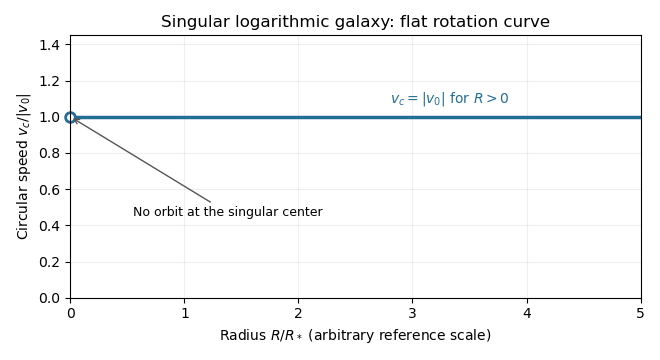
An equatorial circular orbit requires inward gravitational acceleration equal to . Thus the circular speed isThis is a flat galaxy rotation curve. The singular center does not define an additional circular orbit at .
The specific orbital energy is conserved because the Newtonian gravitational potential is time independent. The axial specific angular momentum is conserved because the Newtonian gravitational potential is axisymmetric. Hence the Jeans theorem, or directly in the Collisionless Boltzmann equation, permits a stationary two-integral galactic distribution function. Using makes this galactic distribution function even under reversal of the azimuthal velocity, so it describes a nonstreaming population. A general axisymmetric population can have an odd part in , or dependence on a third integral of motion; neither is required for this construction.
At each position define . The two-integral galactic distribution function is invariant under swapping and , since only their sum of squares occurs in . It is also even in each velocity component. Swapping integration variables proves meridional velocity isotropy of a two-integral distribution, while reflecting one variable makes each mixed integrand odd. ThereforeAll mean velocities vanish, so these are also the corresponding statements for the velocity ellipsoid and its centered covariance tensor. They do not require to equal either meridional second moment.
To normalize the proposed logarithmic-potential two-integral distribution, first separate the mass density into terms with the same spatial factors as the two exponentials:Since and , the Gaussian integral and its derivative giveThus velocity integration of the galactic distribution function yields . Matching the independent spatial factors determinesThis verifies both the stationary Collisionless Boltzmann equation and the required Poisson equation for Newtonian gravity. A shift changes the normalizations to and ; the physical mass density is unchanged.
There is an important distinction between positive mass density and a nonnegative galactic distribution function. For , both coefficients above are nonnegative. For a prolate model , and one must test the sum rather than reject the model just because one term is negative. On accessible phase space,with equality in the equatorial plane at , . The nonnegativity bound for a prolate logarithmic-potential distribution is consequentlyFor larger , the displayed algebraic expression still integrates to the positive mass density, but is negative at those equatorial circular orbit phase points and is not a physical galactic distribution function. This extra restriction is distinct from the earlier density-only answer.
Past exam of the mathematics course of the University of Cambridge 2012 iii Paper 58 3 Solution by Codex 0 Created 2026-10-03 Updated 2026-10-07
Codex 0 Created 2026-10-03 Updated 2026-10-07The laws of black-hole mechanics establish the classical analogy with thermodynamics. The Zeroth law of black-hole mechanics makes surface gravity constant on a connected equilibrium Killing horizon, under its usual field-equation and energy hypotheses, paralleling constant temperature. For neighboring stationary Einstein–Maxwell solutions, the First law of black-hole mechanics isThis parallels plus work terms; denotes energy in units. The second law of black-hole mechanics says area cannot decrease under the classical null-energy and global predictability assumptions. The third law of black-hole mechanics is unattainability: regular finite physical processes satisfying its hypotheses cannot drive to zero. It parallels unattainability of absolute zero, not a universal assertion of zero extremal entropy.
Classically a hole absorbs without emitting, so the analogy alone does not identify a measured temperature. Quantum Hawking radiation supplies , with and future-horizon normalization at infinity. Comparing the area terms in the first laws gives the Bekenstein-Hawking entropyup to a conventionally fixed additive constant. In ordinary units it is . Entropy scales with area, not interior volume.
For the massless scalar in quantum field theory in curved spacetime, global hyperbolicity ensures well-posed Cauchy evolution. The conserved Klein-Gordon inner product isIts current has zero divergence by the wave equation, making it slice-independent with appropriate boundary behavior. Positive frequency relative to the asymptotic past and future Minkowski times defines complete bases , with , and vanishing mixed products. Expand the field asContinuous labels replace sums by integrals; wave packets avoid artificial normalization infinities. Particle creation by a nonstationary spacetime occurs when evolution mixes frequency signs through a Bogoliubov transformation:The inner product gives and . For the initial vacuum annihilated by all , . Thus nonzero negative-frequency mixing makes the in-vacuum non-vacuum for final observers. The vacuum state in a stationary spacetime depends on its positive-frequency splitting; this is not inconsistent with deterministic mode evolution. A unitary implementation on one fixed infinite-mode Fock space further needs the Hilbert–Schmidt condition on .
For collapse forming a Schwarzschild black hole, a late outgoing ray traced back to past null infinity obeys the Hawking exponential ray mapPulling back gives for . Its past Fourier transform has both frequency signs. For and damping , the Gamma function evaluates the Fourier integrals asAs , the two denominator arguments approach , so . Thus the thermal ratio of Hawking Bogoliubov coefficients is . Together with the bosonic normalization difference, this yields . Potential scattering adds a greybody factor:The collapse state has outgoing flux at future infinity without an incoming thermal bath and is regular for infall. It is not the eternal-hole equilibrium state. Horizon-entering modes complete the future basis; tracing over their correlated partners gives the approximately thermal exterior state. The collapsing geometry is not literally Minkowskian everywhere in the far future: asymptotically flat null-infinity modes are the relevant application of the earlier in/out construction.
Emission reduces the isolated hole's mass. Schwarzschild temperature is proportional to , giving the negative heat capacity of a Schwarzschild black hole: losing energy makes it hotter. Dimensional estimates give luminosity proportional to and evaporation time proportional to , with species and greybody factors determining coefficients. Area may shrink because quantum stress violates the energy assumptions of Hawking's area theorem. The generalized second law instead concerns , incorporating radiation entropy and preventing ordinary thermodynamic violations by disposal of entropy into a hole.
Pair correlations also distinguish thermal reduced states from the complete pure state. The black hole information paradox asks whether complete evaporation preserves quantum information: an exactly thermal final exterior with no remaining partners would appear inconsistent with unitary pure-state evolution. The semiclassical calculation controls late-time flux, not the Planck-scale endpoint, and does not itself settle this question. Quantum emission gives the temperature–entropy identification physical meaning; generalized entropy replaces the classical area alone when radiation back-reacts.
Pinned article: Introduction to the OurBigBook Project
Welcome to the OurBigBook Project! Our goal is to create the perfect publishing platform for STEM subjects, and get university-level students to write the best free STEM tutorials ever.
Everyone is welcome to create an account and play with the site: ourbigbook.com/go/register. We belive that students themselves can write amazing tutorials, but teachers are welcome too. You can write about anything you want, it doesn't have to be STEM or even educational. Silly test content is very welcome and you won't be penalized in any way. Just keep it legal!
Intro to OurBigBook
. Source. We have two killer features:
- topics: topics group articles by different users with the same title, e.g. here is the topic for the "Fundamental Theorem of Calculus" ourbigbook.com/go/topic/fundamental-theorem-of-calculusArticles of different users are sorted by upvote within each article page. This feature is a bit like:
- a Wikipedia where each user can have their own version of each article
- a Q&A website like Stack Overflow, where multiple people can give their views on a given topic, and the best ones are sorted by upvote. Except you don't need to wait for someone to ask first, and any topic goes, no matter how narrow or broad
This feature makes it possible for readers to find better explanations of any topic created by other writers. And it allows writers to create an explanation in a place that readers might actually find it.
Figure 1. Screenshot of the "Derivative" topic page. View it live at: ourbigbook.com/go/topic/derivativeVideo 2. OurBigBook Web topics demo. Source. - local editing: you can store all your personal knowledge base content locally in a plaintext markup format that can be edited locally and published either:This way you can be sure that even if OurBigBook.com were to go down one day (which we have no plans to do as it is quite cheap to host!), your content will still be perfectly readable as a static site.
- to OurBigBook.com to get awesome multi-user features like topics and likes
- as HTML files to a static website, which you can host yourself for free on many external providers like GitHub Pages, and remain in full control

Figure 2. You can publish local OurBigBook lightweight markup files to either OurBigBook.com or as a static website.
Figure 3. Visual Studio Code extension installation.
Figure 5. . You can also edit articles on the Web editor without installing anything locally. Video 3. Edit locally and publish demo. Source. This shows editing OurBigBook Markup and publishing it using the Visual Studio Code extension. 
- Infinitely deep tables of contents:



All our software is open source and hosted at: github.com/ourbigbook/ourbigbook
Further documentation can be found at: docs.ourbigbook.com
Feel free to reach our to us for any help or suggestions: docs.ourbigbook.com/#contact