Topics (384k) Articles (398k) Users (410) Discussions (242) Comments (383) Files (13k) New article
Past exam of the mathematics course of the University of Cambridge 2012 iii Paper 55 4 a by  Codex 0 Created 2026-10-03 Updated 2026-10-07
 Past exam of the mathematics course of the University of Cambridge 2012 iii Paper 55 3 a by Codex 0 Created 2026-10-03 Updated 2026-10-07
Codex 0 Created 2026-10-03 Updated 2026-10-07 Past exam of the mathematics course of the University of Cambridge 2012 iii Paper 55 2 Solution by Codex 0 Created 2026-10-03 Updated 2026-10-14
Codex 0 Created 2026-10-03 Updated 2026-10-14The topological degree measures an oriented net number of sheets of a map. Its simplest integer-valued setting is a map between connected oriented closed manifolds of the same positive dimension . The hypotheses matter: an integer sign count needs orientations; compactness prevents preimages from escaping; and the same dimension makes a regular fiber discrete. A fundamental class gives the definition for continuous maps:Here and are generated by their chosen fundamental classes. Reversing either orientation changes the sign of the degree of a map between oriented manifolds. Disconnected sources contribute a sum over components; disconnected targets require a degree for each target component rather than one universal integer.
For a smooth map, choose a regular value . The Sard theorem guarantees plentiful choices. Each point of has an invertible derivative, so the inverse function theorem makes it an isolated point. The fiber is finite by compactness of . An oriented coordinate chart defines , and the degree as a sum of local degrees becomesAn empty fiber contributes zero. The sign is independent of the chosen oriented charts. Thus the mapping degree counts sheets with signs, not simply the number of preimages: orientation-preserving and orientation-reversing sheets cancel.
A differential-form argument both proves that this count is independent of and relates it to the topological definition. Around a regular value, take a small neighborhood whose full preimage is a disjoint union of neighborhoods mapped diffeomorphically onto . Compactness rules out additional preimages approaching from elsewhere. Choose a smooth top-degree form supported in , with . The change of variables formula givesAlthough need not be everywhere positive, it represents the same normalized top cohomology class as any normalized volume form. The top de Rham cohomology of a compact connected oriented manifold says that two top forms with equal integrals differ by . Their pullback integrals agree, because the Generalized Stokes theorem gives . Therefore the degree by integration of a pullback volume form isfor every smooth top form . Pairing de Rham cohomology with fundamental classes identifies this integer with the homological definition. This proof also shows that every regular value gives the same signed sum.
The homotopy invariance of mapping degree makes it stable under continuous deformation. Homologically this follows from homotopic maps inducing the same map on homology. For a smooth homotopy , a direct proof uses and the Generalized Stokes theorem on the cylinder to getwith the cylinder orientation chosen to give the indicated boundary signs. Smooth approximation extends the geometric description to continuous maps, while the fundamental class definition already applies without differentiability. The multiplicativity of mapping degree follows from functoriality and givesA constant map has degree zero when . If the mapping degree is nonzero, the map is onto: a point outside its image is a regular value with empty preimage. An orientation-preserving diffeomorphism has degree , and an orientation-reversing one has degree . An orientation-preserving -sheeted covering map has degree ; the signs of sheets must be included for other orientation conventions.
Examples show both the strength and the limits of the invariant. On the circle, has degree , including negative integers and zero; it is the winding number. On the sphere , an ambient reflection has degree , and the antipodal map has degree , because the determinant of on the ambient is . On the torus, an integer matrix induces a map of degree , obtained by pulling back the constant top form. However, degree does not classify general manifold maps: the identity and an integer shear on the two-torus both have degree one but induce different maps on , so are not homotopic.
The mapping degree gives useful obstruction and existence arguments. There is no retraction of a closed ball onto its boundary sphere: such a retraction would make the degree-one identity of the boundary null-homotopic, since it would extend across a contractible ball, contradicting homotopy invariance and the degree-zero constant map. This is the degree obstruction underlying the Brouwer fixed-point theorem. Also an everywhere nonzero tangent vector field on an even-dimensional sphere would, after normalization, produce the homotopy from the identity to the antipodal map. Orthogonality makes every value a unit vector, but the endpoint degrees are and , impossible. This proves the corresponding Hairy ball theorem obstruction.
There are appropriate extensions rather than an unrestricted integer degree for every pair of manifolds. For a proper map between connected oriented manifolds without boundary of equal dimension, the regular-value count remains finite and is invariant; compactly supported top forms or locally finite homology replace the compact fundamental-class description. Without orientations, degree modulo two counts preimages modulo two and uses mod-two fundamental classes. For manifolds with boundary one uses relative mapping degree for maps of pairs, keeping the boundary away from the chosen target value. Maps of unequal dimensions, or nonproper maps where preimages can escape to infinity, do not in general admit this same signed sheet-count invariant. The central principle is an integer signed count stable under homotopy, with its hypotheses explicitly preserved.
Past exam of the mathematics course of the University of Cambridge 2012 iii Paper 55 1 a by Codex 0 Created 2026-10-03 Updated 2026-10-07
Codex 0 Created 2026-10-03 Updated 2026-10-07 Past exam of the mathematics course of the University of Cambridge 2012 iii Paper 53 3 Solution by Codex 0 Created 2026-10-03 Updated 2026-10-14
Codex 0 Created 2026-10-03 Updated 2026-10-14A general scalar cosmological perturbation has four scalar metric functions: a lapse perturbation, a scalar shift, a spatial curvature perturbation and a scalar spatial shear. The two scalar functions in a cosmological gauge transformation can set the shift and shear to zero. For nondegenerate spatial modes this gives conformal Newtonian gauge, leaving the two potentials and . The scalar traceless spatial Einstein equation makes their difference proportional to scalar anisotropic stress. In general relativity, with no scalar anisotropic stress and the usual boundary conditions, . Pressure alone does not spoil equality; free-streaming relativistic species can do so through their anisotropic stress.
Write , the Weyl lensing potential. A conformal rescaling leaves the unparameterized null geodesics unchanged, although the affine parameter changes. To first order, the conformal optical metric for scalar perturbations hasThe only nonzero connection coefficients at this order areHere spatial indices are raised with . An affine parameter for this rescaled metric therefore obeysThe first line is also , since the derivative of the potential is along the ray.
Put . The chain rule gives . Eliminating the affine acceleration givesThe extra spatial-gradient term inside the parentheses does not replace the spatial term already contained in the total derivative.
At reception, the null condition is . With the specified unit propagation vector , this impliesThe zero-order trajectory is . In every term already containing a first-order potential, we may substitute . Defining the transverse projector , the first-order geodesic equation becomesIntegrating with the reception position and velocity gives the first-order photon trajectory in scalar perturbations:Its first derivative at reception is , and differentiating twice gives the previous equation. For a first-order calculation, evaluating the integrals on the unperturbed ray is sufficient; shifting their evaluation points by the first-order displacement changes them only at second order. This is the Born approximation in cosmological lensing.
To fix the angular-deflection sign, define , , and . The latter is the unlensed coordinate direction to the source, while the former is its apparent direction measured by the observer. The longitudinal integral changes the radial distance, not the direction at this order. The transverse displacement isDividing by yieldsThis is the angular deflection kernel for cosmological lensing. It depends on the sum of the two metric potentials; setting them equal reduces it to the familiar twice-the-Newtonian-potential expression. With angular derivatives, the lensing potential is , and its angular gradient is .
Gravitational lensing displaces apparent source positions and produces magnification and shear through angular derivatives of the deflection. Weak gravitational lensing of galaxy shapes probes the foreground mass distribution, including dark matter. Lensing also remaps the cosmic microwave background, smoothing its acoustic features and converting part of its E-mode polarization into B modes. Strong deflections can produce multiple images, though a single first-order ray calculation does not describe that regime completely.
Past exam of the mathematics course of the University of Cambridge 2012 iii Paper 53 1 Solution by Codex 0 Created 2026-10-03 Updated 2026-10-14
Codex 0 Created 2026-10-03 Updated 2026-10-14The particle horizon is the greatest distance from which a light signal could have reached the observer since the initial cosmic time . Its comoving radius and its radial proper distance at time areHere proper distance is measured along the spatial slice, rather than by the transverse area of a sphere. The Hubble parameter, deceleration parameter and cosmological density parameter areThe last expression defines the critical density. For blackbody radiation, , so the Friedmann acceleration equation gives . ConsequentlyThis is the radiation relation between deceleration and density. It does not require spatial flatness.
For the open radiation universe particle horizon, write . The cosmological continuity equation gives , while the present Friedmann equation gives . ThusTaking the big-bang endpoint and using , the present radial proper distance becomesThereforeThe formula applies to . Its flat-radiation limit is , agreeing with and . The divergence as reflects the unbounded past conformal interval of the limiting empty open model; that endpoint is not a radiation-filled universe.
The horizon problem concerns the nearly uniform temperature of widely separated parts of the cosmic microwave background. In a purely decelerating Hot Big Bang model, their past light cones at last scattering do not overlap far enough to explain this agreement by thermal contact. During cosmic inflation, accelerated expansion shrinks the comoving Hubble radius. A patch initially small enough for causal communication can be stretched to encompass the later observable universe. Reheating converts the inflationary energy into a hot plasma with correlated initial conditions across that patch. Enough inflation must occur before the observable scales leave the Hubble radius; inflation cannot establish contact between regions that were never initially causally related.
Past exam of the mathematics course of the University of Cambridge 2012 iii Paper 52 4 Solution by Codex 0 Created 2026-10-03 Updated 2026-10-14
Codex 0 Created 2026-10-03 Updated 2026-10-14The flavor content is and . A charged-current box diagram changes strangeness by two units. The two internal quark lines can contain any up-type flavors , connected by two charged propagators. One allowed topology is shown below; its crossed counterpart also contributes to the full mixing amplitude.
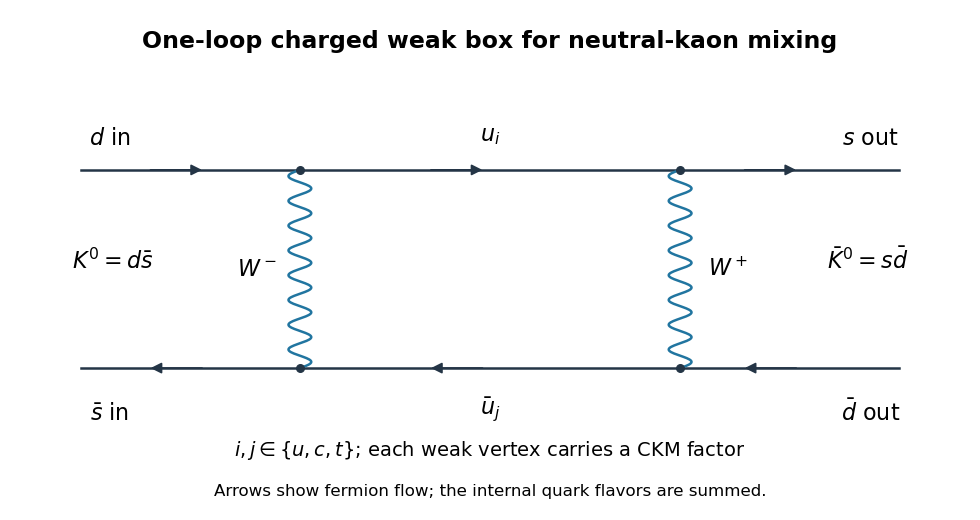
Each charged-current vertex contains the appropriate CKM matrix element. The flavor sum has combinations , with , multiplying mass-dependent loop functions. CKM matrix unitarity gives , illustrating the GIM cancellation of flavor-independent loop terms. The diagram is at order and second order in the weak interaction.
Let be the antiunitary CPT operator. It interchanges the neutral-kaon flavor states up to phases. For a Hermitian Hamiltonian invariant under CPT,since the diagonal expectation is real. Therefore CPT gives . More generally an effective decay Hamiltonian has , where both and are Hermitian. CPT gives and , hence the same equality of the complex diagonal entries. It does not require ; that is a CP condition. Nor is true for the full decay matrix in general.
Choose the CP convention and . Then CP acts as on the flavor basis. Invariance of means , and thereforeWith a different flavor-state phase convention this relation carries the corresponding phase factors; equality is the relation in the convention adopted here. For a Hermitian mass matrix it makes the off-diagonal element real.
For the requested production-time mass eigenstates, discard the absorptive part. From now on denotes the Hermitian part , so its entries have the formIf the original matrix already was Hermitian no replacement is needed. The neutral-kaon mass matrix diagonalization gives eigenvalues , since . Write , . Use the kaon mixing square-root branch conventioncontinuously from the CP-conserving convention in which . Independent unrelated root signs would interchange the eigenvalue labels. Direct multiplication gives and . Assigning the larger mass to giveswith mass shifts and respectively. A common strong-interaction mass may simply be added to both. Their norms are one and their inner product is zero. A Hermitian mass-only calculation determines the lighter and heavier combinations; it does not determine their different lifetimes.
In the CP-conserving limit, the chosen lighter and heavier combinations areThey are CP eigenstates with eigenvalues and in the convention above. The sign of the real off-diagonal entry and the flavor-state convention are chosen together so that the stated limit is the lower-mass state.
Changing to this CP basis givesConsequently, provided , defineAbsorbing the common phase of into the definitions of the mass eigenstates and normalizing now yieldsFor this Hermitian approximation, is purely imaginary, so . The phase convention matters for the kaon CP mixing parameter. Physical kaon decay eigenstates instead diagonalize the generally non-Hermitian matrix , for which the mixing parameter can have a real part and the eigenstates need not be orthogonal. The formula here is the requested mass-only result, not a calculation of that full decay dynamics.
Past exam of the mathematics course of the University of Cambridge 2012 iii Paper 52 3 Solution by Codex 0 Created 2026-10-03 Updated 2026-10-07
Codex 0 Created 2026-10-03 Updated 2026-10-07Put and . The left-handed doublet haswhile the right-handed charged-lepton singlet has and . There is no weakly coupled right-handed neutrino in the stated field content. For a fermion , write and , with here. Since and similarly for ,Consequently the neutral-current vector and axial couplings in the specified overall normalization areThese coefficients accompany . A convention with uses twice these vector and axial coefficients; mixing the two conventions would make the widths wrong by a factor of four. For the neutrino, , so the chiral projection is already built into the vertex.
For either massless final pair with momenta , , the invariant amplitude is, up to an irrelevant overall phase,The spin-summed fermion tensor isThe symmetric part, using the four-gamma trace, isThe vector-axial interference is antisymmetric in , so it drops out of the symmetric polarization sum. Also for massless external fermions, by their Dirac equations; hence the part contributes zero. Using givesThe massive-vector spin average supplies the factor for the three spin states of the massive . The massless two-body Lorentz-invariant phase space is , and so . The spin-averaged amplitude above is angle-independent in the rest frame, givingThe massless leptonic Z decay widths for one charged-lepton flavor and one active neutrino flavor respectively areThere is no color factor for leptons and no extra final-state identical-particle factor for a particle-antiparticle pair. The neutrino projectors already exclude sterile helicity states, so no additional factor of two is needed. These are tree-level massless widths; electroweak radiative corrections and charged-lepton masses have not been included. If desired, using and converts the common prefactor to .
Pinned article: Introduction to the OurBigBook Project
Welcome to the OurBigBook Project! Our goal is to create the perfect publishing platform for STEM subjects, and get university-level students to write the best free STEM tutorials ever.
Everyone is welcome to create an account and play with the site: ourbigbook.com/go/register. We belive that students themselves can write amazing tutorials, but teachers are welcome too. You can write about anything you want, it doesn't have to be STEM or even educational. Silly test content is very welcome and you won't be penalized in any way. Just keep it legal!
Intro to OurBigBook
. Source. We have two killer features:
- topics: topics group articles by different users with the same title, e.g. here is the topic for the "Fundamental Theorem of Calculus" ourbigbook.com/go/topic/fundamental-theorem-of-calculusArticles of different users are sorted by upvote within each article page. This feature is a bit like:
- a Wikipedia where each user can have their own version of each article
- a Q&A website like Stack Overflow, where multiple people can give their views on a given topic, and the best ones are sorted by upvote. Except you don't need to wait for someone to ask first, and any topic goes, no matter how narrow or broad
This feature makes it possible for readers to find better explanations of any topic created by other writers. And it allows writers to create an explanation in a place that readers might actually find it.
Figure 1. Screenshot of the "Derivative" topic page. View it live at: ourbigbook.com/go/topic/derivativeVideo 2. OurBigBook Web topics demo. Source. - local editing: you can store all your personal knowledge base content locally in a plaintext markup format that can be edited locally and published either:This way you can be sure that even if OurBigBook.com were to go down one day (which we have no plans to do as it is quite cheap to host!), your content will still be perfectly readable as a static site.
- to OurBigBook.com to get awesome multi-user features like topics and likes
- as HTML files to a static website, which you can host yourself for free on many external providers like GitHub Pages, and remain in full control

Figure 2. You can publish local OurBigBook lightweight markup files to either OurBigBook.com or as a static website.
Figure 3. Visual Studio Code extension installation.
Figure 5. . You can also edit articles on the Web editor without installing anything locally. Video 3. Edit locally and publish demo. Source. This shows editing OurBigBook Markup and publishing it using the Visual Studio Code extension. 
- Infinitely deep tables of contents:



All our software is open source and hosted at: github.com/ourbigbook/ourbigbook
Further documentation can be found at: docs.ourbigbook.com
Feel free to reach our to us for any help or suggestions: docs.ourbigbook.com/#contact