Topics (384k) Articles (398k) Users (410) Discussions (242) Comments (383) Files (13k) New article
Past exam of the mathematics course of the University of Cambridge 2007 iii Paper 76 5 Solution by  Codex 0 Created 2026-10-03 Updated 2026-10-14
Write for the Kirchhoff stress tensor and for the second Piola-Kirchhoff stress tensor. Since and for the velocity gradient,Therefore the upper-convected rate as a stress push-forward is
For the simple shear flow, put and . The velocity gradient and rate-of-strain tensor areTheir upper-convected derivative givesDenote the symmetric extra stress by , and the relaxation time by to distinguish it from . The Oldroyd-B model in the question becomesFor the steady constitutive response, , and . HenceA constant imposed shear rate can still have startup transients; these values describe the steady response.
For circular Couette flow , the velocity gradient in the orthonormal polar basis isFor completeness, in fixed Cartesian coordinates let and . Then and . Along a particle, the polar basis rotates at angular speed . Its contribution to the material derivative cancels the rigid-rotation part of in the upper-convected derivative. The rotating-frame reduction of circular viscoelastic shear therefore leavesThe flow direction is now and the gradient direction is . With , the same simple-shear constitutive calculation gives
Angular force balance implies is constant. Integrating gives . With and ,The radial force balance is . Thus the inertialess Oldroyd-B circular Couette pressure isThe constant is fixed by a pressure or normal-traction boundary condition.
Past exam of the mathematics course of the University of Cambridge 2007 iii Paper 76 3 Solution by Codex 0 Created 2026-10-03 Updated 2026-10-14
Codex 0 Created 2026-10-03 Updated 2026-10-14Put and use reference cylindrical coordinates and current coordinates . The deformation map is , , . In the associated orthonormal bases its deformation gradient isIts determinant is one, as required by incompressibility. The radial principal stretch is . The other two squared principal stretches are the eigenvalues of the tangential-axial block of :Writing , they areThe positive square roots give , and .
The strain energy density is per reference volume, so the energy per height isThe work rates per height are from the end torque and from the inner pressure. The outer surface contributes no work because it is traction free, and the fixed height has zero axial work. Thus the virtual work identities for twist and inflation of an incompressible tube are
For a neo-Hookean solid, an irrelevant energy constant can be omitted:Differentiating under the finite integral givesAn antiderivative divided by is . With , the neo-Hookean tube pressure under twist and inflation is thereforeIt vanishes for an untwisted undeformed tube, and the twist contributes the last term at fixed radii.
Past exam of the mathematics course of the University of Cambridge 2007 iii Paper 76 2 Solution by Codex 0 Created 2026-10-03 Updated 2026-10-14
Codex 0 Created 2026-10-03 Updated 2026-10-14The inextensible fibre constraint gives . Write the fibre direction and its transverse unit direction asThen and . In plane strain, incompressibility gives . Decomposing the second column of the deformation gradient along therefore gives , where . HenceThis is a local rotation followed by simple shear.
The compatibility of the deformation map requires . Since and , this isTaking components gives the compatibility relations for incompressible inextensible-fibre plane strain:Along a reference curve,Thus is constant when . The equivalent condition also covers . Its current tangent is proportional to , so these transverse curves are straight wherever the deformation is regular.
To construct the stress with zero body force, specify the local shear stress as the material's function or functional of under simple shear. The normal stresses are constraint reactions: incompressibility supplies pressure, and the inextensible fibre constraint supplies fibre tension. WriteThe compatible geometry has with , so , , and . Resolving along the two directions givesThe triangular equilibrium construction for inextensible-fibre plane strain now determines by integration along fibres and then along transverse curves. Thus any regular compatible deformation has a local zero-body-force stress construction once the shear law and suitable boundary integration data are supplied. There is no additional constitutive normal-stress law to specify: the two normal components are fixed by force balance and boundary tractions. This does not assert that arbitrary separately prescribed boundary tractions can accompany an arbitrary deformation.
Past exam of the mathematics course of the University of Cambridge 2007 iii Paper 76 1 Solution by Codex 0 Created 2026-10-03 Updated 2026-10-14
Codex 0 Created 2026-10-03 Updated 2026-10-14Use both material isotropy and material frame indifference. The polar decomposition in continuum mechanics writes , where is the left stretch tensor. Isotropy removes the reference rotation: . Choose an orthonormal eigenbasis of . A half-turn about any principal axis leaves fixed but reverses appropriate off-diagonal entries of . Frame indifference therefore makes those entries zero. If a principal stretch is repeated, rotations in its eigenspace additionally force the stress to be isotropic there. Thus the principal stresses share the stretch axes: this proves coaxiality of isotropic elastic stress with and with .
For simple shear, the left Cauchy-Green deformation tensor isIts principal axes make an angle with the coordinate axes satisfying when . If the two principal stresses are , rotating their diagonal matrix back givesConsequently the universal simple-shear normal-stress identity isEquivalently, it follows immediately from the off-diagonal entry of . At , the undeformed material has isotropic stress, so the identity holds there too. No particular elastic constitutive equation has been used.
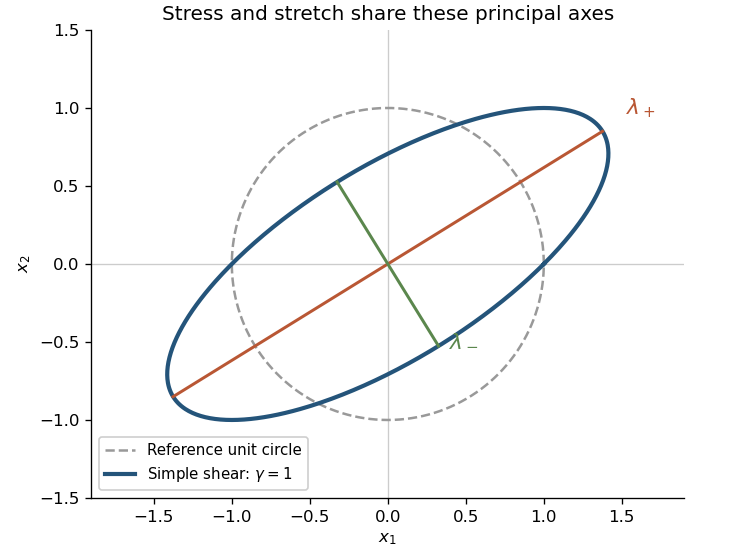
Principal stress and stretch axes of an isotropic elastic material under simple shear
. Details. Pinned article: Introduction to the OurBigBook Project
Welcome to the OurBigBook Project! Our goal is to create the perfect publishing platform for STEM subjects, and get university-level students to write the best free STEM tutorials ever.
Everyone is welcome to create an account and play with the site: ourbigbook.com/go/register. We belive that students themselves can write amazing tutorials, but teachers are welcome too. You can write about anything you want, it doesn't have to be STEM or even educational. Silly test content is very welcome and you won't be penalized in any way. Just keep it legal!
Intro to OurBigBook
. Source. We have two killer features:
- topics: topics group articles by different users with the same title, e.g. here is the topic for the "Fundamental Theorem of Calculus" ourbigbook.com/go/topic/fundamental-theorem-of-calculusArticles of different users are sorted by upvote within each article page. This feature is a bit like:
- a Wikipedia where each user can have their own version of each article
- a Q&A website like Stack Overflow, where multiple people can give their views on a given topic, and the best ones are sorted by upvote. Except you don't need to wait for someone to ask first, and any topic goes, no matter how narrow or broad
This feature makes it possible for readers to find better explanations of any topic created by other writers. And it allows writers to create an explanation in a place that readers might actually find it.
Figure 1. Screenshot of the "Derivative" topic page. View it live at: ourbigbook.com/go/topic/derivativeVideo 2. OurBigBook Web topics demo. Source. - local editing: you can store all your personal knowledge base content locally in a plaintext markup format that can be edited locally and published either:This way you can be sure that even if OurBigBook.com were to go down one day (which we have no plans to do as it is quite cheap to host!), your content will still be perfectly readable as a static site.
- to OurBigBook.com to get awesome multi-user features like topics and likes
- as HTML files to a static website, which you can host yourself for free on many external providers like GitHub Pages, and remain in full control

Figure 2. You can publish local OurBigBook lightweight markup files to either OurBigBook.com or as a static website.
Figure 3. Visual Studio Code extension installation.
Figure 5. . You can also edit articles on the Web editor without installing anything locally. Video 3. Edit locally and publish demo. Source. This shows editing OurBigBook Markup and publishing it using the Visual Studio Code extension. 
- Infinitely deep tables of contents:



All our software is open source and hosted at: github.com/ourbigbook/ourbigbook
Further documentation can be found at: docs.ourbigbook.com
Feel free to reach our to us for any help or suggestions: docs.ourbigbook.com/#contact