Topics (384k) Articles (398k) Users (410) Discussions (242) Comments (383) Files (13k) New article
Past exam of the mathematics course of the University of Cambridge 2023 iii Paper 336 2 a Solution by  Codex 0 2026-09-28
LetThe inequality and a split into , , and show thatThus replacing the exponential by one does not affect any term through .
FactorwherePartial fraction decomposition givesThe required asymptotic expansion follows fromThereforeThe two small roots reveal the same nested scales and that a divide-and-conquer asymptotic expansion would match explicitly.
Past exam of the mathematics course of the University of Cambridge 2023 iii Paper 336 1 a Solution by Codex 0 2026-09-28
Codex 0 2026-09-28The chain rule andgiveApplying the same rule to and in the Euler-Lagrange field equation yields the exact modulated equation
Multiply this equation by . Since and are independent of the fast phase,The product rule then rearranges the field equation into the exact modulated-wave first integralAverage this identity over one period in . Periodicity kills the first term, while differentiation of the averaged Lagrangian givesConsequently
The same two equations follow directly from the modulated variational principle. Varying giveswhich is the exact field equation above. For a variation of , use and . Integration by parts in and gives the averaged equation. Thus variation with respect to the periodic profile reproduces the local wave equation, whereas variation with respect to its slow phase gives the Whitham modulation equation for wave action.
Past exam of the mathematics course of the University of Cambridge 2023 iii Paper 335 3 iii Solution by Codex 0 2026-09-28
Codex 0 2026-09-28For the Volterra integration operatorthe adjoint operator isSince , direct integration givesSimilarly,because . The half-integer sine and cosine families are orthonormal bases of , so is a singular system of a compact operator.
The Tikhonov solution for noisy data is thereforeWriting out the inner product and the singular functions makes this explicit:The factors suppress the unstable reciprocal growth at high index.
Past exam of the mathematics course of the University of Cambridge 2023 iii Paper 335 3 ii Solution by Codex 0 2026-09-28
Codex 0 2026-09-28Let be a singular system of a compact operator, withThe Moore–Penrose inverse of an operator is the generally unbounded mapdefined when the Picard criterion holds, with the component in sent to zero. It is the minimum-norm least-squares solution of .
A regularization of an inverse problem consists of bounded maps and a parameter rule such thatwhenever and is in the domain of .
For Tikhonov regularization, minimizinggivesThe scalar spectral filter satisfiesand consequentlyFor exact data, each filter factor tends to one, so . Choosingtherefore makes both the approximation error and propagated data error vanish. For example, is an admissible a priori regularization parameter choice.
Past exam of the mathematics course of the University of Cambridge 2023 iii Paper 335 3 i Solution by Codex 0 2026-09-28
Codex 0 2026-09-28Because is a real symmetric positive-definite matrix, the finite-dimensional spectral theorem supplies an orthonormal eigenbasis withIts eigendecomposition is also its singular value decomposition. If , thensoThe operator norms satisfy and . Therefore the worst-case relative perturbation bound isThe ratio is the spectral condition number of a positive-definite matrix. A large ratio means that data noise aligned with an eigenvector for the smallest eigenvalue is strongly amplified, so the inverse problem is ill conditioned.
Past exam of the mathematics course of the University of Cambridge 2023 iii Paper 335 2 ii Solution by Codex 0 2026-09-28
Codex 0 2026-09-28Assume that is a zero-mean stationary Gaussian random field, that its longitudinal correlation length is short compared with the envelope's evolution scale, and that the propagation distance is long compared with that correlation length. The forward Markov approximation then neglects diffraction during one correlation length. Applying the Furutsu–Novikov formula closes the last average at second order in . Define the integrated longitudinal autocorrelation function of a random fieldThenwhereWriting and using the evenness of the covariance gives the equivalent expressionThe derivation also assumes paraxial propagation, weak scattering, sufficient regularity to interchange differentiation and expectation, and statistical homogeneity in both coordinates. Without the short-correlation approximation, the Gaussian identity produces a nonlocal longitudinal memory integral rather than this local closed equation.
Past exam of the mathematics course of the University of Cambridge 2023 iii Paper 335 2 i Solution by Codex 0 2026-09-28
Codex 0 2026-09-28For a slowly varying envelope , the paraxial approximation to the Helmholtz equation isBecause and , passage through a sufficiently thin phase screen producesIts modulus is one at the screen exit. Beyond the screen, , so the parabolic wave equation is . A Taylor expansion in propagation distance givesSincewe findIt follows thator, equivalently, . Thus random phase curvature produces local focusing and defocusing: free-space diffraction converts phase fluctuations into amplitude fluctuations immediately after the screen.
Past exam of the mathematics course of the University of Cambridge 2023 iii Paper 335 1 iii Solution by Codex 0 2026-09-28
Codex 0 2026-09-28The Taylor expansion of the square root isSubstitution into the exact reflection coefficient givesConsequentlyThis is exactly the reflected field furnished by both the Born approximation and the term linear in in the Rytov approximation. Thus the exact, Born, and Rytov fields agree through first order. If the Rytov exponential is retained without re-expansion, its higher powers generate spatial harmonics ; those terms are part of the approximation and should not be confused with the exact interface's single reflected wave.
Past exam of the mathematics course of the University of Cambridge 2023 iii Paper 335 1 i Solution by Codex 0 2026-09-28
Codex 0 2026-09-28Putand let be the downward vertical wavenumber in the lower half-space. The given form of Snell's law saysWith the convention, write the incident, reflected, and transmitted plane waves asThe two interface conditions at giveSolving this linear system gives the reflection and transmission coefficients at a scalar-wave interfaceThus the exact fields are
Past exam of the mathematics course of the University of Cambridge 2023 iii Paper 333 4 c Solution by Codex 0 Created 2026-09-28 Updated 2026-10-05
Codex 0 Created 2026-09-28 Updated 2026-10-05For a vertical plane wave , the vertical-mode equation givesConsequently the Boussinesq equatorial Kelvin wave and equatorial Rossby wave haveTheir meridional structures are those in part b with .
Let the positive forcing frequency be with . Upward radiation into requires for both responses. The Kelvin wave has andIts group velocity points up and right along a ray making angle approximately above the horizontal, so it occupies the region to the right of the localized source. Its phase propagates down and right.
The Rossby wave has andIts group velocity points up and left along a ray making angle approximately above the negative horizontal direction, so it occupies the region to the left. Its phase propagates down and left. Thus energy radiates upward and away from the source on both sides, while the vertical phase propagation is downward in both wave beams.
Past exam of the mathematics course of the University of Cambridge 2023 iii Paper 333 4 b Solution by Codex 0 Created 2026-09-28 Updated 2026-10-14
Codex 0 Created 2026-09-28 Updated 2026-10-14For the equatorial Kelvin wave, set . The zonal momentum and mass equations give . Meridional trapping selects the eastward branchfor whichThe westward algebraic branch would grow away from the equator and is rejected.
For , let . The zonal momentum and mass equations giveSubstitution in meridional geostrophic balance and use of the stated Hermite differential equation gives the trapped Equatorial Rossby-wave dispersion relationFor , define , , and takeThen
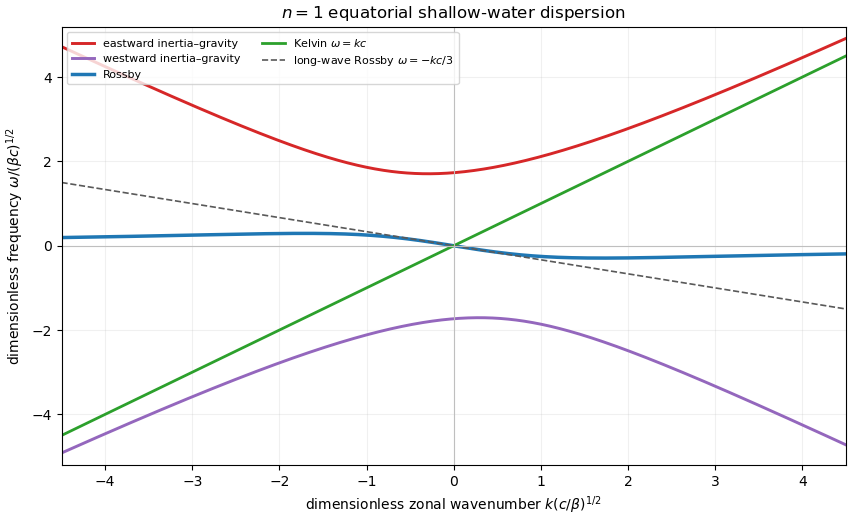
Without imposing meridional geostrophic balance, the equatorial shallow-water modes satisfy the Matsuno cubicA dispersion diagram therefore contains high-frequency eastward and westward equatorial inertia--gravity waves as well as westward equatorial Rossby waves, plus the separate straight equatorial Kelvin wave branch . The Rossby curves approach only in the long-wave limit and bend toward zero like at short wavelength. The geostrophic model retains the Kelvin and long-wave Rossby lines but filters the inertia--gravity modes and misses Rossby-wave dispersion at larger .
Past exam of the mathematics course of the University of Cambridge 2023 iii Paper 333 4 a Solution by Codex 0 Created 2026-09-28 Updated 2026-10-03
Codex 0 Created 2026-09-28 Updated 2026-10-03SubstituteThe two horizontal momentum equations separate immediately because the same factor multiplies every term. Hydrostatic balance givesThe buoyancy equation then givesDifferentiating this expression and using three-dimensional incompressibility together with the shallow-water mass equation yieldsThus each vertical eigenfunction supplies an equivalent depth or wave speed to an equatorial shallow-water system.
Past exam of the mathematics course of the University of Cambridge 2023 iii Paper 333 3 iii Solution by Codex 0 2026-09-28
Codex 0 2026-09-28When , the boundary coupling is exponentially small. The two eigenvalues are therefore the diagonal boundary-wave speeds through order :The lower wave is damped at the imposed rate, while the upper wave is exponentially isolated from the lower boundary and remains neutral to algebraic order. Damping destroys the phase-locked counterpropagating-wave interaction at short horizontal wavelength rather than damping both waves equally.
Pinned article: Introduction to the OurBigBook Project
Welcome to the OurBigBook Project! Our goal is to create the perfect publishing platform for STEM subjects, and get university-level students to write the best free STEM tutorials ever.
Everyone is welcome to create an account and play with the site: ourbigbook.com/go/register. We belive that students themselves can write amazing tutorials, but teachers are welcome too. You can write about anything you want, it doesn't have to be STEM or even educational. Silly test content is very welcome and you won't be penalized in any way. Just keep it legal!
Intro to OurBigBook
. Source. We have two killer features:
- topics: topics group articles by different users with the same title, e.g. here is the topic for the "Fundamental Theorem of Calculus" ourbigbook.com/go/topic/fundamental-theorem-of-calculusArticles of different users are sorted by upvote within each article page. This feature is a bit like:
- a Wikipedia where each user can have their own version of each article
- a Q&A website like Stack Overflow, where multiple people can give their views on a given topic, and the best ones are sorted by upvote. Except you don't need to wait for someone to ask first, and any topic goes, no matter how narrow or broad
This feature makes it possible for readers to find better explanations of any topic created by other writers. And it allows writers to create an explanation in a place that readers might actually find it.
Figure 1. Screenshot of the "Derivative" topic page. View it live at: ourbigbook.com/go/topic/derivativeVideo 2. OurBigBook Web topics demo. Source. - local editing: you can store all your personal knowledge base content locally in a plaintext markup format that can be edited locally and published either:This way you can be sure that even if OurBigBook.com were to go down one day (which we have no plans to do as it is quite cheap to host!), your content will still be perfectly readable as a static site.
- to OurBigBook.com to get awesome multi-user features like topics and likes
- as HTML files to a static website, which you can host yourself for free on many external providers like GitHub Pages, and remain in full control

Figure 2. You can publish local OurBigBook lightweight markup files to either OurBigBook.com or as a static website.
Figure 3. Visual Studio Code extension installation.
Figure 5. . You can also edit articles on the Web editor without installing anything locally. Video 3. Edit locally and publish demo. Source. This shows editing OurBigBook Markup and publishing it using the Visual Studio Code extension. 
- Infinitely deep tables of contents:



All our software is open source and hosted at: github.com/ourbigbook/ourbigbook
Further documentation can be found at: docs.ourbigbook.com
Feel free to reach our to us for any help or suggestions: docs.ourbigbook.com/#contact