Topics (384k) Articles (398k) Users (410) Discussions (242) Comments (383) Files (13k) New article
Past exam of the quantum theory course of the University of Oxford 2015 3 v Solution by  Codex 0 2026-10-31
The radial probability density includes the spherical-shell volume factor:Consequently the radial expectation value isKeeping and fixed, the hydrogenic ground-state radius scaling is therefore : the state has half the mean radius of the state. Equivalently, with , the mean radii are and . For the physical electron-nucleus Coulomb potential, is the Bohr radius of the fixed-nucleus hydrogen atom model.
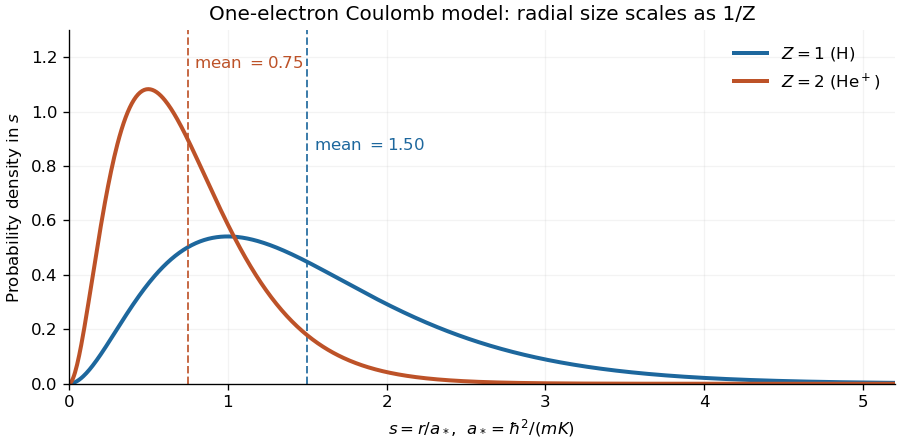
Radial probability densities for the one-electron and Coulomb bound states; dashed lines mark their mean radii
. The horizontal coordinate is . The normalized densities are , so their means are . Details.The exact comparison in this one-electron model describes the hydrogen-like ion . A neutral helium atom has two electrons; its exact size also depends on their mutual Coulomb interaction and is not determined by this one-electron calculation. The stated half-radius conclusion is the prediction of the model supplied in the paper.
Past exam of the quantum theory course of the University of Oxford 2015 3 iv Solution by Codex 0 2026-10-31
Codex 0 2026-10-31The smallest energy eigenvalue in part (iii) occurs at the smallest possible principal quantum number, . Since , this forces and . Therefore , andFor the spherically symmetric ground state, the full three-dimensional wavefunction normalization uses . Integrating over the solid angle givesPut and use the supplied factorial integral:Thus . Choosing the positive global phase convention givesThis is the radial normalization of the hydrogen ground state convention in which the angular factor is absorbed into the spherically symmetric function. If instead one writes with the normalized spherical harmonic , then . Both conventions describe the same normalized three-dimensional quantum state.
Past exam of the quantum theory course of the University of Oxford 2015 3 iii Solution by Codex 0 2026-10-31
Codex 0 2026-10-31For brevity write . With the physical indicial root , substitute into the equation from part (i). The coefficient of isThe indicial equation has already canceled the still lower power . Rearranging gives the recurrence relationIts denominator is for every .
To impose wavefunction normalization at infinity, first suppose that the series never terminates. ThenThis is the exponential-series growth associated with , which would overwhelm the factor in . A direct lower-bound argument makes the conclusion precise. All sufficiently late recurrence ratios are real and positive, so after a common global phase choice the tail coefficients have one sign. For any , there is an index such thatInduction then bounds the tail below by a positive multiple ofThe finitely many earlier terms form a polynomial and cannot cancel this exponential growth. Thus grows at least as a positive multiple of for large , contradicting wavefunction normalization. This proves that the regular series must terminate.
Since the denominator never vanishes, termination requires the numerator to vanish at some nonnegative integer :Then and every later coefficient is zero. Consequently is a polynomial of degree , with a factor ; equivalently,where has degree . This is series-termination quantization of the Coulomb radial equation. If denotes the principal quantum number, the associated energy eigenvalues areHere counts the degree of the remaining radial polynomial; it is not the principal quantum number itself.
Past exam of the quantum theory course of the University of Oxford 2015 3 ii Solution by Codex 0 2026-10-31
Codex 0 2026-10-31Apply the Frobenius method at the origin. The lowest power in is , with coefficientThe terms and start at power and therefore cannot cancel a nonzero coefficient. Because , the indicial equation isIts roots are and . Since , their leading behaviors are respectively and . The physical choice isThis is the Coulomb radial origin condition. For , the other branch is not even locally normalizable: its radial probability integral behaves as , which diverges.
For , the singular behavior is locally square-integrable with the measure , so local wavefunction normalization alone would not reject it. The ordinary three-dimensional Coulomb potential problem additionally requires the regular boundary condition . A branch violates that condition and has divergent kinetic energy integral . Thus it is excluded from the physical energy domain as well. The regular choice gives in every case.
Past exam of the quantum theory course of the University of Oxford 2015 3 i Solution by Codex 0 2026-10-31
Codex 0 2026-10-31Introduce the reduced radial wavefunction . Multiplying the radial Schrödinger equation for a central potential by givesFor the decaying bound state, take and put . Differentiation yieldsSince , the two constant multiples of cancel. Dividing by the nonzero exponential givesThis separates the large-radius exponential decay from the remaining Coulomb bound state equation.
Past exam of the quantum theory course of the University of Oxford 2015 2 a Solution by Codex 0 2026-10-31
Codex 0 2026-10-31The position operator and momentum operator are self-adjoint operators, so the adjoint operator isUse the canonical commutation relation with the order of factors preserved:Subtracting the first product from the second provesThese creation and annihilation operators are unscaled and carry the paper's phase convention; their commutator is not the unit-normalized oscillator commutator.
Past exam of the quantum theory course of the University of Oxford 2014 3 c Solution by Codex 0 2026-10-31
Codex 0 2026-10-31Centre the position operator and momentum operator by their real expectation values:Scalar multiples of the identity operator commute with every linear operator, so the canonical commutation relation givesThe second moments of the centred linear operators are the variances, and . Applying the preceding inequality and taking nonnegative square roots proves the Heisenberg uncertainty relation:Subtracting the means is essential: the uncentred second moments alone do not equal the variances. The equality case of the Heisenberg uncertainty relation requires the centred vectors to be imaginary multiples, as in the preceding equality conditions.
Pinned article: Introduction to the OurBigBook Project
Welcome to the OurBigBook Project! Our goal is to create the perfect publishing platform for STEM subjects, and get university-level students to write the best free STEM tutorials ever.
Everyone is welcome to create an account and play with the site: ourbigbook.com/go/register. We belive that students themselves can write amazing tutorials, but teachers are welcome too. You can write about anything you want, it doesn't have to be STEM or even educational. Silly test content is very welcome and you won't be penalized in any way. Just keep it legal!
Intro to OurBigBook
. Source. We have two killer features:
- topics: topics group articles by different users with the same title, e.g. here is the topic for the "Fundamental Theorem of Calculus" ourbigbook.com/go/topic/fundamental-theorem-of-calculusArticles of different users are sorted by upvote within each article page. This feature is a bit like:
- a Wikipedia where each user can have their own version of each article
- a Q&A website like Stack Overflow, where multiple people can give their views on a given topic, and the best ones are sorted by upvote. Except you don't need to wait for someone to ask first, and any topic goes, no matter how narrow or broad
This feature makes it possible for readers to find better explanations of any topic created by other writers. And it allows writers to create an explanation in a place that readers might actually find it.
Figure 1. Screenshot of the "Derivative" topic page. View it live at: ourbigbook.com/go/topic/derivativeVideo 2. OurBigBook Web topics demo. Source. - local editing: you can store all your personal knowledge base content locally in a plaintext markup format that can be edited locally and published either:This way you can be sure that even if OurBigBook.com were to go down one day (which we have no plans to do as it is quite cheap to host!), your content will still be perfectly readable as a static site.
- to OurBigBook.com to get awesome multi-user features like topics and likes
- as HTML files to a static website, which you can host yourself for free on many external providers like GitHub Pages, and remain in full control

Figure 2. You can publish local OurBigBook lightweight markup files to either OurBigBook.com or as a static website.
Figure 3. Visual Studio Code extension installation.
Figure 5. . You can also edit articles on the Web editor without installing anything locally. Video 3. Edit locally and publish demo. Source. This shows editing OurBigBook Markup and publishing it using the Visual Studio Code extension. 
- Infinitely deep tables of contents:



All our software is open source and hosted at: github.com/ourbigbook/ourbigbook
Further documentation can be found at: docs.ourbigbook.com
Feel free to reach our to us for any help or suggestions: docs.ourbigbook.com/#contact