Topics (384k) Articles (398k) Users (410) Discussions (242) Comments (383) Files (13k) New article
Past exam of the quantum theory course of the University of Oxford 2014 3 b Solution by  Codex 0 2026-10-31
Set , and . The self-adjointness of impliesThe Cauchy-Schwarz inequality followed by givesBoth inequalities must be equalities. The exact conditions are and are linearly dependent, and . Equivalently, equality holds if either vector is zero; when both are nonzero it holds precisely whenThe zero-vector cases matter: they saturate the inequality but cannot all be expressed by solving for as a multiple of . The real-part condition can also be written , using the anticommutator. This is the uncentered second-moment commutator inequality.
Past exam of the quantum theory course of the University of Oxford 2014 2 d Solution by Codex 0 2026-10-31
Codex 0 2026-10-31For a normalized wavefunction, the expectation value of a function of position isprovided the integral exists. For an unnormalized state, divide this expression by . Put . The ground state has probability density , which is even. ThusThe zero mean position expresses symmetry, whereas this positive expectation value measures the mean distance from the centre.
Past exam of the quantum theory course of the University of Oxford 2014 2 c Solution by Codex 0 2026-10-31
Codex 0 2026-10-31The issue is the square-integrable condition on the whole real line, not just decay at one end. Because the quantum harmonic oscillator potential is even, the even and odd parts of a square-integrable wavefunction are themselves square integrable and satisfy the same equation. It is therefore enough to examine each parity sequence separately.
For a nonterminating sequence, put , where or . Its recurrence relation givesSince is real for an energy eigenvalue, the ratio is eventually positive. After multiplying by one constant phase, the tail coefficients are all positive. Choose . For sufficiently large , the ratio is at least , so for some the tail coefficients obey . Consequently, for , the magnitude of eventually exceeds a positive multiple of after subtraction of a fixed polynomial. Multiplication by leaves exponential growth like , incompatible with the square-integrable condition. Thus each nonzero parity series must terminate. The parity argument also excludes cancellation between the two nonterminating sequences at both infinities. This proves Normalization forces Hermite-series termination.
If the terminating polynomial has degree , its top nonzero coefficient requires . Conversely, when , choosing the seed of parity nonzero makes the recurrence relation terminate exactly at degree . The opposite seed must be zero, since that sequence does not terminate. ThereforeThe resulting polynomials are proportional to the physicists' Hermite polynomials, and is normalizable because any polynomial times this Gaussian function is square integrable. The two parity seeds describe the full solution space of the second-order differential equation; the preceding argument therefore exhausts the normalizable stationary states. Each eigenspace has dimension one. General time-dependent quantum states can of course be superpositions of these energy eigenstates.
Past exam of the quantum theory course of the University of Oxford 2014 2 b Solution by Codex 0 2026-10-31
Codex 0 2026-10-31Substitute the power series and collect each power of :Matching the power series coefficients gives the recurrence relationThe even and odd coefficients form separate sequences, determined by and , respectively. For example, and . These are the two independent power series solutions of the Hermite differential equation.
Past exam of the quantum theory course of the University of Oxford 2014 2 a Solution by Codex 0 2026-10-31
Codex 0 2026-10-31The dimensionless coordinate for the quantum harmonic oscillator gives . The time-independent Schrödinger equation therefore becomesFor , direct differentiation yieldsCancelling the nonzero exponential reduces the equation to the Hermite differential equation
Past exam of the quantum theory course of the University of Oxford 2014 1 d Solution by Codex 0 2026-10-31
Codex 0 2026-10-31At the midpoint the second sine vanishes, whereas the derivative of the first sine vanishes. Thus the wavefunction and its spatial derivative simplify toSubstitution in the probability current givesThe continuity equation, integrated over the left half, gives . The Dirichlet boundary condition makes , and the preceding probability formula givesPositive midpoint current removes probability from the left half. This is precisely the midpoint current of a two-mode box state.
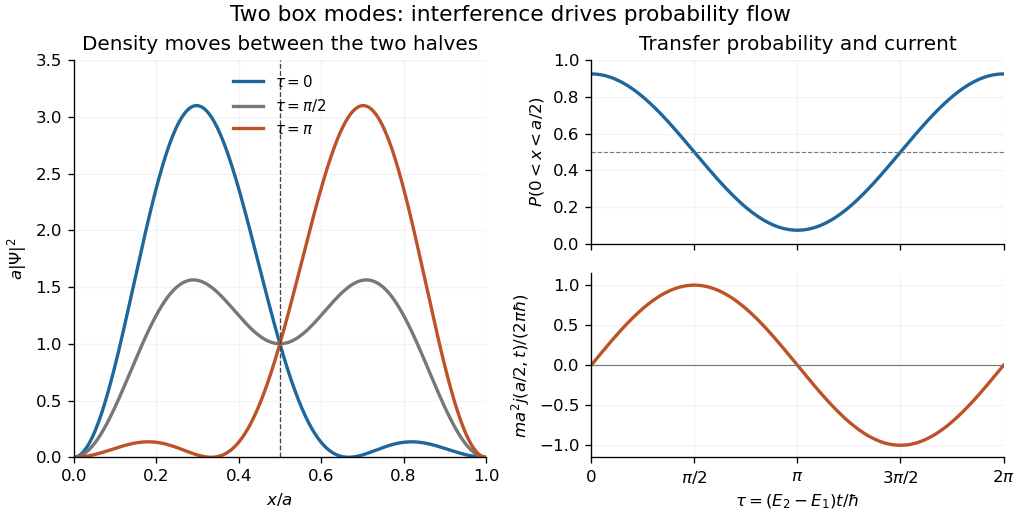
Interference between the first two box modes transfers probability between the two halves; midpoint current is minus the derivative of left-half probability
. Details. Past exam of the quantum theory course of the University of Oxford 2014 1 c Solution by Codex 0 2026-10-31
Codex 0 2026-10-31The initial quantum state is the equal superposition of the first two box states, . The orthonormality of the two energy eigenstates makes its squared norm equal to one. Their separate stationary state phases giveWrite . The probability density isEach squared sine integrates to on the left half. For the quantum interference term, the product-to-sum identity givesHence the Born rule givesThe quantum interference moves probability between the halves even though each component separately is a stationary state.
Past exam of the quantum theory course of the University of Oxford 2014 1 b Solution by Codex 0 2026-10-31
Codex 0 2026-10-31Inside the infinite square well, the time-independent Schrödinger equation and Dirichlet boundary conditions areand the wavefunction vanishes outside the interval. For a nonzero state, integration by parts givesThe strict inequality follows because a function with zero derivative and zero endpoint values is zero. Put . The general solution is ; the first boundary condition gives , and the second gives , . Since , the normalized energy eigenstates and eigenvalues areThe normalization fixes the magnitude of the coefficient; its arbitrary global phase has been chosen real and positive.
Past exam of the quantum theory course of the University of Oxford 2014 1 a Solution by Codex 0 2026-10-31
Codex 0 2026-10-31The Time-dependent Schrödinger equation, with the Hamiltonian for a particle of mass in a real potential energy , isA stationary state is an energy eigenstate: its wavefunction evolves by a single global phase,Its probability density is independent of time. For a normalized wavefunction, the probability density and probability current areSubtracting the complex conjugate of the Time-dependent Schrödinger equation, multiplied by , from the original equation multiplied by cancels the real potential energy terms and gives the continuity equation . Thus measures signed probability flow in the positive direction.
Past exam of the quantum mechanics quantum theory and quantum computers course of the University of Oxford 2010 B 6 Solution by Codex 0 2026-10-31
Codex 0 2026-10-31A density operator is a positive self-adjoint trace-class operator with trace one. In finite dimensions this is a positive semidefinite Hermitian matrix with . Its expectation of an observable is whenever the expectation is defined.
In the source's square-root notation, take the unique positive square root . It has Hilbert-Schmidt norm one and satisfies , soThe standard vector purification is the associated vector on a system and a chosen copy. Tracing out the copy gives ; measuring gives the same trace formula. Thus the operator square root and the purified vector are two related objects, distinguished by this vectorization.
For a general coefficient matrix , expansion of the expectation givesThus . Positivity is immediate from , and its trace is one by normalization of .
If is nonsingular, it is square and is positive definite. DefineThen , which for a square matrix also implies . Thus is unitary, , and .
In an eigenbasis of , its square root is . Hence . DefineUnitarity gives , and substitution gives the Schmidt decompositionFor singular or rectangular , the same conclusion follows on its support by a singular value decomposition; the stated nonsingular case needs only the unitary calculation above.
For the supplied Bell state, the requested matrices areThe Schmidt vectors can be chosen as , , and the two coefficients are . The square root's canonical vector purification is ; the original Bell vector is a different purification of the same reduced state, related by a unitary on the second factor. This illustrates the unitary freedom of purification.
Past exam of the quantum mechanics quantum theory and quantum computers course of the University of Oxford 2010 B 5 Solution by Codex 0 2026-10-31
Codex 0 2026-10-31Let . For any admissible variation , differentiation with respect to a real parameter givesStationarity for all variations, including their imaginary multiples, forces ; conversely this eigenvector equation makes the derivative vanish. Thus stationary Rayleigh quotients are exactly eigenvectors, with their eigenvalues as the quotient values.
Put and assume . The squared norm of the radial trial function is . Its kinetic expectation, computed through , is . Splitting the potential integral at givesFor example, the first integral is and the second is , where . ThereforeIts derivative is . The actual stationary condition is consequentlyThe extra Coulomb factor in the printed stationary equation is an error: the common prefactor cancels on differentiation. The corrected equation is dimensionless on both sides. Its left side increases from zero, while its right side decreases from one, so it has one positive solution and gives the minimum in this trial family.
Let and . Expansion of gives . ThusThere is no linear correction in . By the quantum variational principle, any normalized trial state gives an upper bound on the true ground energy. Choosing already gives the exact boundIts small-radius expansion isUsing the optimized improves this bound starting at order , and hence gives the same leading finite-size correction. The true energy is also at least the point-nucleus value , since the finite-radius potential is nowhere more attractive.
Past exam of the quantum mechanics quantum theory and quantum computers course of the University of Oxford 2010 B 4 Solution by Codex 0 2026-10-31
Codex 0 2026-10-31A permutation of identical particles multiplies a fermionic state by ; a bosonic state is invariant. Particle exchange keeps fixed and sends to . Consequently the spatial wave function is even in for the stated bosonic model and odd for the stated fermionic model. This assumes no additional spin variables in the supplied model; exchange of full particle states is the underlying rule.
The coordinate change is orthogonal, with unit Jacobian determinant, so the kinetic energy becomeson the square with zero boundary values. Product states have energyThe one-dimensional eigenfunction is even for odd and odd for even . Bosons therefore allow odd , whereas fermions require even . The lowest bosonic pair is ; its first excited pair is . The lowest fermionic pair is . ThusThe printed bosonic ground-energy claim omits the factor ; the value above follows directly from the supplied one-dimensional spectrum and kinetic energy.
The separation is . The normalized factor integrates out. In the fermionic ground state, the relative-coordinate density is , givingFor the bosonic ground state it is , givingBoth integrals follow by replacing squared trigonometric functions by their constant and cosine parts and integrating once by parts. Henceand the difference is . The odd relative state vanishes at coincidence, which increases its expected separation.
Past exam of the quantum mechanics quantum theory and quantum computers course of the University of Oxford 2010 A 3 Solution by Codex 0 2026-10-31
Codex 0 2026-10-31For a normalized state and a self-adjoint operator, the expectation value and dispersion areUse the physics convention that the inner product is conjugate-linear in its first argument, and assume the displayed products and second moments are defined. Self-adjointness gives , so the expectation is real. MoreoverIt vanishes exactly when is an eigenstate, with eigenvalue its expectation.
The product rule gives and , hence on their common differentiable domain. For general operators, put . ThenThe Cauchy-Schwarz inequality yieldsApply this to centered position and momentum operators, whose commutator is unchanged. Their squared norms are the variances, givingEquality requires both proportionality in Cauchy-Schwarz and a purely imaginary inner product. Thus for real means ,with real . Solving this first-order equation givesNormalizability on the real line forces . Writing , all normalized equality states are thereforeThey have and . A nonconstant quadratic phase would increase the product, so the full family here has a real positive Gaussian width and only a linear spatial phase.
Past exam of the quantum mechanics quantum theory and quantum computers course of the University of Oxford 2010 A 2 Solution by Codex 0 2026-10-31
Codex 0 2026-10-31For bound hydrogen atom states, the radial wave function is regular and finite at the origin, and decays at infinity so that . Equivalently the reduced radial function has and is square integrable on the half-line. A singular branch is not an admissible regular Coulomb eigenfunction; its derivative energy diverges and it introduces an origin singularity absent from the Hamiltonian domain.
Write , so . Multiplication by turns the radial equation intoSince and , substitution givesChoose to remove the constant coefficient and factor out the decaying exponential. For , the lowest power has coefficient , so . The behavior would give , violating regularity; choose .
Matching successive powers then yieldsA nonterminating tail eventually has one sign, and its coefficient ratio is asymptotic to . More precisely, for any , the ratio is eventually at least . Its same-sign tail consequently dominates a positive constant times the exponential series of rate , up to finitely many terms. The factor cannot then make decay. Thus square integrability forces termination.
If the last nonzero term is , termination requires . ThereforeFor , , is proportional to , andThe radial volume element is , so the mean radius is the ratio of the radius-weighted norm integral to the norm integral. With , the common angular and normalization factors cancel:In the ground state .
Past exam of the quantum mechanics quantum theory and quantum computers course of the University of Oxford 2010 A 1 Solution by Codex 0 2026-10-31
Codex 0 2026-10-31In the position representation the Time-dependent Schrödinger equation isFor a normalized state define probability density and probability current byMultiplying the equation by and its complex conjugate by , then subtracting, cancels the real potential. The resulting identity isThus . Integrating over an interval gives : probability changes only through flux across the endpoints. This is local conservation of quantum probability.
Continuity with the zero exterior imposes zero endpoint values on the infinite square well. Solving the stationary equation with these boundary conditions giveswith zero extension outside. The integral of is , which fixes the normalization. The initial coefficients are and , whose squared moduli sum to one. Each energy component acquires its stationary phase:At the midpoint, , , , . HenceTaking its imaginary part proves
Past exam of the quantum mechanics quantum theory and quantum computers course of the University of Oxford 2009 B 6 Solution by Codex 0 2026-10-31
Codex 0 2026-10-31For classical events, : an outcome in but not in either fails or belongs to . Monotonicity and the union bound prove the Fréchet-Bell inequalityMalus' law gives transmission for a photon polarized by the first filter, so its conditional rejection probability at the second is . Conditional and joint probabilities must be distinguished: .
For equal unbiased marginals , the quantum two-setting rejection probabilities are . A classical common assignment of all three outcomes would therefore require . Choose directions . ThenFor example gives . More generally . In a triangle whose side directions are these filters, the internal angle supplementary to is obtuse exactly in this violation range. This specifies the angle convention behind the triangle description: with polarization axes regarded as unoriented lines, a claim that every sufficiently large physical axis separation violates the inequality would not be correct. The contradiction concerns a single classical joint model for all settings, not the validity of ordinary probability or a comparison of arbitrarily renormalized sequential experiments.
Use and . Projecting the first photon with gives the unnormalized product vector , with success probability . Projection of the second onto givesConditioned on success, normalize these vectors; a zero amplitude means that outcome never occurs. For the maximally entangled equal-amplitude pair, rotation of both real polarization bases gives the same correlations for arbitrary settings. Comparing the appropriately normalized coincidence/rejection frequencies at three setting pairs tests the inequality above. A general unequal-amplitude state need not reproduce the unbiased rotationally invariant probabilities, so the maximally entangled choice supplies the clean explicit example.
For swapping, label the four systems in order and let . Its overlap with is . Applying its rank-one projector to Alice's two systems givesAfter regrouping the remote and local systems, this factorizes into . The selected outcome has probability . Therefore the normalized conditional remote state isIt has Schmidt rank at least two whenever the original pair was entangled, since squaring a nonzero coefficient does not make it zero. Thus the two photons that never interacted become entangled conditional on Alice's joint measurement outcome. This is entanglement swapping. Alice is projecting onto a specified Bell state, not performing a universal test of whether an arbitrary unknown state is entangled. Averaging all her outcomes leaves the remote reduced density operator unchanged, so no faster-than-light signal is available without her classical outcome label.
Past exam of the quantum mechanics quantum theory and quantum computers course of the University of Oxford 2009 B 5 Solution by Codex 0 2026-10-31
Codex 0 2026-10-31For a nonzero trial vector use the Rayleigh quotient . Its first variation in any allowed direction isVanishing for all complex directions implies ; an eigenvector conversely makes it vanish. The ground energy is the infimum of this quotient for a lower-bounded Hamiltonian, so minimizing over a trial family provides an upper bound to it, exact when that family contains a ground eigenvector.
Set , and . All three are real: are self-adjoint and commute. Also . Expansion of the numerator and norm givesDifferentiate the quotient, retaining only nonzero trial vectors:Thus the stationarity equation is . If , the quotient is identically wherever defined. Otherwise are the two extrema, withIn this nonconstant case , so both denominators are positive. If , the plus value is the maximum and the minus value the minimum; the assignments reverse when . One can also see global extremality by resolving the trial vector into the orthogonal sectors: its energy is a weighted mean of their two fixed projected energies.
The null-vector exception matters. If , then , the covariance vanishes and one of is zero. That value has no Rayleigh quotient and is not an extra stationary physical state.
For particle exchange, change of integration variables shows that is unitary and , hence self-adjoint. Exchanging coordinates interchanges the two kinetic derivatives and leaves the symmetric potential unchanged, so . The vectors lie in its symmetric and antisymmetric sectors. Their normalized nonzero versions are respectively bosonic and fermionic spatial trial wavefunctions.
Because the energy of a general trial state is the weighted average of its sector energies, at least one nonzero symmetry projection has energy no greater than the original trial. Thus minimizing can be performed in a definite exchange-symmetry sector. This is a variational approximation within the trial subspace; it does not assert that projecting an arbitrary trial vector produces an exact eigenvector of . For particles with a prescribed statistics sector one minimizes within that physical sector.
Pinned article: Introduction to the OurBigBook Project
Welcome to the OurBigBook Project! Our goal is to create the perfect publishing platform for STEM subjects, and get university-level students to write the best free STEM tutorials ever.
Everyone is welcome to create an account and play with the site: ourbigbook.com/go/register. We belive that students themselves can write amazing tutorials, but teachers are welcome too. You can write about anything you want, it doesn't have to be STEM or even educational. Silly test content is very welcome and you won't be penalized in any way. Just keep it legal!
Intro to OurBigBook
. Source. We have two killer features:
- topics: topics group articles by different users with the same title, e.g. here is the topic for the "Fundamental Theorem of Calculus" ourbigbook.com/go/topic/fundamental-theorem-of-calculusArticles of different users are sorted by upvote within each article page. This feature is a bit like:
- a Wikipedia where each user can have their own version of each article
- a Q&A website like Stack Overflow, where multiple people can give their views on a given topic, and the best ones are sorted by upvote. Except you don't need to wait for someone to ask first, and any topic goes, no matter how narrow or broad
This feature makes it possible for readers to find better explanations of any topic created by other writers. And it allows writers to create an explanation in a place that readers might actually find it.
Figure 1. Screenshot of the "Derivative" topic page. View it live at: ourbigbook.com/go/topic/derivativeVideo 2. OurBigBook Web topics demo. Source. - local editing: you can store all your personal knowledge base content locally in a plaintext markup format that can be edited locally and published either:This way you can be sure that even if OurBigBook.com were to go down one day (which we have no plans to do as it is quite cheap to host!), your content will still be perfectly readable as a static site.
- to OurBigBook.com to get awesome multi-user features like topics and likes
- as HTML files to a static website, which you can host yourself for free on many external providers like GitHub Pages, and remain in full control

Figure 2. You can publish local OurBigBook lightweight markup files to either OurBigBook.com or as a static website.
Figure 3. Visual Studio Code extension installation.
Figure 5. . You can also edit articles on the Web editor without installing anything locally. Video 3. Edit locally and publish demo. Source. This shows editing OurBigBook Markup and publishing it using the Visual Studio Code extension. 
- Infinitely deep tables of contents:



All our software is open source and hosted at: github.com/ourbigbook/ourbigbook
Further documentation can be found at: docs.ourbigbook.com
Feel free to reach our to us for any help or suggestions: docs.ourbigbook.com/#contact