Topics (384k) Articles (398k) Users (410) Discussions (242) Comments (383) Files (13k) New article
Past exam of the short options course of the University of Oxford 2014 3 d Solution by  Codex 0 2026-10-31
For the explicit basis in part (c), has coefficients . ThusAt these values the conics factor, up to nonzero constants, asGeometrically these are exactly the three pairings of the four base points into two pairs, with a projective line joining each pair. No double line can contain four points in general linear position.
The numerical parameter values depend on the selected basis, but the three distinct singular members do not. Another pair of independent nonsingular basis conics gives an invertible projective change of pencil parameter. Its parameter infinity is nonsingular because the second basis form is nonsingular. Therefore all three singular members again occur at three distinct finite values of . This proves the claimed count for any such basis.
Past exam of the short options course of the University of Oxford 2014 3 c Solution by Codex 0 2026-10-31
Codex 0 2026-10-31Use part (a) to put the four projective points atA quadratic polynomial vanishing at the first three has no square terms, and vanishing at the fourth givesThese form a two-dimensional vector space. Choose the two membersTheir coefficient triples are independent and both satisfy the relation. Their symmetric bilinear form matrices are of the formFor and , both determinants are , so both selected conics are nonsingular. Any coefficient triple with zero sum is uniquely a linear combination of these two. Hence every conic through the four points has matrixUndoing the projective transformation carries the entire family back to the original four points, preserving nonsingularity. This is a pencil of conics through four points.
Past exam of the short options course of the University of Oxford 2014 3 b Solution by Codex 0 2026-10-31
Codex 0 2026-10-31A projective quadric is the zero locus of a nonzero homogeneous quadratic polynomial , with symmetric over a field of characteristic different from two. A projective point on it is singular when all first partial derivatives vanish. Since , the quadric is nonsingular exactly when is invertible.
Over the complex numbers, a nonzero quadratic form in three variables can be diagonalized by an invertible change of basis. Its rank classifies a projective conic:
- Rank three gives a nonsingular conic.
- Rank two gives two distinct projective lines, since the reduced form factors as . Their intersection is the singular point.
- Rank one gives a double projective line, defined by a squared linear form. The gradient vanishes along that line.
The zero polynomial is excluded from the definition of a conic. Thus these last two cases are precisely the singular conics.
Past exam of the short options course of the University of Oxford 2014 3 a Solution by Codex 0 2026-10-31
Codex 0 2026-10-31The required general linear position condition is that every of the representing vectors are linearly independent. Such an ordered configuration is a projective frame.
Choose representatives of the first projective points; they form a basis. Write a representative of the last point as . Every is nonzero: otherwise the last point together with the other basis points would fail the independence condition. Rescale the basis representatives to , so that .
Do the same for the target configuration, obtaining representatives with . The unique linear map sending the basis to is invertible and also sends to . Its induced projective transformation sends every point to its prescribed partner. Thus any two ordered projective frames are projectively equivalent.
Past exam of the short options course of the University of Oxford 2014 2 c Solution by Codex 0 2026-10-31
Codex 0 2026-10-31Factor the group order as . The Sylow theorems say that the number of Sylow subgroups for the prime seven divides and is congruent to one modulo seven. Among , only one qualifies. Thus there is a unique normal subgroup of order .
Every group of prime-square order is Abelian. Indeed its center of a group is nontrivial, and a cyclic quotient by the center of a group forces the whole group to be abelian. Consequently is either or , and in either case it has two composition factors, both .
It remains to consider , of order twelve. Its number of Sylow subgroups for the prime three is either one or four:
- If it is one, the normal order-three subgroup has factor , and the remaining quotient has order four. An order-four group is abelian and has two factors .
- If it is four, these order-three subgroups have disjoint nonidentity elements and account for eight elements. Any Sylow subgroup for the prime two, of order four, must consist of the four remaining elements, since its nonidentity elements have power-of-two orders. It is therefore unique and normal. Its two factors are , and the quotient has order three, giving .
Lift the composition series of to using the subgroup correspondence theorem, and join it to a composition series inside . This givesas the multiset of composition factors. The Jordan–Hölder theorem makes this independent of the chosen series. In particular every group of order is a solvable group, with composition length five; that is a statement about composition length, not necessarily its derived length.
Past exam of the short options course of the University of Oxford 2014 2 b Solution by Codex 0 2026-10-31
Codex 0 2026-10-31Let be the given length-two composition series. Thus and are simple groups. Let be any proper nontrivial normal subgroup of , such as the penultimate term of another composition series.
If , its two factors are already the given ones. Suppose . Since is normal in the simple group , it is either or . The latter would mean , but then would be a proper nontrivial normal subgroup of , impossible. Thus .
Also cannot be contained in , since it would then be a nontrivial normal subgroup of distinct from . The product is a normal subgroup of , strictly containing . Simplicity of therefore forces . The second isomorphism theorem for groups givesIn particular is simple. Every other composition series has such an as its last proper term, and no nontrivial refinement inside a simple is possible. Hence every composition series has length two.
The general Jordan–Hölder theorem states that any two composition series of a finite group have the same length and the same composition factors up to group isomorphism and permutation. The argument above proves both assertions in this length-two case: another series either uses itself or has factors isomorphic to the original pair in the opposite order. No general uniqueness theorem was used to prove this special case.
Past exam of the short options course of the University of Oxford 2014 2 a Solution by Codex 0 2026-10-31
Codex 0 2026-10-31A simple group is a nontrivial group whose only normal subgroups are itself and the trivial subgroup.
A composition series is a chain in which each is a normal subgroup of and each quotient group is simple and nontrivial. Its length is , and these quotients are its composition factors. The individual terms need not all be normal in .
A solvable group is a group whose derived series reaches the trivial group: starting with , define . For finite groups this is equivalent to having a composition series whose factors are all cyclic groups of prime order.
Past exam of the rings and modules course of the University of Oxford 2017 3 c Solution by Codex 0 2026-10-31
Codex 0 2026-10-31If , then is a scalar matrix. Its invariant factors of a linear operator are four copies of , so its rational canonical form isHere and , including when .
Now let and putOn each two-dimensional invariant block, satisfies . The vectors form a cyclic vector basis, since their coordinate matrix is with determinant . Directly,Applying this basis change to both blocks givesThus and . In particular there are two invariant factors , rather than a single block for . Also for every real , so it is an irreducible polynomial over . This is an instance of rational canonical form under an affine change.
Finally implies . Substituting , in the preceding result gives , and henceIts minimal polynomial is and its characteristic polynomial is . The normalized reciprocal of is also , agreeing with rational canonical form of an inverse.
Past exam of the rings and modules course of the University of Oxford 2017 3 b Solution by Codex 0 2026-10-31
Codex 0 2026-10-31The rational canonical form of is a block diagonal matrixsimilar to a matrix of , where the are monic nonconstant polynomials and the sum of their degrees is . They are the invariant factors of a linear operator. The block is the companion matrix for , representing multiplication by on . The invariant factors are uniquely determined by .
Every companion block has a cyclic vector and therefore has both minimal polynomial and characteristic polynomial equal to , by part (a). The determinant of a block diagonal matrix is the product of its block determinants, givingA polynomial annihilates the whole matrix exactly when it annihilates every block. On block , dividing by leaves a remainder of smaller degree; if that remainder annihilated the block without being zero, it would contradict minimality of . Thus the annihilation condition is exactly for every . The monic polynomial of least degree with this property is their least common multiple. The divisibility chain makes this , soThese are the minimal and characteristic polynomials from invariant factors formulae. On the zero vector space the product is empty and both polynomials are defined to be one.
Past exam of the rings and modules course of the University of Oxford 2017 3 a Solution by Codex 0 2026-10-31
Codex 0 2026-10-31Write . A cyclic vector for is a vector whose successive iterates span ; equivalently, when ,are a basis. The equivalence follows because the first linear dependence in the iterates makes their preceding span invariant under , so no later iterate can enlarge it.
In this basis there are unique coefficients with . Put . Then , and commutation with powers of gives . Therefore kills an entire basis and is the zero map. No nonzero polynomial of degree less than annihilates , because that would be a linear dependence of the displayed basis. Thus .
The matrix of in the cyclic basis is the companion matrix with ones on its subdiagonal and last column . Expanding along its last column givesthe cofactors are . This proves the characteristic polynomial of a companion matrix formula here. HenceThis proves that a cyclic operator has equal minimal and characteristic polynomials. If , both polynomials are one by convention, so the equality remains valid.
Past exam of the rings and modules course of the University of Oxford 2017 2 c Solution by Codex 0 2026-10-31
Codex 0 2026-10-31Since , products of integer linear combinations of remain of the same form. Thus the Eisenstein integers form a subring of , and hence an integral domain. Their Eisenstein norm isIt is a positive integer on nonzero elements and is multiplicative, because the complex modulus is multiplicative.
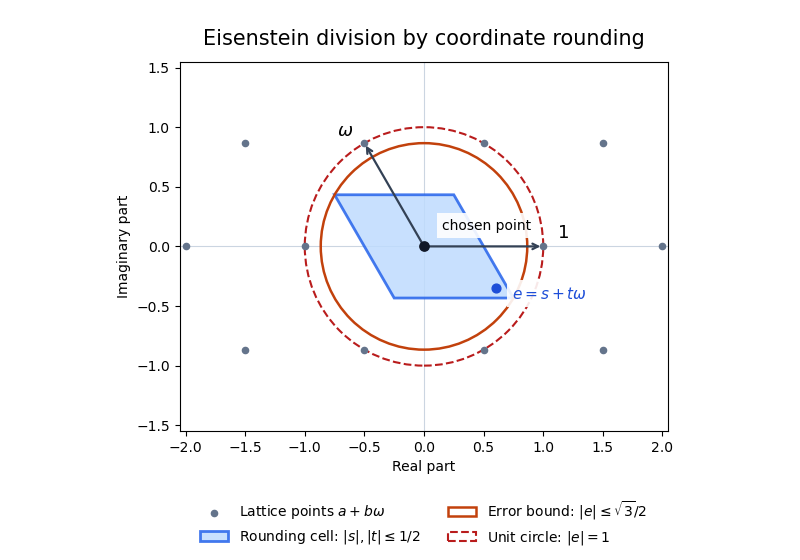
For with , write with real . Choose integers with , and let . With and ,Consequently belongs to and satisfies when . This proves is a Euclidean domain with Euclidean function , the Euclidean norm on the Eisenstein integers.
For the representation of the prime , first note that . Now suppose and . The factorizationshows that the Eisenstein integer divides a product. It divides neither factor: an element lies in exactly when both integer coefficients are divisible by , and the second coefficients here are and . Hence is not a prime element of .
To justify the necessary factorization step, in any principal ideal domain an irreducible element is prime. If , write . Since , irreducibility makes a unit or an associate of . The latter would give , so is a unit and for some . If , multiplication of this identity by gives . This proves irreducible elements of a principal ideal domain are prime without assuming unique factorization.
By part (a), is a principal ideal domain. The integer has norm , so it is a nonzero nonunit. Since it is not prime, the result just proved implies that it is reducible: with both nonunits. A nonzero element of is a unit exactly when its norm is one, since gives inverse and multiplicativity proves the converse. ThusThe only possible positive integer factors exceeding one are . Writing givesThis is the prime representation by the Eisenstein norm argument.
Past exam of the rings and modules course of the University of Oxford 2017 2 b Solution by Codex 0 2026-10-31
Codex 0 2026-10-31The three answers, in the given order, are no, yes, yes.
For , consider the ideal . Its members have even constant coefficient, so and the ideal is proper. If , then divides the constant , forcing to be constant by additivity of polynomial degree in this integral domain. Since also divides , it must divide the coefficient , giving . That would make the whole ring, a contradiction. Thus is not a principal ideal domain, and part (a) shows it cannot be a Euclidean domain. This is the nonprincipal ideal generated by a prime and an indeterminate obstruction.
Evaluation at gives the ring isomorphismIndeed, division by the monic polynomial leaves a unique remainder , and its value is zero only when both integer coefficients vanish. Thus the quotient maps bijectively, with operations preserved, onto the Gaussian integers. These form a Euclidean domain for the Gaussian integer norm , a standard Euclidean example allowed in this part. Geometrically, rounding the real and imaginary coordinates gives a quotient error with squared modulus at most .
Finally,via . Every polynomial over occurs. The kernel consists exactly of polynomials whose -independent part has even coefficients: write to see that this is precisely . Hence the induced quotient map is a bijective ring homomorphism. Its target is a Euclidean domain with Euclidean function : a polynomial ring over a field is Euclidean by the division algorithm in part (a).
Past exam of the rings and modules course of the University of Oxford 2017 2 a Solution by Codex 0 2026-10-31
Codex 0 2026-10-31A Euclidean domain is an integral domain with a Euclidean function such that, for with , there exist satisfyingThe polynomial ring has this property with . To perform polynomial division, subtract an appropriate multiple of the divisor to cancel the leading term of the current remainder. Its polynomial degree decreases strictly at each step, so the process terminates below the divisor's degree. The required division of leading coefficients is possible in the field . Thus a polynomial ring over a field is Euclidean, with the same argument applying to every field.
Now let be a nonzero ideal of a Euclidean domain, and choose with the least possible value of . For every , divide . The remainder belongs to , since . If it were nonzero, its smaller Euclidean value would contradict the choice of . Thus and every lies in . Conversely because is an ideal. Hence . The zero ideal is already , proving every Euclidean domain is a principal ideal domain.
Pinned article: Introduction to the OurBigBook Project
Welcome to the OurBigBook Project! Our goal is to create the perfect publishing platform for STEM subjects, and get university-level students to write the best free STEM tutorials ever.
Everyone is welcome to create an account and play with the site: ourbigbook.com/go/register. We belive that students themselves can write amazing tutorials, but teachers are welcome too. You can write about anything you want, it doesn't have to be STEM or even educational. Silly test content is very welcome and you won't be penalized in any way. Just keep it legal!
Intro to OurBigBook
. Source. We have two killer features:
- topics: topics group articles by different users with the same title, e.g. here is the topic for the "Fundamental Theorem of Calculus" ourbigbook.com/go/topic/fundamental-theorem-of-calculusArticles of different users are sorted by upvote within each article page. This feature is a bit like:
- a Wikipedia where each user can have their own version of each article
- a Q&A website like Stack Overflow, where multiple people can give their views on a given topic, and the best ones are sorted by upvote. Except you don't need to wait for someone to ask first, and any topic goes, no matter how narrow or broad
This feature makes it possible for readers to find better explanations of any topic created by other writers. And it allows writers to create an explanation in a place that readers might actually find it.
Figure 1. Screenshot of the "Derivative" topic page. View it live at: ourbigbook.com/go/topic/derivativeVideo 2. OurBigBook Web topics demo. Source. - local editing: you can store all your personal knowledge base content locally in a plaintext markup format that can be edited locally and published either:This way you can be sure that even if OurBigBook.com were to go down one day (which we have no plans to do as it is quite cheap to host!), your content will still be perfectly readable as a static site.
- to OurBigBook.com to get awesome multi-user features like topics and likes
- as HTML files to a static website, which you can host yourself for free on many external providers like GitHub Pages, and remain in full control

Figure 2. You can publish local OurBigBook lightweight markup files to either OurBigBook.com or as a static website.
Figure 3. Visual Studio Code extension installation.
Figure 5. . You can also edit articles on the Web editor without installing anything locally. Video 3. Edit locally and publish demo. Source. This shows editing OurBigBook Markup and publishing it using the Visual Studio Code extension. 
- Infinitely deep tables of contents:



All our software is open source and hosted at: github.com/ourbigbook/ourbigbook
Further documentation can be found at: docs.ourbigbook.com
Feel free to reach our to us for any help or suggestions: docs.ourbigbook.com/#contact