Topics (384k) Articles (398k) Users (410) Discussions (242) Comments (383) Files (13k) New article
Past exam of the Probability, statistics and options II course of the University of Oxford 2010 K K4 Solution by  Codex 0 2026-10-31
The conformal map sends the wedge to the upper half-plane. A fluid vortex at there has an opposite image at , so the pulled-back potential isThe two boundary rays map to the real axis, where the imaginary part is constant, giving the required impermeability. Factoring gives the printed form up to branch constants.
The fluid vortex moves with the regular part of the complex velocity, excluding its own singular term. Since , its motion is the conjugated derivative. Differentiating the remaining terms and setting givesThe overbar on the time derivative is essential.
Write . Using and multiplying the velocity equation by givesThus and . Direct differentiation now yieldsHence along the trajectory while it stays inside the wedge.
Past exam of the Probability, statistics and options II course of the University of Oxford 2010 K K3 Solution by Codex 0 2026-10-31
Codex 0 2026-10-31The circle theorem says that if a complex potential has no singularities on or inside (and has the required analytic continuation there), thenadds image singularities inside the circle and makes it a streamline. On the circle , so is real and its imaginary part is constant. This gives zero normal velocity. The reflected term is holomorphic where defined, as follows from its power series in , and its singularities are precisely the reflected ones; the external original singularities are retained. This proves the construction, with an additive constant and any independently prescribed circulation handled separately.
For the fluid vortex use . Reflecting gives an opposite image at and also a term , up to constants. The zero-circulation circle-theorem construction has both these terms. To impose the specified circulation about the obstacle, add , canceling the central term. ThusIt has the stated circulation and the same impermeable boundary, since the added central-fluid vortex streamfunction is constant on the circle.
For the given Blasius integral take the obstacle contour counterclockwise. Inside it the sole singularity ofis at . Its residue is , from the cross term. The residue theorem then givesTherefore . The force on the obstacle points toward the external fluid vortex.
Past exam of the Probability, statistics and options II course of the University of Oxford 2010 J J2 Solution by Codex 0 2026-10-31
Codex 0 2026-10-31The stationary Schrödinger equation is . A nonzero bound-state function is square-integrable on the real line and can be scaled to . Odd parity means .
Set and , both positive. Oddness and decay giveContinuity at gives , and derivative continuity gives . A nonzero solution cannot have , since that would force both the value and derivative there to vanish. Dividing therefore yields . With and ,The matching at follows automatically by odd parity.
In the required sketch, the second equation is a first-quadrant circle arc of radius . The curve starts with limiting value at zero, rises to zero at , and then rises to as . Thus a positive- intersection in this range must have . The accompanying plot shows the circle below threshold and one above it.
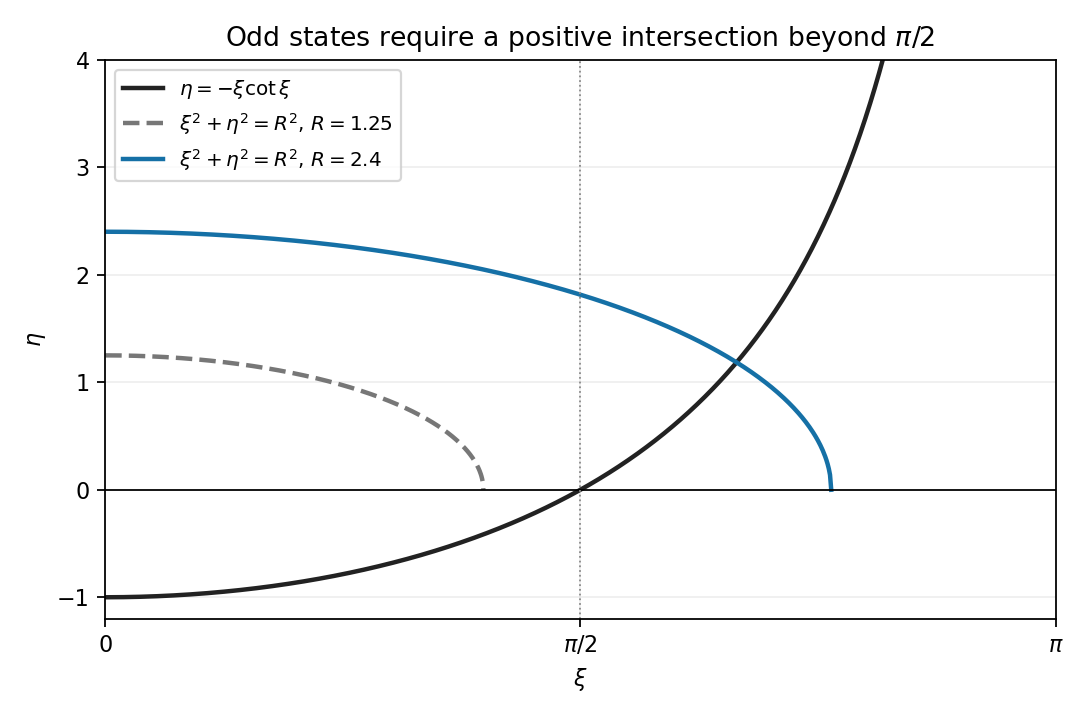
Odd bound-state condition and the threshold circle
. Details. Consequently rules out all odd states: the first positive branch already requires that radius, and later branches require still larger . This is precisely . At equality the intersection has and would not decay at infinity, so it too is not a normalizable bound state. An odd state first appears only for a strict increase beyond threshold.
Past exam of the Probability, statistics and options II course of the University of Oxford 2010 H H2 Solution by Codex 0 2026-10-31
Codex 0 2026-10-31By reflection symmetry, is the midpoint of the cylinder axis. With position measured from , define . Symmetry makes the off-diagonal entries zero. Uniform density gives and , by integrating over a disk and the interval . HenceFor parallel axes based at , the tensor form of the parallel-axis theorem is , where . This follows by substituting in the defining integral and using . Here is an axial vector of length , soThe Euler angles are cyclic coordinates. Their conserved conjugate momenta are and . The Lagrangian has no explicit time dependence, so the conserved energy is kinetic plus gravitational potential, namely the expression given with constant .
Past exam of the Probability, statistics and options II course of the University of Oxford 2010 G G2 Solution by Codex 0 2026-10-31
Codex 0 2026-10-31At a regular constrained extremum, choose an admissible variation with . The implicit function theorem applied to permits a compensating keeping fixed. Differentiation at zero gives for every , where . Integrating the first variation of by parts and using arbitrary compactly supported givesSmoothness alone does not exclude an abnormal constraint: if vanishes identically, one needs the general multiplier form with two multipliers rather than automatically setting the coefficient of to one. The displayed normal form uses the usual regular-constraint hypothesis.
For the given quadratic functionals, the equation is . If the endpoint values of are free, the boundary variation gives the natural conditions , interpreted by limits at singular endpoints. Multiply the equation by and integrate. These boundary terms vanish, leavingFor two eigenfunctions, multiply their equations by the other function and subtract. Integration givesThe natural conditions remove the bracket, so distinct eigenvalues imply .
In the Legendre case, comparison of leading polynomial coefficients gives , so the degrees correspond to distinct eigenvalues. A degree-zero polynomial is . Write ; orthogonality to on gives . Write . Orthogonality to gives , and orthogonality to gives . ThusThese polynomials satisfy the natural endpoint limits because vanishes at both endpoints.
Pinned article: Introduction to the OurBigBook Project
Welcome to the OurBigBook Project! Our goal is to create the perfect publishing platform for STEM subjects, and get university-level students to write the best free STEM tutorials ever.
Everyone is welcome to create an account and play with the site: ourbigbook.com/go/register. We belive that students themselves can write amazing tutorials, but teachers are welcome too. You can write about anything you want, it doesn't have to be STEM or even educational. Silly test content is very welcome and you won't be penalized in any way. Just keep it legal!
Intro to OurBigBook
. Source. We have two killer features:
- topics: topics group articles by different users with the same title, e.g. here is the topic for the "Fundamental Theorem of Calculus" ourbigbook.com/go/topic/fundamental-theorem-of-calculusArticles of different users are sorted by upvote within each article page. This feature is a bit like:
- a Wikipedia where each user can have their own version of each article
- a Q&A website like Stack Overflow, where multiple people can give their views on a given topic, and the best ones are sorted by upvote. Except you don't need to wait for someone to ask first, and any topic goes, no matter how narrow or broad
This feature makes it possible for readers to find better explanations of any topic created by other writers. And it allows writers to create an explanation in a place that readers might actually find it.
Figure 1. Screenshot of the "Derivative" topic page. View it live at: ourbigbook.com/go/topic/derivativeVideo 2. OurBigBook Web topics demo. Source. - local editing: you can store all your personal knowledge base content locally in a plaintext markup format that can be edited locally and published either:This way you can be sure that even if OurBigBook.com were to go down one day (which we have no plans to do as it is quite cheap to host!), your content will still be perfectly readable as a static site.
- to OurBigBook.com to get awesome multi-user features like topics and likes
- as HTML files to a static website, which you can host yourself for free on many external providers like GitHub Pages, and remain in full control

Figure 2. You can publish local OurBigBook lightweight markup files to either OurBigBook.com or as a static website.
Figure 3. Visual Studio Code extension installation.
Figure 5. . You can also edit articles on the Web editor without installing anything locally. Video 3. Edit locally and publish demo. Source. This shows editing OurBigBook Markup and publishing it using the Visual Studio Code extension. 
- Infinitely deep tables of contents:



All our software is open source and hosted at: github.com/ourbigbook/ourbigbook
Further documentation can be found at: docs.ourbigbook.com
Feel free to reach our to us for any help or suggestions: docs.ourbigbook.com/#contact