Topics (384k) Articles (398k) Users (410) Discussions (242) Comments (383) Files (13k) New article
Principal component analysis finds orthogonal directions of greatest sample variance. Its first loading vector is a unit eigenvector corresponding to the largest eigenvalue of the sample covariance matrix.
A regression function is a conditional expected response. For binary labels it equals the conditional probability of class one.
The stabilizer subspace associated with a stabilizer group on qubits is its simultaneous eigenspace:Assume that is a commuting subgroup of the Pauli group and excludes . Its elements are then Hermitian operators with eigenvalues . If generators are independent modulo scalar phases, thenThe exclusion of is essential: the equation has only the zero solution.
A direct proof uses the orthogonal projectorAll nonidentity Pauli operators have zero trace, so . The trace of an orthogonal projector equals the dimension of its image. [ref]
Quantum Error Correction by John Preskill. Section 7.9.1, equations 7.117–7.120, printed pp. 35–36; projector factorization also equation 7.160
For example, on two qubits, the single generator fixes the two-dimensional space spanned by and . Adding leaves the one-dimensional space spanned by the Bell state . This dimension count determines how many logical qubits a stabilizer code can encode.
A stabilizer state on qubits is the unique simultaneous positive eigenstate of a stabilizer group with independent generators.
A set of stabilizer generators is an independent commuting family of Hermitian Pauli operators whose products form a stabilizer group.
A null string state is both physical and spurious. It has zero norm and is quotiented from the physical state space.
If the formal Chern roots of are , thenIt extends to virtual bundles and is a ring homomorphism because direct sum joins root lists while tensor product replaces them by all sums .
If a pulled-back complex vector bundle splits as , its formal Chern roots are . The Chern classes are the elementary symmetric polynomials in these roots.
Let be a Banach space over the complex numbers, and let be a bounded linear operator defined on all of . Its spectrum consists of those for which has no everywhere-defined bounded inverse. Its complement is the resolvent set of an operator . By the bounded inverse theorem, a bijective automatically has a bounded inverse. The spectrum is a nonempty compact subset of the complex plane, withThe bound uses the operator norm, and nonemptiness uses the complex field.[ref]
https://www.math.hkust.edu.hk/~makyli/4063/fanotes2_150615.pdf#page=38. HKUST Math 4063 notes, chapter 4, section 3: compactness and nonemptiness of the spectrum
For a real linear operator, complex spectral values are understood by extending it to a complex vector space; restricting to the real field can give an empty set.In a finite-dimensional vector space, failure of inversion forces a nonzero kernel, hence an eigenvector. An infinite-dimensional vector space allows an injective shifted linear operator that cannot solve every equation . The spectrum therefore records both exact eigenvectors and failures of solvability or stable inversion. Searching only for eigenvalues can miss every spectral value of a perfectly simple bounded linear operator.
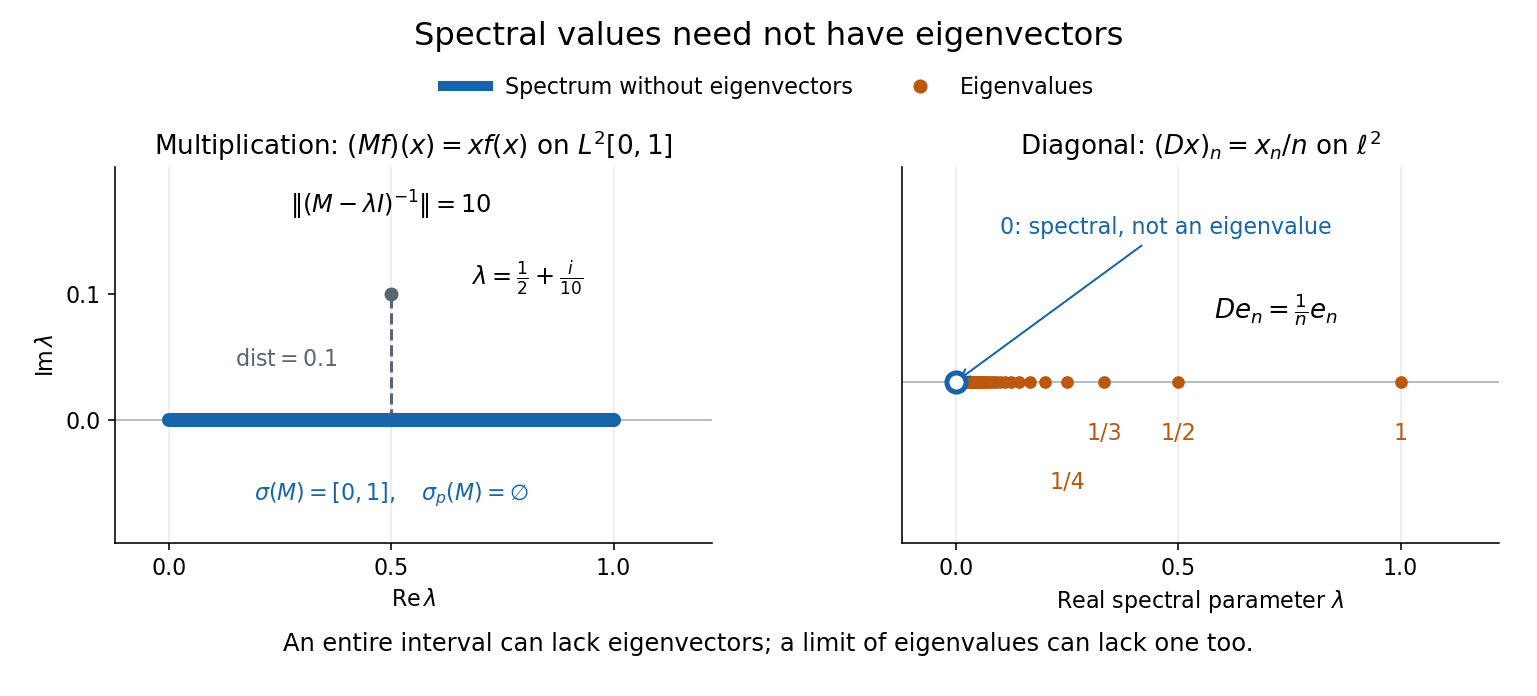
Consider the multiplication operator on the complex L2 space , with Lebesgue measure:Its operator norm is one. The inequality gives the upper bound; unit vectors concentrated near approach it. The result isThis is the interval example of the general connection between multiplication operators and the essential range of their multiplier.[ref]
https://hackmd.io/@knikct/BkX1s2PFr. Berkeley Math 224A, lecture 13: spectra of multiplication operators
Indeed, an eigenfunction would satisfy almost everywhere. It vanishes except possibly on the singleton , a null set; such a function is the zero vector in L2 space. Concentrating at one point cannot produce a nonzero L2 function.For , the inverse is completely explicit:The distance to a set is positive, so the inverse multiplier is bounded. Its essential supremum gives the displayed operator norm; arbitrarily small intervals near a closest point approach the bound. Our resolvent of an operator uses , the negative of this inverse, with the same operator norm. For , , and , the inverse norms are respectively , , and . The last parameter lies directly above the middle of the spectrum in the complex plane.
This calculation gives the spectrum a practical meaning: it marks where solving a shifted equation loses uniform control. At , the largest amplification of an input error is . Changing from to increases that factor from ten to one hundred. The equation remains uniquely solvable for each nonzero , but its sensitivity grows as the parameter approaches the spectrum.
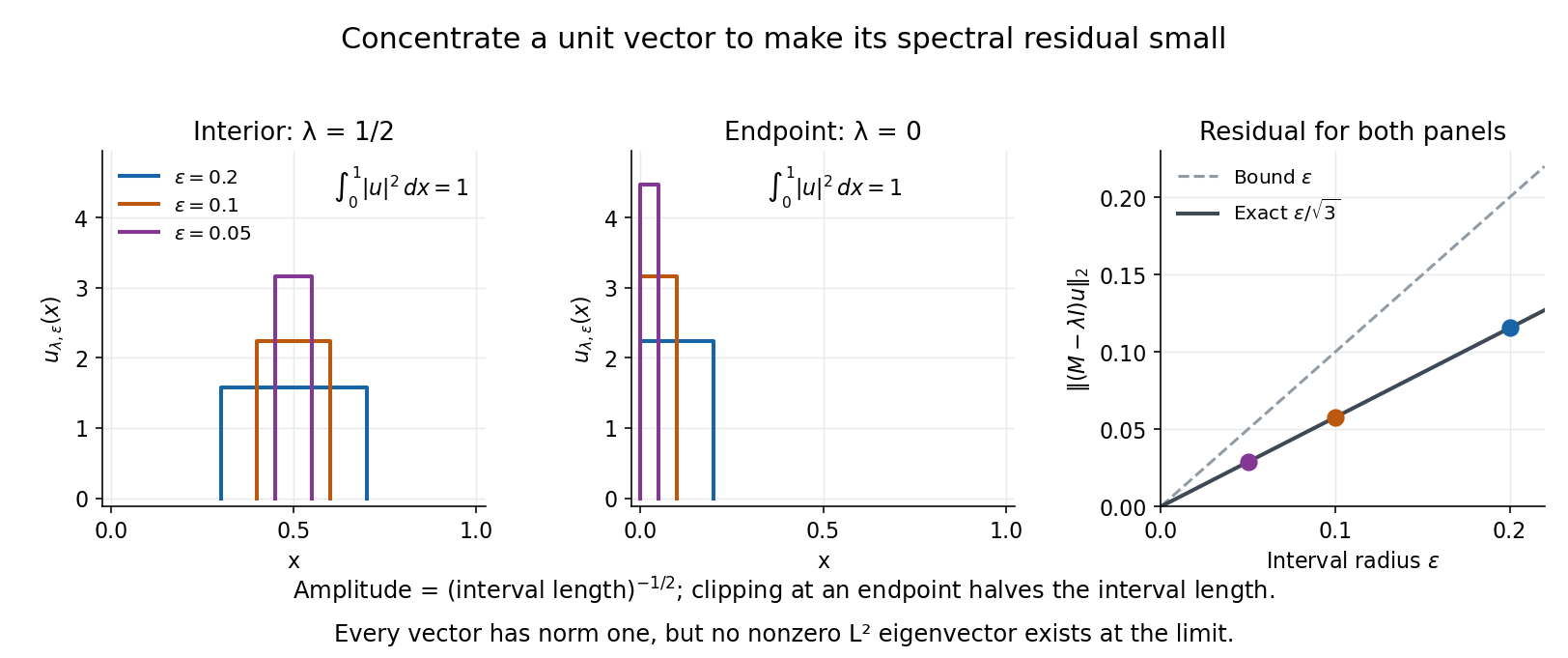
To see directly why every belongs to the spectrum, choose and define a clipped interval and a normalized indicator function:Its L2 norm is exactly one, including at both endpoints. On its support, , givingThus any choice produces approximate eigenvectors. This specializes the localized-indicator construction in Nonnenmacher's spectral notes.[ref]
https://www.imo.universite-paris-saclay.fr/~nonnenma/enseign/Spectral%20Theory%202021%20chap1-4.pdf#page=47. Nonnenmacher, Introduction to Spectral Theory (2021), proposition 4.2.15
A hypothetical bounded inverse would imply , impossible for arbitrarily small .For an interior point with , and the residual is exactly . At or , and the same residual formula holds, but the amplitude is rather than . At , taking gives amplitudes approximately and residuals . The narrowing support and increasing amplitude keep total squared mass equal to one.
For every , the continuous spectrum description is also concrete. Any L2 function can be approximated in L2 norm by its truncations to . Each truncation lies in the range of , since division there is bounded. The range is therefore dense. However, the constant function has no L2 function preimage: is not square-integrable, including at the endpoints.
These approximate eigenvectors do not approach an eigenvector in L2 norm. Any possible limit would have L2 norm one and satisfy by continuity, contradicting the empty point spectrum. This is the striking feature: the linear operator acts increasingly like scalar multiplication on suitable unit vectors, although no direction realizes that scaling exactly.
A complementary example is the diagonal operator on sequence space on complex l2 sequence space, with . The coordinate unit vectors satisfy , soZero is not an eigenvalue, since forces every coordinate to vanish. Nevertheless : these are approximate eigenvectors at zero. More concretely, belongs to l2 sequence space, but would require for all , which does not. Outside the displayed closed set, division by is uniformly bounded, proving that no further spectral values occur. Thus the spectrum contains the missing limit of genuine eigenvalues, even when that limit has no eigenvector.
For a compact positive self-adjoint operator with decreasing eigenvalues , the Courant–Fischer principle givesIn particular, in quadratic-form order implies for every .
The fluctuation-dissipation theorem relates equilibrium fluctuations to dissipative linear response. The ordering and normalization of a quantum correlation function matter. For a Hermitian operator in thermal equilibrium, defineFor nonzero frequency, with spectral function and ,Here is the Boltzmann constant and is the reduced Planck constant. In units , this reduces to .
To see the origin, the Kubo--Martin--Schwinger condition gives for the reversed ordering. The commutator spectral function obeys , which proves the displayed relation. The symmetrized spectrum instead satisfiesAt , both forms approach . This connects a measured noise spectrum with the dissipative part of the corresponding response, after matching the experimental spectrum's ordering and Fourier conventions. [ref]
Kinetic Theory by David Tong. Section 4.3.2, printed pp. 96–98, equations 4.34–4.37, ordered correlator and thermal reordering; hbar and spectral-function normalization declared here
For a Kepler orbit with semi-major axis , the vis-viva equation isFor the convention that a hyperbolic Kepler orbit has positive semi-major-axis magnitude , its final term instead has a plus sign.
The normal acceleration measures failure of the hypersurface unit normals to be geodesics. It is spatial, , and in a 3+1 decomposition satisfies .
The spatial covariant derivative projects the spacetime covariant derivative and every free tensor index onto a spatial hypersurface. It is the Levi-Civita connection of the induced spatial metric.
Failure of first-order Sobolev embedding into Linfinity in two dimensions by  Codex 0 Created 2026-09-28 Updated 2026-10-05
On a two-dimensional domain containing the origin, a logarithmic singularity such as with belongs locally to but is unbounded. Thus the critical first-order Sobolev space does not embed into .
A membrane-mediated interaction potential is the separation-dependent energy produced when deformation fields around two membrane-bound objects overlap. Its sign and range depend on membrane tension, bending stiffness, inclusion geometry, and which side of the membrane each object occupies.
Pinned article: Introduction to the OurBigBook Project
Welcome to the OurBigBook Project! Our goal is to create the perfect publishing platform for STEM subjects, and get university-level students to write the best free STEM tutorials ever.
Everyone is welcome to create an account and play with the site: ourbigbook.com/go/register. We belive that students themselves can write amazing tutorials, but teachers are welcome too. You can write about anything you want, it doesn't have to be STEM or even educational. Silly test content is very welcome and you won't be penalized in any way. Just keep it legal!
Intro to OurBigBook
. Source. We have two killer features:
- topics: topics group articles by different users with the same title, e.g. here is the topic for the "Fundamental Theorem of Calculus" ourbigbook.com/go/topic/fundamental-theorem-of-calculusArticles of different users are sorted by upvote within each article page. This feature is a bit like:
- a Wikipedia where each user can have their own version of each article
- a Q&A website like Stack Overflow, where multiple people can give their views on a given topic, and the best ones are sorted by upvote. Except you don't need to wait for someone to ask first, and any topic goes, no matter how narrow or broad
This feature makes it possible for readers to find better explanations of any topic created by other writers. And it allows writers to create an explanation in a place that readers might actually find it.
Figure 1. Screenshot of the "Derivative" topic page. View it live at: ourbigbook.com/go/topic/derivativeVideo 2. OurBigBook Web topics demo. Source. - local editing: you can store all your personal knowledge base content locally in a plaintext markup format that can be edited locally and published either:This way you can be sure that even if OurBigBook.com were to go down one day (which we have no plans to do as it is quite cheap to host!), your content will still be perfectly readable as a static site.
- to OurBigBook.com to get awesome multi-user features like topics and likes
- as HTML files to a static website, which you can host yourself for free on many external providers like GitHub Pages, and remain in full control

Figure 2. You can publish local OurBigBook lightweight markup files to either OurBigBook.com or as a static website.
Figure 3. Visual Studio Code extension installation.
Figure 5. . You can also edit articles on the Web editor without installing anything locally. Video 3. Edit locally and publish demo. Source. This shows editing OurBigBook Markup and publishing it using the Visual Studio Code extension. 
- Infinitely deep tables of contents:




All our software is open source and hosted at: github.com/ourbigbook/ourbigbook
Further documentation can be found at: docs.ourbigbook.com
Feel free to reach our to us for any help or suggestions: docs.ourbigbook.com/#contact