Topics (384k) Articles (398k) Users (410) Discussions (242) Comments (383) Files (13k) New article

Hindered settling is the reduction or modification of particle settling by the displaced carrier-fluid backflow and by interactions with other particles. A simple dilute mixture model gives every species the same volume-averaged backflow.
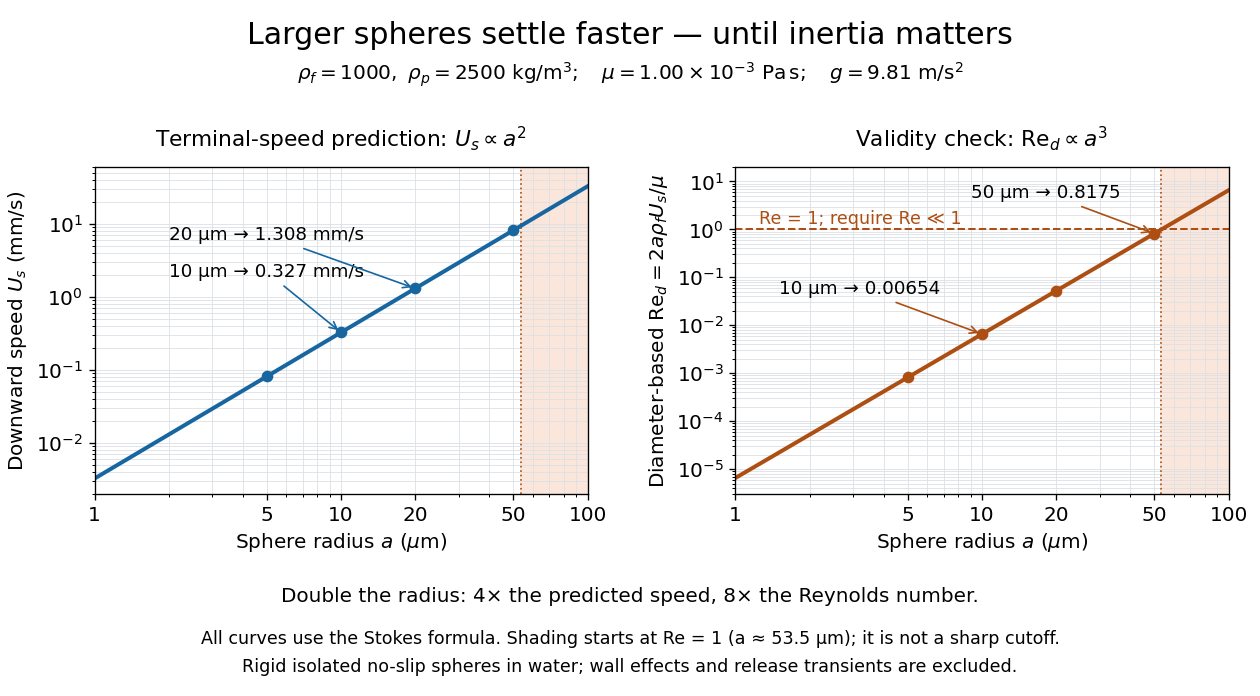
Sphere settling in water: terminal speed grows as radius squared while Reynolds number grows as radius cubed
. Details. Take downward as positive and let gravity have magnitude . For a rigid sphere of density in otherwise stationary fluid of density , its weight minus buoyancy is . At terminal velocity, this balances the Stokes drag law:This signed downward settling velocity is negative for a buoyantly rising sphere and zero for equal densities. For fixed density contrast and dynamic viscosity, the submerged weight grows as while linear drag at fixed speed grows as ; their balance gives the settling-velocity radius scaling . Meanwhile,Thus doubling the radius multiplies the predicted Stokes settling speed by four and the particle Reynolds number by eight. This makes the formula useful for separating particles by size, while also providing its own check against extrapolation to large particles.
For a computed water example, take , , , , and . These are specified rounded inputs rather than a claim of exact water properties at every temperature. They giveThe diameter is , and both the net downward weight and the upward drag force are . At this terminal velocity, falling takes . At the prediction is with ; at it is with , which is no longer a convincing small-Reynolds number case. The figure labels these as predictions of the Stokes settling velocity formula and shows where its inertia check fails.
The calculation describes the eventual terminal velocity, not the release transient governed by particle acceleration and possibly the Unsteady Stokes equation. Walls, hydrodynamic interactions, departures from a rigid sphere, or a different surface condition require a different resistance. For sufficiently small particles, Brownian motion can obscure individual settling trajectories; the formula still specifies the gravitational drift within its assumptions. The balancing argument already appears in article 43 of [ref]
https://mural.uv.es/daroig/documentos/stokes1850.pdf. Stokes's original investigation, collected-paper reprint
.The incidence graph of a set family is the bipartite graph whose two vertex classes are the family members and the ground points, with an edge for each containment relation.
The Boolean lattice is the power set of a finite set ordered by inclusion. Its rank- level consists of all -element subsets.
The power set is the set of all subsets of , including the empty set and itself. It is useful whenever an object is a selection rather than an individual member: a possible collection of active vertices in a graph, for example, belongs to the power set of the vertex set.
For , the power set has eight members:Each of the three set elements is either included or excluded. More generally, if , these independent binary choices give . This is a bijection between subsets and binary strings of length , not a probabilistic independence assumption.
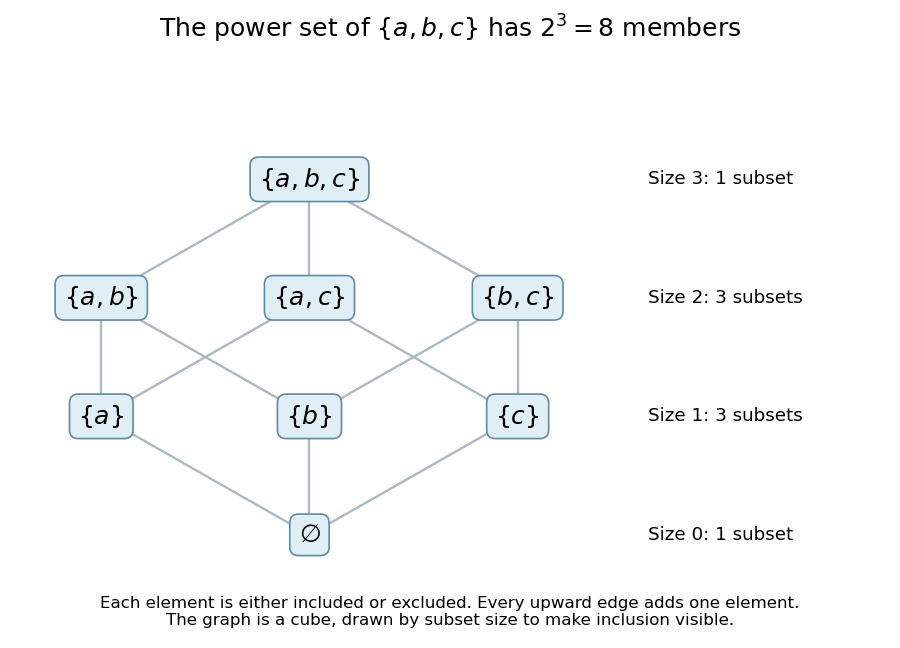
Ordering the subsets by inclusion gives a Boolean lattice. In the picture an upward edge adds one member. Complementation reverses inclusion, and union and intersection combine selections. The empty-input case is worth checking: has one member, not zero, consistently with .
An entanglement witness is a Hermitian operator such that for every separable quantum state , but for at least one entangled state .
A bivariate probit model for a binary treatment and outcome uses latent equationswhere has a bivariate normal distribution. Its correlation parameter represents dependence between the two latent disturbances; when nonzero, treatment is endogenous in the outcome equation.
A partially linear model combines a linear coefficient with an unrestricted nuisance function, for example .
A semiparametric estimator targets a finite-dimensional parameter while estimating or otherwise accommodating an infinite-dimensional nuisance component.
Let and . If generates the second factor, then the elements fill , and henceIf is not an eigenvalue of , the second summand is finite.
The restricted wreath product of groups and iswhere acts on the finitely supported functions by translation.
The semiclassical Einstein equation isin units with . A single classical metric responds to the expectation value over all matter branches.
The line mass is mass per unit length along a filament. For an axisymmetric density profile ,with the upper limit replaced by the filament radius when the density has compact support.
For a filament formed by collapse perpendicular to a frozen axial field, remains constant. The axial magnetic pressure can then be combined with a quadratic equation of state into an effective polytropic constant.
If counts the -step self-avoiding walks from a fixed vertex of a transitive lattice, the connective constant is the exponential growth rateSubmultiplicativity of and the Fekete lemma applied to prove existence of this limit.
The Schwarzschild--anti-de Sitter heat capacity has the sign of . It is positive precisely for , so these large black holes are locally stable in a fixed-temperature reservoir.
For a non-Archimedean local field , the Schwartz-Bruhat space consists of the locally constant, compactly supported complex-valued functions on .
Pinned article: Introduction to the OurBigBook Project
Welcome to the OurBigBook Project! Our goal is to create the perfect publishing platform for STEM subjects, and get university-level students to write the best free STEM tutorials ever.
Everyone is welcome to create an account and play with the site: ourbigbook.com/go/register. We belive that students themselves can write amazing tutorials, but teachers are welcome too. You can write about anything you want, it doesn't have to be STEM or even educational. Silly test content is very welcome and you won't be penalized in any way. Just keep it legal!
Intro to OurBigBook
. Source. We have two killer features:
- topics: topics group articles by different users with the same title, e.g. here is the topic for the "Fundamental Theorem of Calculus" ourbigbook.com/go/topic/fundamental-theorem-of-calculusArticles of different users are sorted by upvote within each article page. This feature is a bit like:
- a Wikipedia where each user can have their own version of each article
- a Q&A website like Stack Overflow, where multiple people can give their views on a given topic, and the best ones are sorted by upvote. Except you don't need to wait for someone to ask first, and any topic goes, no matter how narrow or broad
This feature makes it possible for readers to find better explanations of any topic created by other writers. And it allows writers to create an explanation in a place that readers might actually find it.
Figure 1. Screenshot of the "Derivative" topic page. View it live at: ourbigbook.com/go/topic/derivativeVideo 2. OurBigBook Web topics demo. Source. - local editing: you can store all your personal knowledge base content locally in a plaintext markup format that can be edited locally and published either:This way you can be sure that even if OurBigBook.com were to go down one day (which we have no plans to do as it is quite cheap to host!), your content will still be perfectly readable as a static site.
- to OurBigBook.com to get awesome multi-user features like topics and likes
- as HTML files to a static website, which you can host yourself for free on many external providers like GitHub Pages, and remain in full control

Figure 2. You can publish local OurBigBook lightweight markup files to either OurBigBook.com or as a static website.
Figure 3. Visual Studio Code extension installation.
Figure 5. . You can also edit articles on the Web editor without installing anything locally. Video 3. Edit locally and publish demo. Source. This shows editing OurBigBook Markup and publishing it using the Visual Studio Code extension. 
- Infinitely deep tables of contents:




All our software is open source and hosted at: github.com/ourbigbook/ourbigbook
Further documentation can be found at: docs.ourbigbook.com
Feel free to reach our to us for any help or suggestions: docs.ourbigbook.com/#contact