
A biological cell is a membrane-bounded basic unit of living organization. In a cell-level experiment it can be an experimental unit, provided that treatment assignment and relevant interactions are handled at that level.
The shared architecture of cellular life combines a selective cell membrane, internal cytoplasm, inherited information in DNA, and ribosomes that assemble proteins. Metabolism supplies transformations of matter and energy needed for maintenance and growth. These components form a coupled system: a boundary retains useful molecules, enzymes organize chemical reactions, and inherited information supports rebuilding the machinery. See Clark, Douglas and Choi, Biology 2e: prokaryotic cells.
A worked structural comparison: in a typical prokaryote, DNA occupies a region without a surrounding cell nucleus; in a typical nucleated eukaryote, much of the DNA lies inside a membrane-bounded cell nucleus. Both still have a cell membrane, cytoplasm and ribosomes. The extra boundary compartmentalizes processes; it does not create a different basic principle of living organization. See Clark, Douglas and Choi, Biology 2e: eukaryotic cells.
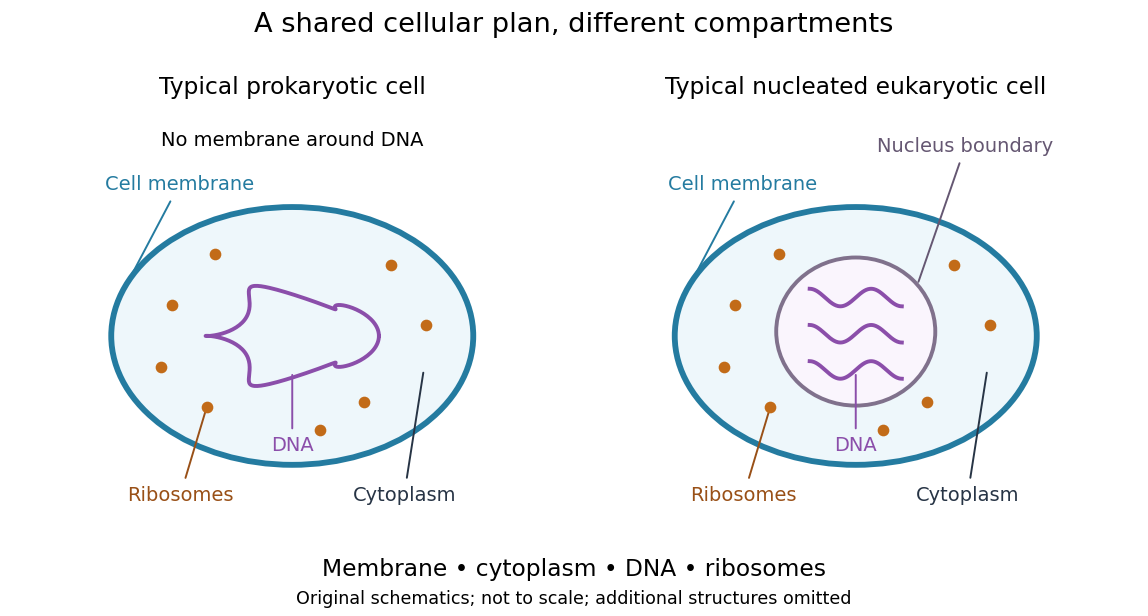
Shared cellular architecture with different DNA compartmentalization
. Original simplified schematics of a prokaryote and a nucleated eukaryote. Colors identify corresponding components; sizes and component counts are illustrative, and additional structures are omitted. Details.
Shared architecture describes cellular life and its developmental machinery, rather than requiring every specialized biological cell to retain every component. A mature mammalian red blood cell, for example, lacks a cell nucleus, although it develops from nucleated precursors. See Clark, Douglas and Choi, Biology 2e: components of blood. This distinction makes cellular unity compatible with striking specialization.
New to topics? Read the docs here!