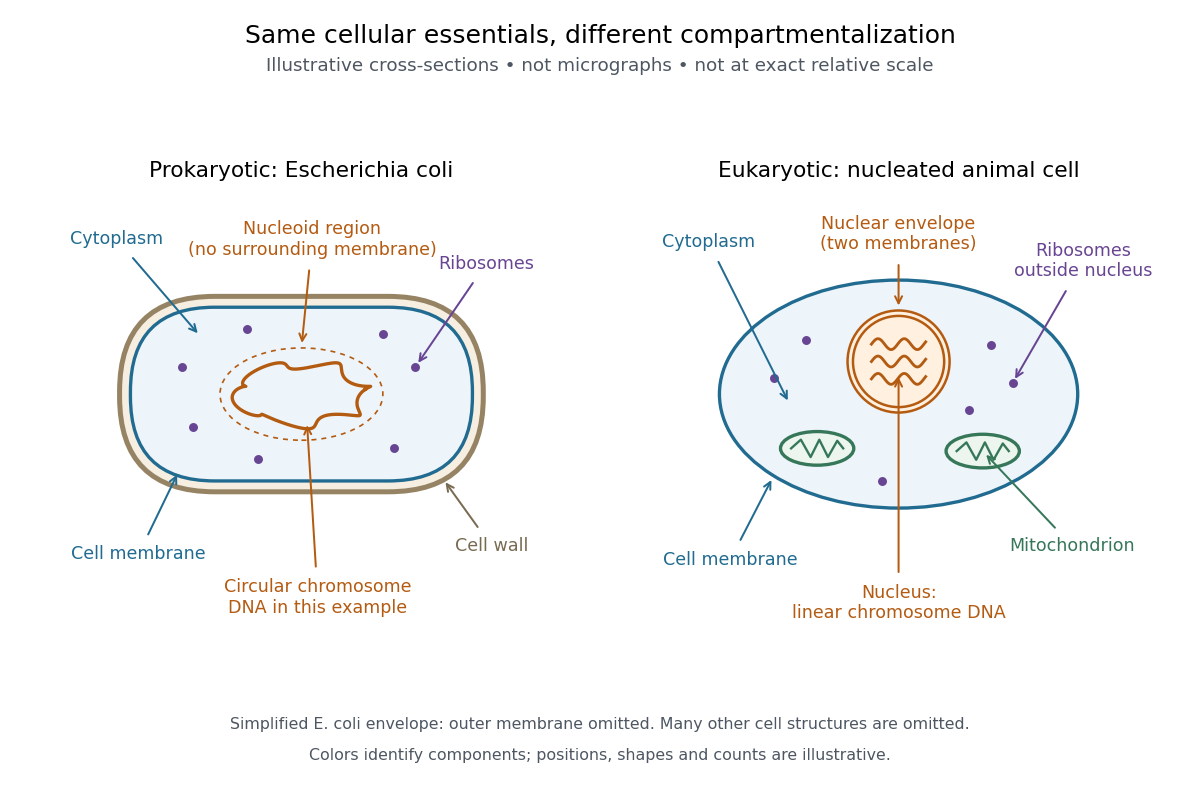
A prokaryote is an organism whose biological cells lack a membrane-bounded cell nucleus. The DNA of its chromosomes occupies a nucleoid within the cytoplasm. Bacteria and archaea have this cellular organization. Both contain ribosomes that perform biological translation and a selective cell membrane; neither is a bag of unorganized chemicals. See OpenStax Biology 2e, 4.2: prokaryotic organization.
The word prokaryotic describes organization, not a single exclusive clade. Grouping bacteria and archaea by the absence of a cell nucleus is useful for comparing biological cells, but does not establish that they share a more recent ancestor with one another than either does with eukaryotes. See three-domain system and two-domain system for the different ancestry models.
Prokaryotic does not mean membrane-free. Cyanobacteria contain internal thylakoid membranes for oxygenic photosynthesis, despite lacking chloroplasts and a cell nucleus. Many prokaryotes have circular chromosomes, but circular shape and a single chromosome are not defining requirements. See OpenStax Biology 2e, 22.2: bacterial and archaeal structures.