
The cytoplasm is the material inside a cell membrane but outside the cell nucleus, when one is present. It includes the cytosol, the organelles suspended in it, and other structures; it is not just a name for the liquid. In a prokaryote, which has no cell nucleus, the nucleoid and ribosomes are within the cytoplasm. See Clark, Douglas and Choi, Biology 2e, 4.3: cytoplasm and cytosol and Clark, Douglas and Choi, Biology 2e, 4.2: prokaryotic organization.
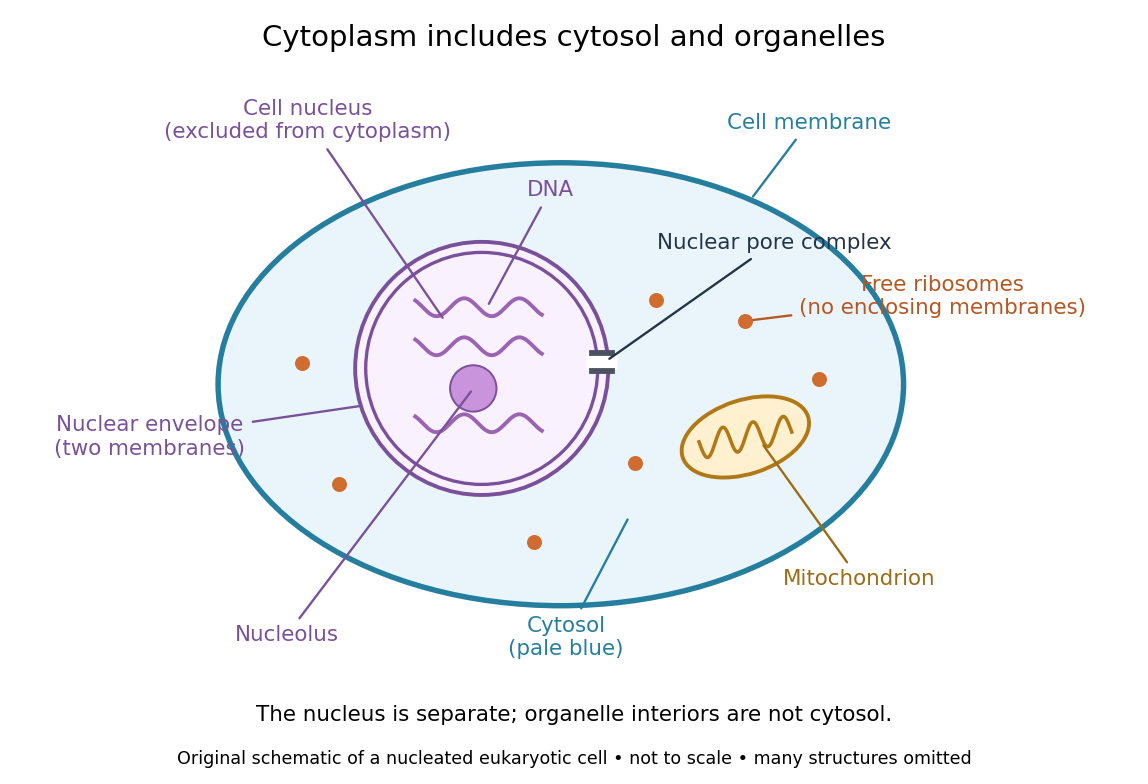
Try classifying four positions in the diagram. A point in the pale blue region belongs to both cytosol and cytoplasm. A point inside the mitochondrion belongs to an organelle included in the cytoplasm, but not to the surrounding cytosol. A point on a free ribosome belongs to the cytoplasm, but the ribosome itself is not cytosol. A point inside the cell nucleus belongs to neither cytoplasm nor cytosol. These distinctions prevent the misleading inference that everything outside the cell nucleus shares one undivided liquid environment.
The usefulness of the cytoplasm is this combination of shared surroundings and specialized structures: enzymes in the cytosol carry out many steps of metabolism, while organelles maintain their own internal conditions. A soluble protein made by a free ribosome may work in the cytosol or be transported elsewhere, including into the cell nucleus. Cellular organization therefore combines separation with exchange, rather than assigning each protein permanently to its place of synthesis. See Alberts et al., Molecular Biology of the Cell (2002): traffic between nucleus and cytosol.


New to topics? Read the docs here!