
The Debye T-cubed test asks whether a bulk three-dimensional crystal's lattice molar heat capacity approaches a cubic law well below its Debye temperature . It tests the low-frequency acoustic phonon branches in the Debye model, rather than asserting that every contribution to a real sample's heat capacity is cubic. Peter Debye's continuum description makes a striking connection: a thermal measurement can reveal the low-frequency vibrational density of states without resolving individual vibrations.[ref]
3 Quantum Gases. Statistical Physics by David Tong; §3.3.1, The Debye Model: low-temperature heat capacity
For a monatomic bulk model, the Debye model has vibrational density of states up to the Debye frequency , containing normal modes. With , the thermal vibrational internal energy becomesThe reduced Planck constant is , the Boltzmann constant is , and counts chemical atoms. For , replace the upper limit by infinity. The integral is , as in the Stefan–Boltzmann law derivation. Differentiating at fixed volume gives, per mole of chemical atoms,where is the molar gas constant. The cubic exponent comes from three-dimensional acoustic phonon branches with linear low-wavevector dispersion relations. The coefficient encodes their propagation speeds. Formula-unit normalization in a compound requires its number of chemical atoms per formula unit; do not silently substitute moles of formula units for moles of chemical atoms.
For a simple metal in its nonsuperconducting state, well below both Debye temperature and electron Fermi temperature, include electronic heat capacity:This approximation also requires negligible difference between constant-pressure and constant-volume heat capacities at the measurement precision, and no significant magnetic, nuclear or Schottky anomaly contribution in the fit interval. Thus linear regression of against separates an electronic intercept from a lattice slope. For an insulating crystal with no relevant low-energy magnetic excitations, the electronic term can instead be negligible; a superconductivity transition changes the electronic response.[ref]
3 Quantum Gases. Statistical Physics by David Tong; §§3.3.1 and 3.6.3: phonon and electronic low-temperature contributions
After subtracting calorimeter addenda, Brando's second gold sample, , gave a linear versus plot in the nonsuperconducting state. The reported electronic intercept was ; deviations from reference heat capacities were below .[ref]
Development of a Relaxation Calorimeter for Temperatures between 0.05 and 4 K by Manuel Brando. §IV.B and Fig. 9: separate validation sample, molar electronic intercept and reference-comparison inset; plotted temperatures extend to about 3 K
This supports the combined linear-plus-cubic description over the plotted interval. Because the platform subtraction used reference gold, it is also an instrument validation with a shared material standard, rather than a wholly independent determination of the Debye model from an uncalibrated instrument.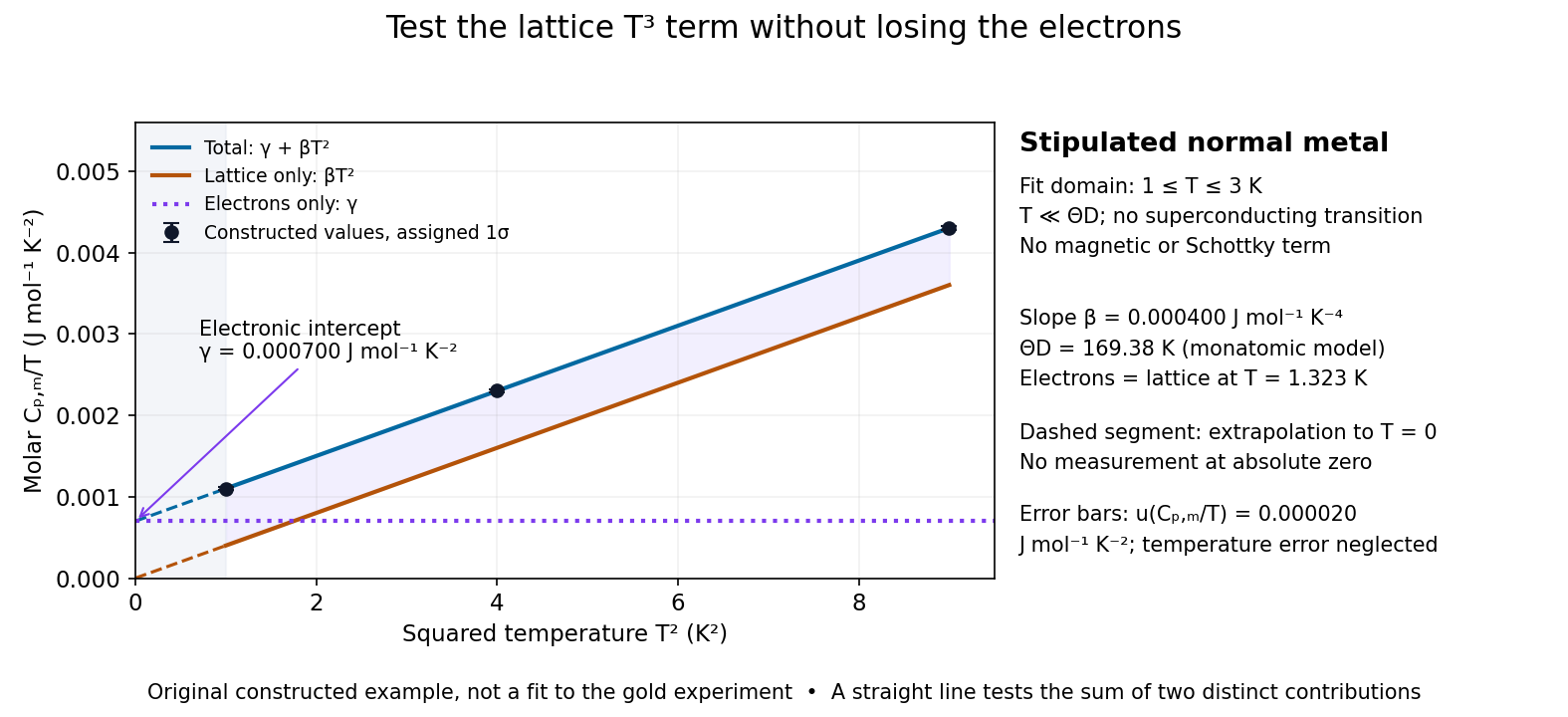

For a worked original inference, stipulate values of equal to at . Assign independent and negligible temperature error. Equal-weight linear regression on givesThe points sit exactly on the stipulated line; these standard uncertainties come from the assigned input precision, not an estimate from zero residual scatter. With , inversion givesAt , the electronic and lattice molar heat capacities are respectively and . Their equality occurs at : even in this clean model, the total heat capacity approaches a linear, rather than cubic, law as tends to zero in the normal state.
A straight line over a narrow interval is a useful diagnostic, not a universal proof. Inspect residuals and repeat the fit over several upper and lower temperature cutoffs; curvature can signal higher lattice terms, an unremoved Schottky anomaly, or a faulty calorimeter addenda subtraction. Correlated thermometer calibration and sample-amount errors affect both axes and can dominate the illustrative linear regression uncertainty. Low-dimensional samples, additional low-energy excitations and proximity to a phase transition need other models. The test is valuable precisely because its failures can reveal physics beyond the bulk acoustic approximation.
New to topics? Read the docs here!