Hermitian inner product
ID: hermitian-inner-product

A Hermitian inner product is a Hermitian form on a complex vector space which has positive definiteness: for every nonzero vector . It is precisely a complex inner product. Only with this definiteness condition doesdefine a norm rather than a seminorm or an expression that may not be real. The standard Hermitian inner product on is ; positive weights give , with squared norm .[ref]
https://linear.axler.net/InnerProduct.pdf. Sheldon Axler, Linear Algebra Done Right, third edition, §6.A, definitions 6.3 and 6.9 and examples 6.4
A Hermitian inner product need not have a real matrix. For instance, with the linear-first coordinate convention,The last expression proves positive definiteness without a lengthy calculation of eigenvalues. For it gives , while for it gives . These unequal values expose why a silent switch to would change this particular Hermitian inner product: with these same entries it gives at . All entries must keep their roles from the matrix of a Hermitian form.
The Cauchy-Schwarz inequality for a Hermitian inner product statesEquality holds exactly when are linearly dependent, including when either is zero. For a nonzero , outline the proof by setting and . Then , and the Pythagorean theorem givesNonnegativity proves the inequality, while positive definiteness makes equality equivalent to . The scalar has no extra conjugate because the first argument is linear.[ref]
https://linear.axler.net/InnerProduct.pdf. Axler, Linear Algebra Done Right, third edition, orthogonal decomposition 6.14 and Cauchy-Schwarz inequality 6.15
The Cauchy-Schwarz inequality also holds for a positive semidefinite Hermitian form, but equality need not imply linear dependence: for , the independent vectors and give . Equality then describes dependence after passing to the quotient vector space by the radical of a Hermitian form. The indefinite Hermitian form in Hermitian form shows that conjugate symmetry alone does not even guarantee the inequality.
For a worked orthogonal projection, take , and . Then , and , with and for the squared norms. The residual is perpendicular in this Hermitian inner product even though its ordinary real dot product with is . For complex , the same orthogonal projection uses ; rotating multiplies by , while rotating multiplies by . This combines geometric decomposition with sensitivity to the relative complex arguments of the multipliers.
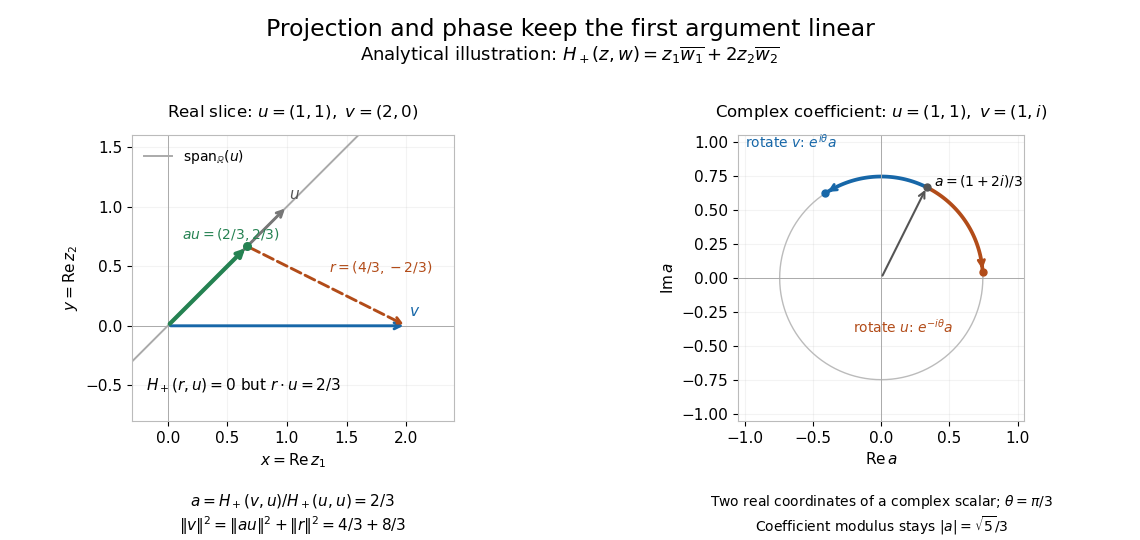
Analytical illustration: weighted orthogonal projection on a real slice and opposite changes of complex argument of its projection coefficient
. Details. 
A Hermitian inner product therefore supplies more than a positive diagonal: orthogonality, orthogonal projection onto a span, and the triangle inequality for its norm make approximation and distance meaningful. For the function space of complex continuous functions on , has positive definiteness, because a nonzero continuous function has positive modulus on a small interval. The same construction turns overlap under integration into lengths and best approximation in finite-dimensional vector subspaces.
New to topics? Read the docs here!