Intensive and extensive thermodynamic quantities
ID: intensive-and-extensive-thermodynamic-quantities

An extensive quantity measures how much of a thermodynamic system there is; an intensive quantity describes its state independently of that amount. The clean comparison is replication: take independent identical systems at the same thermodynamic equilibrium, with the same substance, composition and thermodynamic phase. Combining their accounting boundaries multiplies internal energy , entropy , volume , mass and amount of substance , while leaving temperature , pressure and chemical potential unchanged.[ref]
Statistical Physics by David Tong. Statistical Physics, chapter 1 The Fundamentals of Statistical Mechanics, §1.4.3 Extensive and Intensive Quantities
For copies the ledger isAn integer counts actual copies; a positive real describes the corresponding bulk scaling law. Copies can remain separated: replication need not involve removing a partition, changing a container or performing any work. Distinguish , the amount of substance measured in moles, from , the dimensionless count of specified entities, where is the Avogadro constant in . For example, contains specified entities; tripling it gives and entities. This uses the exact Avogadro constant , which does not triple. In the differential , is a molar chemical potential in ; the coefficient of instead has units of energy per entity.
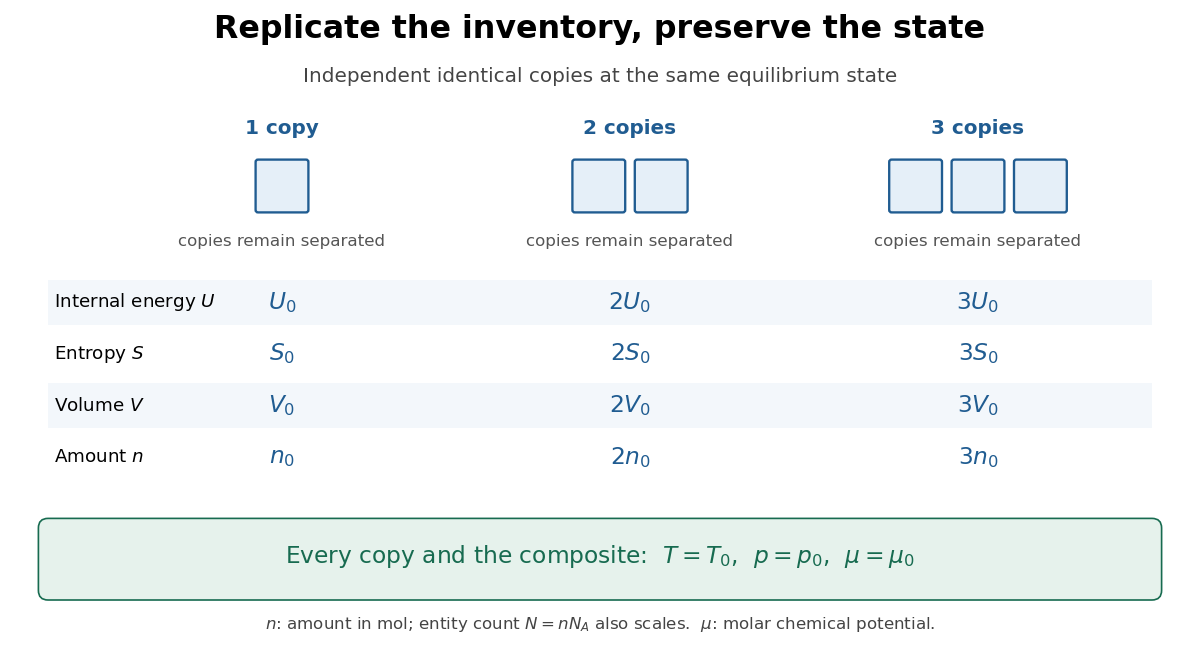
Replication multiplies the extensive ledger while preserving the equilibrium state
. Details. 
As a direct check, the ideal gas law givesFor a monatomic ideal gas with only translational degrees of freedom active, internal energy of an ideal gas gives , so at unchanged temperature. Here is the molar gas constant. The scaling distinction lets a small sample supply an equation of state for a much larger amount: material state and inventory become separate questions.
Replication does not mean multiplying every linear dimension by : a geometrically similar container then has times the volume. Nor does it mean combining samples at different states. Equal temperature establishes thermal equilibrium but does not imply equal pressure, composition or mass density. Density of a composite system makes this distinction concrete.
New to topics? Read the docs here!