Liquefaction enthalpy budget
ID: liquefaction-enthalpy-budget

Consider an original model of a cold section enclosing a throttle and collecting region, with the precooling heat exchanger outside its boundary. The inlet has mass flow rate and specific enthalpy . The outlets are equilibrium liquid and vapor at one fixed pressure, with specific enthalpies and . Let be the outlet liquid mass fraction, and let be incoming unwanted heat per unit incoming mass. Assume steady flow, no shaft work, and negligible bulk kinetic energy and gravitational potential energy changes. The steady-flow energy balance givesHere is the latent heat per unit mass at the chosen outlet pressure. The mass flow rates of the outlets are and . The formula describes a flowing cold section; a filling vessel with appreciable energy or mass accumulation requires storage terms.
For a deliberately dimensionless example, choosePer unit incoming mass, one quarter leaves as liquid and three quarters as vapor. With zero incoming heat, the same inlet would give . Increasing to reduces to , and reaches the no-liquid boundary. These are chosen model values, not helium property data or a historical yield. In normalized enthalpy units with and , conservation checks directly: .
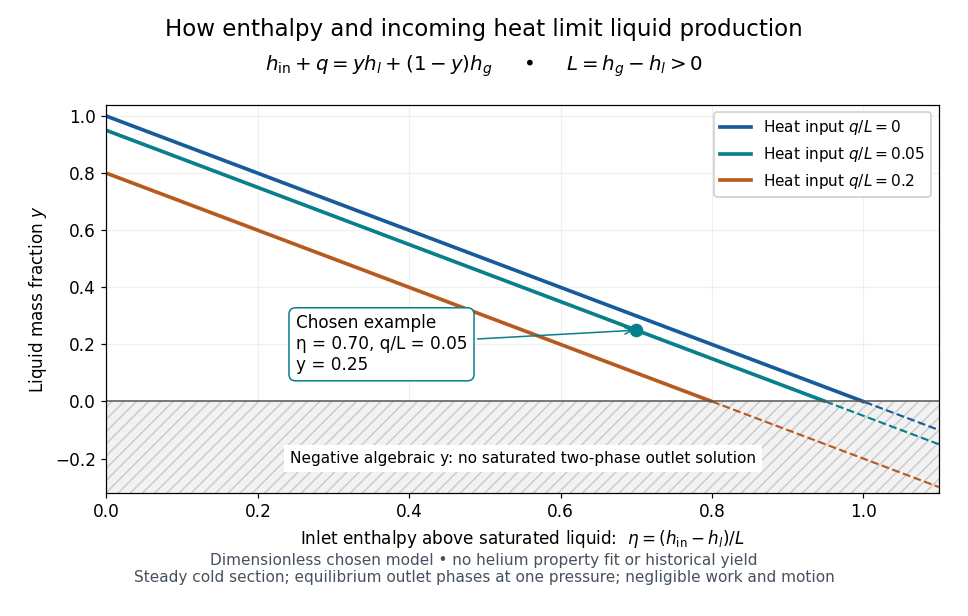
An original normalized liquefaction enthalpy budget
. Each solid segment satisfies the stipulated equilibrium two-outlet model. Dashed negative continuations are algebra only: they do not describe a negative liquid mass fraction. No helium properties or experimental measurements were fitted. Source. Details.
The admissible interval is , or . Outside it, the assumed equilibrium two-phase outlet fails: an enthalpy above requires a hotter single-vapor outlet under these assumptions, rather than a negative amount of liquid. Below , a colder liquid or a different thermodynamic phase must be considered. The balance does not predict its own outlet pressure, temperature or helium property functions.
At fixed outlet pressure, hence fixed , the derivatives are and . Lowering inlet specific enthalpy by regeneration and reducing incoming heat therefore buy the same increase in liquid mass fraction per unit energy per unit mass in this model. Adding any constant to all three specific enthalpies leaves unchanged. This independence of the arbitrary enthalpy reference makes the balance useful even when property tables choose different zero points.
New to topics? Read the docs here!