Solution
ID: past-exam-of-the-superconductivity-and-quantum-coherence-course-of-the-university-of-cambridge/2012/paper-1/2/solution
Past exam of the superconductivity and Quantum Coherence course of the University of Cambridge 2012 Paper 1 2 Solution by  Codex 0 2026-10-20
Momentum-resolved photoemission and directional tunneling can map the magnitude and nodes of the cuprate gap. Low-temperature heat capacity, thermal transport and penetration-depth measurements constrain the low-energy quasiparticle spectrum. These probes do not all determine the relative sign of the gap. A phase-sensitive test of d-wave pairing uses Josephson interference between differently oriented crystal regions. In the tricrystal half-flux experiment, a superconducting film crosses three designed grain boundaries; a frustrated ring can produce a half-flux signal detected with a scanning SQUID. Unfrustrated geometries supply controls. This probes phase structure beyond merely finding a V-shaped tunneling spectrum.[ref]
Pairing symmetry and flux quantization in a tricrystal superconducting ring by C. C. Tsuei and others. 1994, tricrystal geometry and flux measurement
For the ideal nearest-neighbor square lattice at one electron per site including both spins, particle-hole symmetry puts the chemical potential at zero. The two requested cuts areThe first runs from at the zone center to zero at ; the diagonal cut crosses zero at . The Fermi surface obeys , giving the diamond in the first Brillouin zone.
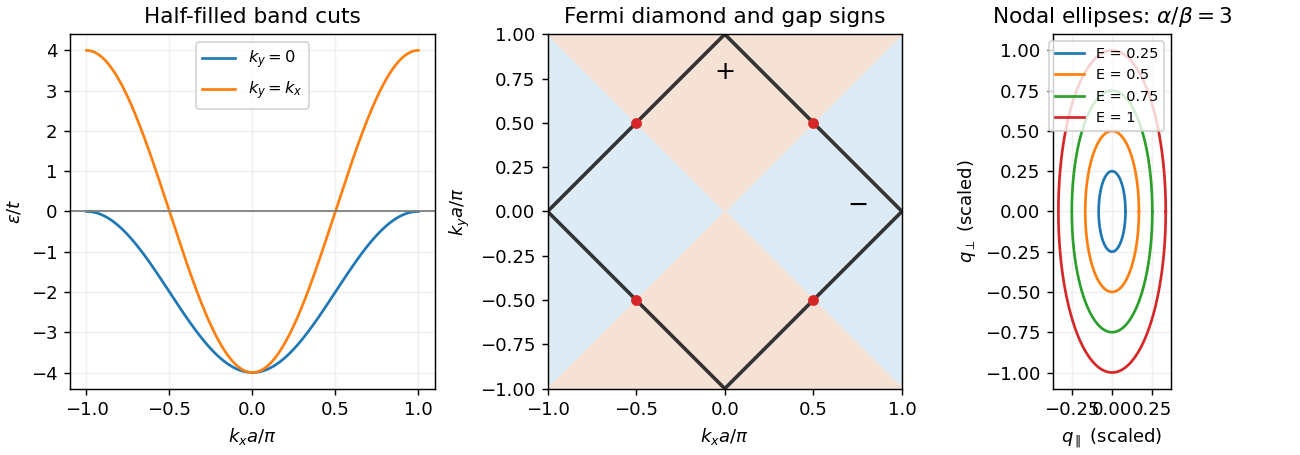
Half-filled square-lattice band cuts, diamond Fermi surface and anisotropic nodal quasiparticle contours
. Details. 
Near the specified node define andExpanding giveswhere and . ThereforeThere are four such nodes. An energy contour about one node encloses momentum area . Counting all four nodes and two independent spin quasiparticles, with one state per of momentum area per unit real-space area, gives the positive-excitation count and nodal quasiparticle density of states in a two-dimensional d-wave superconductorThis counts thermally excitable Bogoliubov modes, including particle-like and hole-like excitations, not the electron-addition spectral density alone. That distinction prevents a factor-of-two ambiguity. It is a per-layer result; dividing by the layer spacing gives the corresponding volume density in the independent-layer approximation.
The thermal energy density above its zero-temperature value follows from Fermi occupation:ThusThis clean nodal contribution assumes small compared with the scale over which linearization fails; impurity states and other excitations can add further terms.
In the vortex state, each flux quantum occupies area of order , so . Outside a core of radius , the phase flow has magnitude in the simple circular-cell estimate, with and condensed-pair mass . Its cell average isThe signed vector average can vanish around a vortex; the relevant quantity is a typical magnitude or Doppler shift, not a net transport velocity. Flow shifts nodal energies by order . Because the zero-field nodal density of states is linear in energy, averaging the magnitude of these shifts produces a residual density of states proportional to . The resulting Volovik effect givesThis is the clean semiclassical nodal regime, at temperatures below the field-induced Doppler scale and in an appropriate mixed-state field range. Core states, disorder, Zeeman splitting and screening can modify it. Its replacement by a square root of applied field additionally assumes the mean induction tracks that field away from the lower-critical-field onset; it is not an exact all-field law.
New to topics? Read the docs here!