Power, Sex, Suicide by Nick Lane (2006) part 5 "Murder or suicide" mentions that apoptosis has two main functions:
- prevent cancer
- but it is also an important part of body development, e.g. fingers are separated because cells between them kill themselves. Otherwise we would have webbed feet like ducks. There is also a lot of apoptosis during the development of the brain. This has been observed notably in C. elegans see also: Section "C. elegans cell lineage".
Power, Sex, Suicide by Nick Lane (2006) part 5 "Murder or suicide" mentions that the key events that leads to apoptosis is when certain proteins normally present in the inner mitochondrial membrane spill out, and that this often happens when free radicals are produced in excess: the cell is really not doing well in those cases. This point suggests that the initial mitochondrial endosymbiosis happened due to a parasite that lived inside another cell. It mentions that even today we see parasites kill the host cell when they feel that the cell does not have many nutrients. This frees the parasites to then infect other cells.
Articles by others on the same topic

The cell cycle is the sequence of events by which a biological cell prepares for and completes division, including DNA replication and distribution of chromosomes. In Saccharomyces cerevisiae, changing bud appearance provides an accessible readout; see the Burgess, Powers and Mell account and Hartwell, Culotti and Reid's primary study cited there.
For a typical cycling diploid eukaryotic biological cell, the order is G1 phase, S phase, G2 phase, then M phase. DNA replication doubles nuclear DNA amount during S phase; mitosis distributes the copies, and cytokinesis separates the daughters. The useful distinction is between copying a library and allocating its copies: DNA replication changes how much material exists, whereas division changes which biological cell contains it.
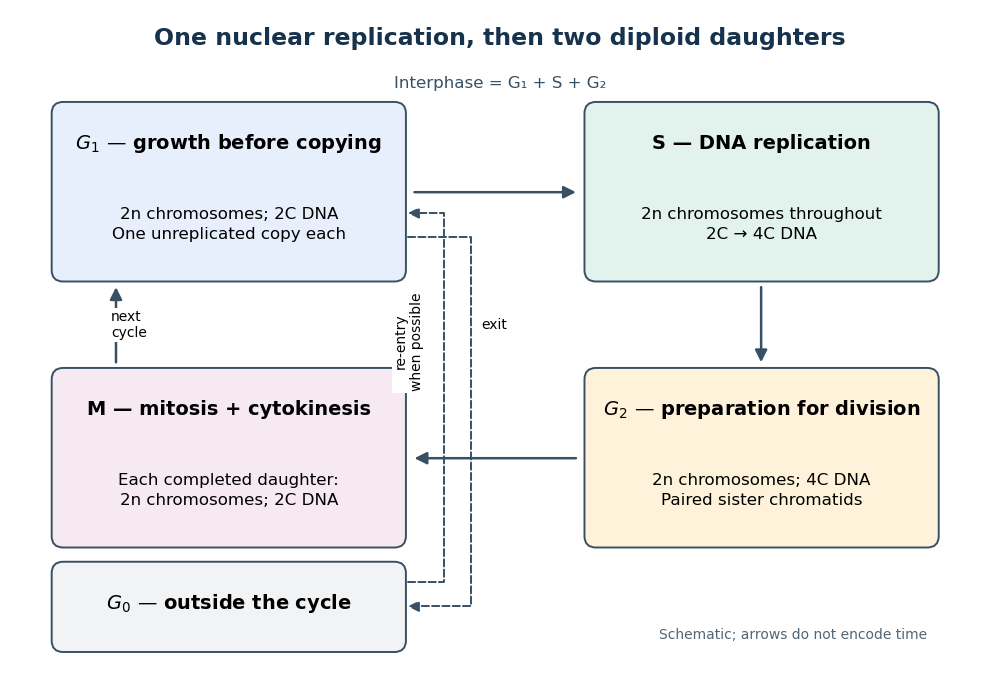

Gene expression continues to supply RNA and proteins as the biological cell grows; it is different from duplicating the genome. In the yeast cross-species complementation experiment, restored growth requires successful repeated cell cycles, but growth alone does not locate a defect within a phase. Bud appearance in Saccharomyces cerevisiae provides another readout, while a flow cytometric DNA-content assay asks how much nuclear DNA is present and DNA pulse labeling asks whether new DNA was synthesized during an exposure.