
Past exam of the mathematics course of the University of Cambridge 2019 ia Paper 2 9F a Solution Created 2026-09-24 Updated 2026-10-14
The Kolmogorov axioms for a probability measure are nonnegativity, normalization , and countable additivity on pairwise disjoint events. For , conditional probability is defined byBecause the events are pairwise disjoint and their union is , countable additivity gives the law of total probabilityFor any with , the definition of conditional probability and this identity give Bayes' theorem:
Past exam of the mathematics course of the University of Cambridge 2019 ia Paper 2 8C c Solution Created 2026-09-24 Updated 2026-09-29
Past exam of the mathematics course of the University of Cambridge 2019 ia Paper 2 8C b Solution Created 2026-09-24 Updated 2026-10-14
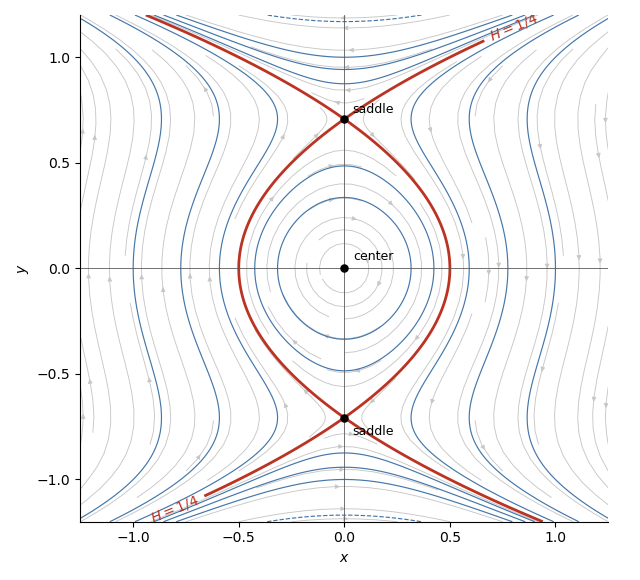
A critical point of a dynamical system satisfies and , so the critical points areThe Jacobian matrix of the vector field isAt the origin its eigenvalues are . Moreover, has a strict local minimum there, so the origin is a stable center of a planar dynamical system. At either other critical point,has eigenvalues , so both points are unstable saddle points. Their common value identifies the special separatrices shown below.

Past exam of the mathematics course of the University of Cambridge 2019 ia Paper 2 8C a Solution Created 2026-09-24 Updated 2026-09-29
Along a trajectory, the chain rule givesThus is a first integral, and every trajectory lies on one of its level sets.
Past exam of the mathematics course of the University of Cambridge 2019 ia Paper 2 7C e Solution Created 2026-09-24 Updated 2026-09-29
Using the Taylor expansionwe obtainWhen cooling is negligible, the milk lowers the temperature by one unit at . The hot-water term begins at and raises it at one unit per unit time, so one further unit of time is needed to erase the deficit.
Past exam of the mathematics course of the University of Cambridge 2019 ia Paper 2 7C d Solution Created 2026-09-24 Updated 2026-09-29
Past exam of the mathematics course of the University of Cambridge 2019 ia Paper 2 7C c Solution Created 2026-09-24 Updated 2026-09-29
For , the Heaviside step function contributes a constant unit forcing. Solving the resulting first-order linear differential equation from the value at gives
Past exam of the mathematics course of the University of Cambridge 2019 ia Paper 2 7C b Solution Created 2026-09-24 Updated 2026-09-29
Integrating the equation through gives the jump condition for an impulseFor the equation is again homogeneous, so propagation of the post-jump temperature givesTherefore
Past exam of the mathematics course of the University of Cambridge 2019 ia Paper 2 7C a Solution Created 2026-09-24 Updated 2026-09-29
Past exam of the mathematics course of the University of Cambridge 2019 ia Paper 2 5C c Solution Created 2026-09-24 Updated 2026-10-03
The identityshows that is a particular solution. Combining it with the homogeneous solution from part (b) givesThe condition gives , and gives . HenceThe exact initial-value solution is . Since ,Thus the absolute endpoint error is , consistent with the second-order truncation error of the centred scheme.
Past exam of the mathematics course of the University of Cambridge 2019 ia Paper 2 5C b Solution Created 2026-09-24 Updated 2026-09-29
The characteristic equation of a linear recurrence isIts repeated root givesSince , this can be written , exactly the discrete form of the continuous solution of .
Past exam of the mathematics course of the University of Cambridge 2019 ia Paper 2 5C a Solution Created 2026-09-24 Updated 2026-09-29
The Taylor expansions about areAdding them cancels the odd powers of and givesThus the centred finite difference has truncation error , so .
Past exam of the mathematics course of the University of Cambridge 2019 ia Paper 2 3F c Solution Created 2026-09-24 Updated 2026-09-29
Every allocation is determined by the set of children on the red bus, so there are equally likely allocations. Exactly one places every boy on red and every girl on green. HenceApplying Stirling formula to the numerator and denominator gives the central binomial coefficient asymptoticand therefore
Past exam of the mathematics course of the University of Cambridge 2019 ia Paper 2 3F b Solution Created 2026-09-24 Updated 2026-09-29
Past exam of the mathematics course of the University of Cambridge 2019 ia Paper 2 3F a Solution Created 2026-09-24 Updated 2026-09-29
Since the natural logarithm is increasing, comparison with an integral givesThe lower bound is . Dividing all three expressions by and applying the squeeze theorem gives
Past exam of the mathematics course of the University of Cambridge 2019 ia Paper 2 11F b Solution Created 2026-09-24 Updated 2026-09-29
Let be right-arm length minus left-arm length. A linear combination of jointly normal random variables is normal, andwhileThus , and standardization of a normal random variable gives
Past exam of the mathematics course of the University of Cambridge 2019 ia Paper 2 11F a iii Created 2026-09-24 Updated 2026-09-24
Past exam of the mathematics course of the University of Cambridge 2019 ia Paper 2 11F a ii Created 2026-09-24 Updated 2026-09-29
Past exam of the mathematics course of the University of Cambridge 2019 ia Paper 1 8A d ii Created 2026-09-24 Updated 2026-09-24
Past exam of the mathematics course of the University of Cambridge 2019 ia Paper 1 8A d i Created 2026-09-24 Updated 2026-09-24
There are unlisted articles, also show them or only show them.