
Past exam of the mathematics course of the University of Cambridge 2019 ia Paper 4 11A b Solution Created 2026-09-24 Updated 2026-09-29
Write and . The constant electric force gives momentumCombining with the relativistic energy-momentum relation givesThe dimensional analysis from part (a) confirms that has the dimensions of momentum, so is dimensionless and the expression has the dimensions of velocity.
The speed increases monotonically from zero and approaches the speed of light asymptotically:Integrating in the direction of the field givesAt small times, the Taylor expansion of the square root gives the nonrelativistic limitwhich is motion from rest with the constant acceleration .
Past exam of the mathematics course of the University of Cambridge 2019 ia Paper 4 11A a ii Created 2026-09-24 Updated 2026-09-24
Past exam of the mathematics course of the University of Cambridge 2019 ia Paper 4 11A a i Created 2026-09-24 Updated 2026-09-24
Past exam of the mathematics course of the University of Cambridge 2019 ia Paper 4 10A b iii Created 2026-09-24 Updated 2026-09-24
Past exam of the mathematics course of the University of Cambridge 2019 ia Paper 4 10A b ii Created 2026-09-24 Updated 2026-09-24
Past exam of the mathematics course of the University of Cambridge 2019 ia Paper 4 10A b i Created 2026-09-24 Updated 2026-09-24
Past exam of the mathematics course of the University of Cambridge 2019 ia Paper 4 10A a Solution Created 2026-09-24 Updated 2026-10-14
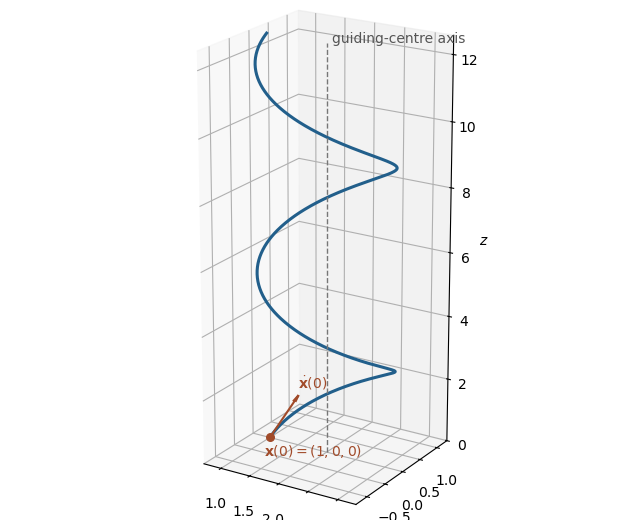
The Lorentz force and Newton's second law giveWriting , the component equations areThe initial velocity therefore givesand integration with the initial position givesThis is helical motion in a uniform magnetic field: a helix of radius around the line , , with its axis parallel to the magnetic field.

Past exam of the mathematics course of the University of Cambridge 2019 ia Paper 3 6D d Solution Created 2026-09-24 Updated 2026-09-29
A three-cycle is an even permutation, as is a product of two disjoint three-cycles. Thus every element counted in part (c) lies in , and every order-three element of was already counted there. The answer remains .
Past exam of the mathematics course of the University of Cambridge 2019 ia Paper 3 6D c Solution Created 2026-09-24 Updated 2026-09-29
An element of order three in has cycle type or . There aresingle three-cycles. For two disjoint three-cycles, choose the two unordered three-element supports and an orientation on each:Hence contains elements of order three.
Past exam of the mathematics course of the University of Cambridge 2019 ia Paper 3 6D b Solution Created 2026-09-24 Updated 2026-09-29
Past exam of the mathematics course of the University of Cambridge 2019 ia Paper 3 6D a Solution Created 2026-09-24 Updated 2026-09-29
Lagrange's theorem for finite groups states that if and is finite, thenso divides . Indeed, the left cosets of partition , and multiplication by a coset representative is a bijection from to each coset.
Past exam of the mathematics course of the University of Cambridge 2019 ia Paper 3 5D ii Solution Created 2026-09-24 Updated 2026-09-29
Cauchy's theorem for finite groups states that if a prime number divides the order of a finite group , then contains an element of order .
ConsiderThe first entries determine the last, so is divisible by . The cyclic group acts on by cyclically shifting the coordinates; the shifted tuple remains in because . Every orbit has size one or . The fixed points are exactly with . Their number is therefore divisible by . Since the identity is one fixed point, another exists; its order is .
Now let the abelian group have order for distinct primes . Cauchy's theorem supplies of orders . Their cyclic subgroups intersect trivially, and commutativity shows that has order . Thus is cyclic andThe corresponding assertion for order is false: is not isomorphic to , since the former has an element of order while every nonidentity element of the latter has order .
Past exam of the mathematics course of the University of Cambridge 2019 ia Paper 3 5D i Solution Created 2026-09-24 Updated 2026-09-29
Suppose first that and are normal subgroups. For and , the commutatorlies in , because , and in , because . Since , , so and commute.
Conversely, suppose every element of commutes with every element of . Write an arbitrary as . For ,so . The symmetric calculation proves .
Past exam of the mathematics course of the University of Cambridge 2019 ia Paper 3 12B b Solution Created 2026-09-24 Updated 2026-09-29
For a spherically symmetric function , the Laplacian in spherical coordinates isIntegrating from zero to and using regularity at the origin gives
For the stated density, integration and the boundary condition giveThe two pieces and their first derivatives agree at . If another solution existed, its difference from would be harmonic with zero boundary data, so part (a) proves Uniqueness of the Dirichlet problem.
On the shell , normalize the outer radial part to obtain the harmonic functionBy the Dirichlet principle, this function minimizes the energy among all with the same boundary values. Sinceits energy isTherefore
Past exam of the mathematics course of the University of Cambridge 2019 ia Paper 3 12B a Solution Created 2026-09-24 Updated 2026-09-29
Green's first identity and the boundary condition giveThus , so is constant on each connected component of ; its zero boundary value forces .
Since on and , another application of Green's first identity givesConsequentlyExpanding and using the vanishing cross term yields the Dirichlet principle
Past exam of the mathematics course of the University of Cambridge 2019 ia Paper 3 10B b Solution Created 2026-09-24 Updated 2026-09-29
The unit sphere and the kernel are invariant under every rotation in three dimensions fixing . Therefore has the same axisymmetry, so part (a) gives
Choose spherical polar coordinates with polar axis and put . Since ,The tensor contraction giving the trace isSimilarly,At these expressions have the continuous limiting values and . Writing them as and gives
Past exam of the mathematics course of the University of Cambridge 2019 ia Paper 3 10B a Solution Created 2026-09-24 Updated 2026-09-29
Under an orthogonal change of coordinates represented by , the component matrix changes byThus is similar to , so its characteristic polynomial, eigenvalues, and their algebraic multiplicities are unchanged.
If is symmetric, the spectral theorem for real symmetric matrices makes it diagonalizable, so algebraic and geometric multiplicities agree. Consequently the dimensions of its eigenspaces are also independent of the coordinate frame.
For the stated tensor, choose a unit eigenvector belonging to the simple eigenvalue . Its perpendicular plane is the eigenspace of , soHence
Past exam of the mathematics course of the University of Cambridge 2019 ia Paper 2 9F c Solution Created 2026-09-24 Updated 2026-10-14
Urn has balls, so a draw from it is white with probability . Given that the first ball is white, Bayes' theorem gives the posterior probabilityAfter replacement, the second draw is conditionally independent of the first given the urn. HenceConsequently .
Past exam of the mathematics course of the University of Cambridge 2019 ia Paper 2 9F b ii Created 2026-09-24 Updated 2026-09-24
Past exam of the mathematics course of the University of Cambridge 2019 ia Paper 2 9F b i Created 2026-09-24 Updated 2026-09-24
There are unlisted articles, also show them or only show them.