
Past exam of the mathematics course of the University of Cambridge 2012 ia Paper 2 10F ii Solution Created 2026-09-24 Updated 2026-10-07
The independent uniform distributions give a constant joint probability density on the unit square. For , integrate over :For the random quadratic with uniform coefficients, real roots require its discriminant to be nonnegative, equivalently . The boundary has probability zero, and the area under this parabola isOn that event the roots are , both nonpositive. Bounding both absolute values by one therefore amounts to bounding the more negative root:Since , squaring the inequality is legitimate and gives . The admissible unit-square region is . Its probability isDividing by the real-root probability gives the requested conditional probability:
Past exam of the mathematics course of the University of Cambridge 2012 ia Paper 2 10F i Solution Created 2026-09-24 Updated 2026-10-07
The cumulative distribution function is . For the differentiable distribution in the question, its probability density function is , so probabilities over intervals are obtained by integrating . The survival probability is . Differentiating immediately givesThe strict inequality is consistent with the definition using . This relation connects the probability density function with the decline of the survival probability.
Past exam of the mathematics course of the University of Cambridge 2012 ia Paper 1 9E b Solution Created 2026-09-24 Updated 2026-10-07
The arithmetic-geometric mean inequality givesBy induction these inequalities hold at every step, so is increasing and bounded above by , while is decreasing and bounded below by . The bounded monotone sequence theorem gives limits with . Taking limits in the arithmetic mean recurrence gives , whence . Thus both sequences converge to the same positive limit, the arithmetic-geometric mean iteration's limit. No elementary closed formula for that limit is needed.
Past exam of the mathematics course of the University of Cambridge 2012 ia Paper 1 9E a Solution Created 2026-09-24 Updated 2026-10-07
A sequence converges to precisely whenFor a finite collection of convergent sequences, choose for the same tolerance in row , and let . If , every available lies within of , and so does any selected . Every such finite rowwise selection converges to . The finiteness is what permits a single maximum of the cutoffs.
For the infinite collection, defineFor every fixed , this sequence is eventually exactly , and hence converges to . But its diagonal selection is , which has two distinct subsequential limits and does not converge. A moving row index can always choose the exceptional entry before that row reaches its eventual behavior.
Past exam of the mathematics course of the University of Cambridge 2012 ia Paper 1 8B b ii Created 2026-09-24 Updated 2026-09-24
Past exam of the mathematics course of the University of Cambridge 2012 ia Paper 1 8B b i Created 2026-09-24 Updated 2026-09-24
Past exam of the mathematics course of the University of Cambridge 2012 ia Paper 1 8B a ii Created 2026-09-24 Updated 2026-10-07
Past exam of the mathematics course of the University of Cambridge 2012 ia Paper 1 7B c Solution Created 2026-09-24 Updated 2026-10-07
The Cayley-Hamilton theorem says that every square complex matrix satisfies its own characteristic polynomial: if , thenFor a diagonalisable matrix, write with . The characteristic polynomial is , including repeated roots. Evaluating it at gives zero in each diagonal position, and polynomial evaluation respects matrix similarity: . This proves the requested case.
For the final assertion, let be any complex eigenvalue of , with nonzero eigenvector . From we obtain , so . The characteristic polynomial of this nilpotent linear map is therefore . Applying the full Cayley-Hamilton theorem yields . This argument does not assume is diagonalisable.
Past exam of the mathematics course of the University of Cambridge 2012 ia Paper 1 7B b Solution Created 2026-09-24 Updated 2026-10-07
If with invertible, then . Multiplicativity of the determinant givesThe roots of the characteristic polynomial, counted with their multiplicities, are the eigenvalues with their algebraic multiplicities. Thus similar matrices have the same eigenvalues with the same algebraic multiplicities.
The converse is false. The matricesboth have characteristic polynomial , but every matrix similar to is , whereas . Alternatively, their geometric multiplicities for differ.
Past exam of the mathematics course of the University of Cambridge 2012 ia Paper 1 7B a Solution Created 2026-09-24 Updated 2026-10-07
Expansion along the first column gives the characteristic polynomialThus the eigenvalue has algebraic multiplicity two. Solving gives and then , leaving arbitrary. Its eigenspace is and has geometric multiplicity one. A diagonalisable matrix needs an eigenvector basis, so is not diagonalisable.
Past exam of the mathematics course of the University of Cambridge 2012 ia Paper 1 1C c Solution Created 2026-09-24 Updated 2026-10-07
Put . Comparing imaginary parts gives , so . Comparing real parts then gives . The left side is positive, so squaring is legitimate only with , but even then it would give . This contradiction proves there is no solution. Equivalently, with nonzero imaginary part the complex modulus is strictly greater than the real part.
Past exam of the mathematics course of the University of Cambridge 2012 ia Paper 1 1C b ii Created 2026-09-24 Updated 2026-09-24
Past exam of the mathematics course of the University of Cambridge 2012 ia Paper 1 1C b i Created 2026-09-24 Updated 2026-09-24
Past exam of the mathematics course of the University of Cambridge 2012 ia Paper 1 1C a Solution Created 2026-09-24 Updated 2026-10-14
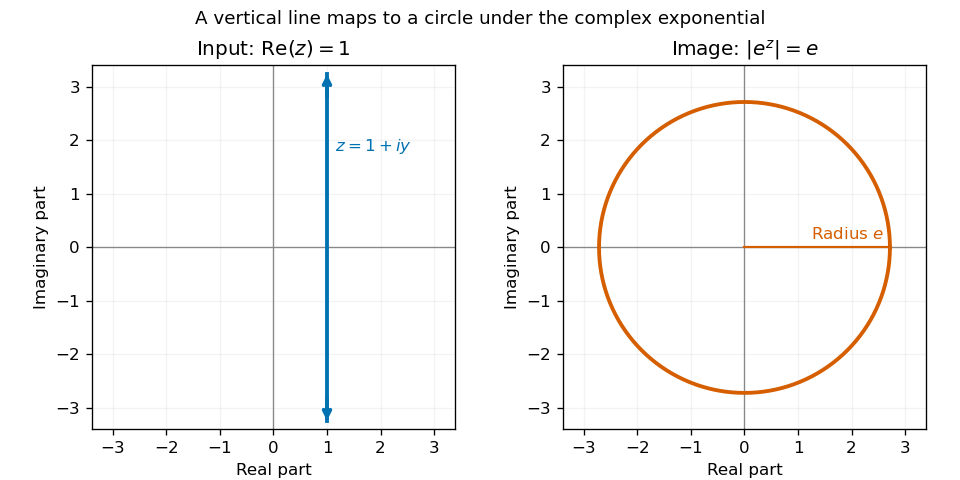
Write with . In the complex plane, this is the vertical line through . The complex exponential gives , so its complex modulus is always . Conversely, every point of that modulus has an complex argument and is obtained in this way. The image is the entire circle centered at zero with radius , traversed repeatedly as varies; it is not a disk.

Past exam of the mathematics course of the University of Cambridge 2012 ia Paper 1 12F b ii Created 2026-09-24 Updated 2026-10-07
Past exam of the mathematics course of the University of Cambridge 2012 ia Paper 1 12F a iv Created 2026-09-24 Updated 2026-09-24
Past exam of the mathematics course of the University of Cambridge 2012 ia Paper 1 12F a iii Created 2026-09-24 Updated 2026-09-24
Past exam of the mathematics course of the University of Cambridge 2012 ia Paper 1 12F a ii Created 2026-09-24 Updated 2026-10-07
Past exam of the mathematics course of the University of Cambridge 2012 ia Paper 1 11D iv Solution Created 2026-09-24 Updated 2026-10-07
No: there need not be even one orbit tending to zero. Partition the domain into the disjoint intervalsand, for the unique with , defineThe left endpoint is strictly below , so . Moreover and , so remains in the same interval. For every iterate,Every starting point belongs to some finite-index interval, so this proves the claim for all . The open left endpoints matter: an orbit approaches a boundary but never crosses it. This is discontinuous trapping of decreasing iterates, not a violation of the bounded monotone sequence theorem; each orbit does converge, just to a positive value where continuity fails.
Past exam of the mathematics course of the University of Cambridge 2012 ia Paper 1 11D iii Solution Created 2026-09-24 Updated 2026-10-07
Use the discontinuous exampleIn both pieces . For , the image stays strictly above , and induction givesThis positive limiting point is not a fixed point, since . The discontinuity is precisely why the limit cannot be passed through . Therefore the pointwise zero-limit conclusion can fail without continuity.
There are unlisted articles, also show them or only show them.