For every finite n, these values tend to 1as x↑1, so sup0<x<1fn(x)=1. With ε=1/2, choosing x>2−1/2n gives fn(x)>1/2. Thus no single iterate works for every starting point, although each fixed starting point tends to zero.
Fix x∈(0,1) and put x0=x, xn+1=f(xn). Then 0<xn+1<xn≤x0<1. The bounded monotone sequence theorem gives a limit ℓ∈[0,x0]. If ℓ>0, it lies in the domain, where continuity allows passage to the limit in the recurrence: ℓ=f(ℓ). That is a fixed point, contrary to f(ℓ)<ℓ. Hence fn(x)→0 for every x∈(0,1). Continuity is used at a possible positive limiting point, not at the excluded endpoint zero.
Yes. The arbitrary variable-lag condition forces the Cauchy sequence property. Suppose otherwise. Then some ε0>0 has the property that, for every N, there exist p,q≥N with ∣ap−aq∣≥ε0. In particular, for each n, choose such p,q≥n. By the triangle inequality, at least one satisfies ∣ap−an∣≥ε0/2 or ∣aq−an∣≥ε0/2. That index must be strictly greater than n, since the difference at n itself is zero.
Take an=(−1)n. Then ∣an/n∣=1/n→0, but an+1−an=−2(−1)n alternates between 2 and −2. Thus convergence of the scaled sequence does not imply convergence of its successive differences.
To justify the Cesàro mean limit directly, choose J so that ∣dj−L∣<ε for j≥J. The finite initial sum contributes at most n−1∑j<J∣dj−L∣, which tends to zero. The remaining terms contribute at most ε, and replacing (n−1)L/n by L contributes ∣L∣/n. Consequently an/n→L.
The averaged drift is positive below r−, negative between r− and r+, and positive above r+. Thus the inner orbit is attracting and the outer orbit repelling, with leading displacementamplitudes r− and r+ and period 2π+O(ϵ). The simple zeros of the Poincaré return map persist for sufficiently small ϵ.
If α2<8β, the leading quadratic is strictly positive for all s≥0; the energy increases on every nonzero unperturbed orbit, so the energy balance method yields no periodic orbits in any fixed compact range of nonzero amplitudes for sufficiently small ϵ. This perturbative calculation does not itself establish a uniform global exclusion at amplitudes growing as ϵ tends to zero. At equality, the leading drift has a double zero at r2=α/β. It is positive on both sides, with a semistable candidate at that amplitude. First-order averaging alone cannot decide whether the exact system has zero, one, or two nearby periodic orbits at equality: higher-order drift determines the unfolding of this degenerate zero. The original PDF has α2=8β; the extra exponent on β in the converted TeX is an OCR error.
Let KN={k∈Z2:∣k1∣,∣k2∣≤N}, use uN=∑k∈KNukeiπk⋅x and impose u0=0. The coefficient has a0=3 and a±e1=a±e2=1/2, with all other coefficients zero. Fourier differentiation and convolution give
where coefficients outside KN and u0 are zero. The forcing is fe1=fe2=1/(2i), f−e1=f−e2=−1/(2i) and zero elsewhere. The k=0equation is 0=0 and is replaced by normalization. For a real solution u−k=uk, so the system can equivalently be written in real sine/cosine coordinates.
Integration of the periodic Poisson equation gives the necessary compatibility condition f0=0. With it, the normalization fixes u0=0 and every other Fourier mode gives −π2∣k∣2uk=fk. The Fourier-Galerkin approximation is therefore
Convergence with spectral accuracymeans faster decay than every fixed algebraic power of N. A smooth periodic extension gives this rate; an analytic periodic extension to a complex strip gives the stronger exponential rate O(e−cN) on a slightly narrower strip. Division by ∣k∣2 preserves that Fourier decay, so the normalized solution has the same type of spectral convergence.
Two qualifications are required by the literal source assumptions. The mean-zero condition on f was not stated: f≡1 meets the printed analyticity and endpoint equalities but has no periodic solution. Also endpoint equality of f alone does not make its periodic extension analytic. For example f(x,y)=x2−1/3 is analytic, has matching endpoint values and zero mean, but its nonzero Fourier coefficients are f(k,0)=2(−1)k/(π2k2). Then u(k,0)=−2(−1)k/(π4k4), with only algebraic decay. Thus the standard spectral-speedconclusion is valid under the intended analytic-periodic torus assumption and compatibility, not for every function satisfying only the displayed endpoint values.
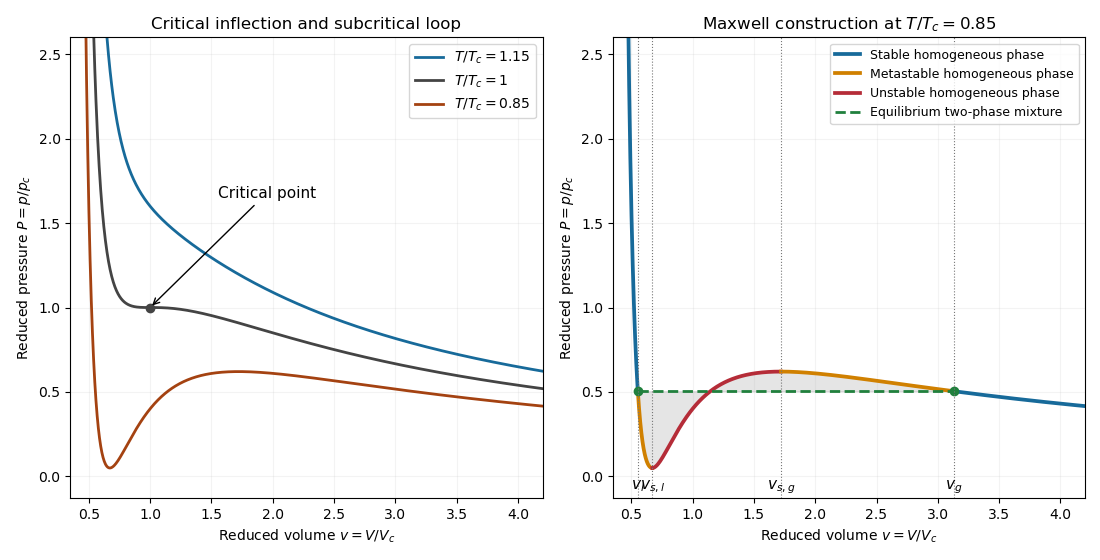
Set s=τz. The leading departure from the coexistence pressure is τ3/2(6z−3z3/2). Equal pressure at the two outer endpoints together with the Maxwell equal-area condition selects the symmetric pair zl=−2, zg=2, with coexistence pressure 1−4τ+O(τ2). To see why, a horizontal line through the odd cubic has zero signed area between its outer equal-heightroots only at zero height: the signed area is strictly decreasing with line height, and symmetry makes it zero there. Thus
The cubic scaling therefore has exponent three, with a negative coefficient. A fixed noncritical isotherm does not pass through the critical point, so that qualification is essential.
Let Vs,l<Vs,g be the two spinodalvolumes where p′(V)=0. A homogeneous phase is mechanically unstable on Vs,l<V<Vs,g, since p′>0 gives negative compressibility. The negative-slope branches Vl<V<Vs,l and Vs,g<V<Vg are metastable homogeneous liquid and gas respectively: they resist small perturbations but a two-phase state has lower freeenergy. The single-phase stable branches are V<Vl and V>Vg. Throughout the coexistence interval [Vl,Vg], the equilibrium state is amixture at pressure p0 with its phase fractions chosen to produce the total volume. The preceding figure labels both the formal homogeneous branches and the equilibrium coexistence segment.
Above Tc the isotherms decrease monotonically; at Tc there is a horizontal inflection; below Tc the formal curve develops alocal minimum and maximum. The physically equilibrated isotherm replaces part of that loop by a constant-pressure coexistence segment.
The Gibbs free energy is G=U−TS+pV. For an extensive thermodynamic system, scaling the amount of matter at fixed pressure, temperature and composition scales G by the same factor, hence G(T,p,N)=Nμ(T,p). Euler's relation U=TS−pV+μN gives the same conclusion. This uses the ordinary thermodynamic-limit extensivity assumption, rather than a universal claim about finite-size or long-range-interacting systems.
The fundamental thermodynamic identity gives dG=−SdT+Vdp+μdN. Comparing with d(Nμ) at fixed N yields
Convexity and the quadratic growth bound imply ∣Fu(v,x)∣≤C(1+∣v∣) uniformly in x. Indeed bound the derivative between the two secant slopes with increments ±(1+∣v∣) and use the upper and lower bounds on F. This makes Fu(u,x)square integrable and justifies differentiating the energy in every H01 direction by domination. At the minimizer,
For u∈H01(Ω), both u and its weak gradient are square integrable. The assumed bounds give ∣F(u,x)∣≤K(1+∣u∣2), so the potential term is integrable and E(u) is finite. Also