
Past exam of the mathematics course of the University of Cambridge 2014 ib Paper 2 12F iv Created 2026-09-24 Updated 2026-09-24
Past exam of the mathematics course of the University of Cambridge 2014 ib Paper 2 12F iii Created 2026-09-24 Updated 2026-09-24
Past exam of the mathematics course of the University of Cambridge 2014 ib Paper 2 12F ii Created 2026-09-24 Updated 2026-09-24
Past exam of the mathematics course of the University of Cambridge 2014 ib Paper 2 12F i Created 2026-09-24 Updated 2026-09-24
Past exam of the mathematics course of the University of Cambridge 2014 ib Paper 2 11E Solution Created 2026-09-24 Updated 2026-10-06
Let be a finite integral domain. For any , multiplication is injective: implies , hence because there are no zero divisors. An injective map of a finite set to itself is surjective, so for some . Every nonzero element is invertible; therefore a finite integral domain is a field.
For an irreducible polynomial , consider a nonzero class in the quotient ring . Since does not divide , irreducibility gives . The Euclidean algorithm in the polynomial ring gives polynomials with . Modulo , . Thus the quotient by an irreducible polynomial is a field.
For a field with four elements, useThe quadratic has no root in , so is irreducible. Write . Polynomial division shows the elements are , with . Its multiplication table is
For a field with nine elements, useThe values of at are , so the quadratic is irreducible. Every class is uniquely , , with . These nine classes form a finite field; multiplication is , with coefficients modulo three.
Past exam of the mathematics course of the University of Cambridge 2014 ib Paper 2 10G ii Created 2026-09-24 Updated 2026-09-24
Past exam of the mathematics course of the University of Cambridge 2014 ib Paper 2 10G i Created 2026-09-24 Updated 2026-09-24
Past exam of the mathematics course of the University of Cambridge 2014 ib Paper 1 9G iv Created 2026-09-24 Updated 2026-09-24
Past exam of the mathematics course of the University of Cambridge 2014 ib Paper 1 9G iii Created 2026-09-24 Updated 2026-09-24
Past exam of the mathematics course of the University of Cambridge 2014 ib Paper 1 9G ii Created 2026-09-24 Updated 2026-09-24
Past exam of the mathematics course of the University of Cambridge 2014 ib Paper 1 9G i Created 2026-09-24 Updated 2026-09-24
Past exam of the mathematics course of the University of Cambridge 2014 ib Paper 1 8H Solution Created 2026-09-24 Updated 2026-10-06
A useful form of the Lagrangian sufficiency theorem is as follows. For minimization of subject to and , formIf is feasible, , , and globally minimizes over the ambient domain for these fixed multipliers, then is a global constrained minimizer. Indeed, for every feasible ,The first inequality uses multiplier signs; the last equality uses feasibility and complementary slackness. Equality constraints alone require no sign restriction on their multipliers. A stationary point of a differentiable convex Lagrangian is a global minimum, which is a common way to verify the theorem's hypothesis.
Here takeStationarity gives . Feasibility then gives and . For that multiplier,The Lagrangian has its unique global minimum at , so the sufficiency theorem proves
Past exam of the mathematics course of the University of Cambridge 2014 ib Paper 1 7H ii Created 2026-09-24 Updated 2026-09-24
Past exam of the mathematics course of the University of Cambridge 2014 ib Paper 1 7H i Created 2026-09-24 Updated 2026-09-24
Past exam of the mathematics course of the University of Cambridge 2014 ib Paper 1 6C ii Created 2026-09-24 Updated 2026-09-24
Past exam of the mathematics course of the University of Cambridge 2014 ib Paper 1 6C i Created 2026-09-24 Updated 2026-09-24
Past exam of the mathematics course of the University of Cambridge 2014 ib Paper 1 5B Solution Created 2026-09-24 Updated 2026-10-14
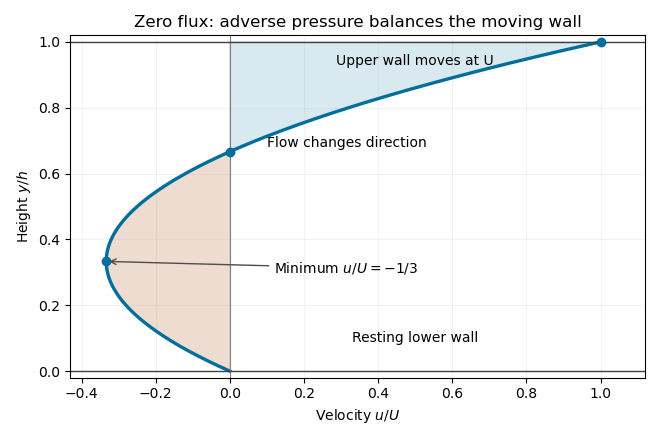
Take a steady parallel velocity and interpret the specified gradient as . The horizontal Navier-Stokes equation reduces to : the pressure force opposes positive motion. The no-slip boundary condition imposes , . Integrating twice givesThe velocity gradient is , an increasing function of . It is negative somewhere in the channel exactly when its lower-wall limit is negative:Under this condition the negative-gradient interval is .
The volume flux per unit span isThus the zero-flux Couette-Poiseuille flow requiresThe profile starts at zero, reaches at , crosses zero at , and reaches at the moving wall. Negative and positive flux contributions cancel, even though the local velocity is nonzero.

Past exam of the mathematics course of the University of Cambridge 2014 ib Paper 1 4C Solution Created 2026-09-24 Updated 2026-10-06
The convex Legendre transform, or convex conjugate, isFor a differentiable strictly convex function, an attained maximum is characterized by , and then at that maximizing .
For the affine covariance of the convex conjugate, assume and substitute :HencePositive scaling is necessary for this supremum definition, although the printed formula does not specify it. For example, and give , not the finite expression . If the transform is instead defined as a stationary value using a locally invertible gradient, the same algebraic identity holds for any : the critical-point relation is , and substitution of that stationary gives the displayed formula. That extension does not assert a supremum for negative scaling.
For the positive-definite quadratic form, symmetry and positive eigenvalues of giveThe second term is nonpositive and vanishes exactly at . Therefore
Past exam of the mathematics course of the University of Cambridge 2014 ib Paper 1 3F Solution Created 2026-09-24 Updated 2026-10-06
Write . The tangent vectors areTheir squared lengths and inner product give the first fundamental formThe unit normal determined by this ordered parametrization isTaking inner products of with , and yields , , . Consequently the second fundamental form of a ring torus isThis normal points into the tube. Choosing the outward unit normal reverses both coefficients and gives ; the choice must therefore accompany an answer for the second fundamental form.
The Gaussian curvature is unchanged by that reversal:Since the denominator is positive, on the outside of the torus, where , and on its inner side, where . It vanishes on the two circles . This is the Gaussian curvature of a ring torus.
Past exam of the mathematics course of the University of Cambridge 2014 ib Paper 1 2B Solution Created 2026-09-24 Updated 2026-10-06
Let the regular curves be with and nonzero tangent vectors . By the chain rule, their transformed tangents are . Multiplication by the nonzero complex number scales both tangent lengths by and rotates both directions by . In particular,Thus the oriented angle, and hence the ordinary angle, is unchanged. This proves that the holomorphic function is a local conformal map at ; the nonzero derivative prevents a degenerate tangent.
A suitable conformal inversion of a quadrant isIf with and , then has modulus greater than one and argument strictly between zero and . The inverse is again , so every point of the desired exterior quadrant is attained uniquely. The origin is outside the open source region, and there.
There are unlisted articles, also show them or only show them.