
Past exam of the mathematics course of the University of Cambridge 2014 ib Paper 2 6A Solution Created 2026-09-24 Updated 2026-10-06
Use compatible orientations for the loop and spanning surface. The relevant Maxwell equations areThe magnetic flux transport for a moving circuit separates the change of the field from the motion of its boundary. To see the boundary term, freeze at time . Orient the closed swept surface as . Its side element isto first order. Hence its flux is . By the divergence theorem and , the sum of the three fluxes is zero, giving the purely geometric changeAdding the temporal field change and applying Stokes theorem yieldsThusThe boundary contribution is the motional electromotive force; the field contribution is Faraday's law.
Past exam of the mathematics course of the University of Cambridge 2014 ib Paper 2 5D iii Created 2026-09-24 Updated 2026-09-24
Past exam of the mathematics course of the University of Cambridge 2014 ib Paper 2 5D ii Created 2026-09-24 Updated 2026-09-24
Past exam of the mathematics course of the University of Cambridge 2014 ib Paper 2 5D i Created 2026-09-24 Updated 2026-09-24
Past exam of the mathematics course of the University of Cambridge 2014 ib Paper 2 4E iii Created 2026-09-24 Updated 2026-09-24
Past exam of the mathematics course of the University of Cambridge 2014 ib Paper 2 4E ii Created 2026-09-24 Updated 2026-09-24
Past exam of the mathematics course of the University of Cambridge 2014 ib Paper 2 4E i Created 2026-09-24 Updated 2026-09-24
Past exam of the mathematics course of the University of Cambridge 2014 ib Paper 2 3F Solution Created 2026-09-24 Updated 2026-10-06
A function has uniform continuity if for every there is a such that, for all , implies . The same must work everywhere in .
The product need not be uniformly continuous. Both and are Lipschitz continuous, hence uniformly continuous on , but their product is . For and , the input separation tends to zero whileThis contradicts uniform continuity. The issue is captured by products of unbounded uniformly continuous functions; bounded factors would give a uniform product estimate.
A uniformly continuous function on is bounded. Take for output tolerance one and cover by finitely many intervals of radius less than , centred at points in . Every is within of some , so . This proves the general principle that a uniformly continuous function on a totally bounded set is bounded.
The reciprocal-cosine function is not uniformly continuous. TakeBoth sequences lie in , , but the two function values are and . Their difference is always two, violating the sequential criterion for uniform continuity.
Past exam of the mathematics course of the University of Cambridge 2014 ib Paper 2 2E Solution Created 2026-09-24 Updated 2026-10-06
An even permutation in the alternating group has one of the cycle types listed below. In the symmetric group, a type with cycles of length has centralizer order and class size : commuting permutations can rotate each cycle and exchange equal-length cycles.
An conjugacy class remains one class if its centralizer contains an odd permutation. Otherwise it splits into two equal classes, since the centralizer is already contained in the index-two subgroup . This is the alternating conjugacy class splitting criterion. For the nonsplitting nonidentity types here, odd commuting permutations are respectively a constituent transposition, a transposition of fixed points, the interchange of two 3-cycles, and the constituent 4-cycle. For a 5-cycle with one fixed point, the centralizer is its cyclic group of order five and contains only even permutations.
Thus the conjugacy classes of the alternating group on six letters are:The two 5-cycle representatives lie in different classes. A relabelling that conjugates a 5-cycle to its square acts on its five positions as multiplication by two modulo five, a 4-cycle on the nonzero positions, hence is odd. Every other such conjugator differs by an even centralizer element. The sizes sum to , so the list is exhaustive.
For simplicity of the alternating group on six letters, let be a normal subgroup. It contains the identity and is a union of full conjugacy classes; also divides by Lagrange's theorem. A proper subgroup has order at most .
If the class of size 45 is absent, is odd. The odd divisors of are . A nontrivial union has order at least 41, but no selection of the even class sizes sums to , so order 45 is impossible. Thus in this case.
If the size-45 class is present, write with and . The possible values at most are , none dividing . Hence no proper nontrivial normal subgroup exists:
Past exam of the mathematics course of the University of Cambridge 2014 ib Paper 2 20H Solution Created 2026-09-24 Updated 2026-10-06
Write . For , . For , conditioning on the first step and using the Markov property gives . This establishes the required equations for the hitting probability.
To prove the hitting probability is the minimal nonnegative harmonic extension, let . Then andIf is any nonnegative solution of the same boundary equations, . Positivity of the transition probabilities implies by induction for every . The events increase to , so and . Therefore is the minimal nonnegative solution.
For the tournament won by two consecutive victories, a transient pair , with and third player , moves with equal probabilities to the absorbing state or the transient pair . Thus the two transient cycles arewith probability of absorption at each step. A full cycle without absorption has probability , so absorption occurs almost surely.
Starting from , the successive absorption winners are , with first-cycle probabilities . Summing the geometric repetitions givesStarting from , the order is , giving .
Because the first game is between and , the initial ordered pair of winners is , each with probability . Combining the immediate wins with the transient hitting probabilities,Their sum is one, consistent with almost-sure absorption.
Past exam of the mathematics course of the University of Cambridge 2014 ib Paper 2 1G Solution Created 2026-09-24 Updated 2026-10-06
For a linear map with finite-dimensional, the rank-nullity theorem statesTo prove it, choose a basis of the kernel of a linear map and use basis extension to obtain as a basis of . The vectors span the image of a linear map: applying to a basis expansion kills the first terms. They are also linearly independent. Indeed, if , then , so it is a combination of . Independence of the full basis forces every . Consequently , proving the theorem.
Here the image of a linear map has dimension , since it lies in . ThusEvery possibility occurs: for , map to . This map has rank and kernel dimension .
Past exam of the mathematics course of the University of Cambridge 2014 ib Paper 2 19C Solution Created 2026-09-24 Updated 2026-10-14
For the Peano kernel theorem, the integral Taylor remainder isHere . The error functional must be linear, vanish on every polynomial of degree at most , and permit its action to be interchanged with this remainder integral. The last regularity condition holds for the finite combinations of point evaluations and derivative evaluations used below, by applying the corresponding differentiated remainder formula. Under these conditions the polynomial terms vanish, yielding
For the three-point asymmetric second-derivative formula, choose the error convention . Exactness on giveshenceApplying to , for almost every , gives the Peano kernelThe value at is immaterial to the integral. The sketch rises from zero through at one to the left limit at two, jumps down to the right limit , and then rises to zero at three.
The sharp error constants for a Peano kernel are the corresponding integral-operator norms. HereAs ,Indeed, and . They are best possible even for : for , choose continuous nonnegative third derivatives concentrated just left of two with unit integral; for , approximate the sign of by continuous functions of supremum norm one. Integrating any such third derivative three times supplies an admissible , and the resulting ratios approach the stated constants.
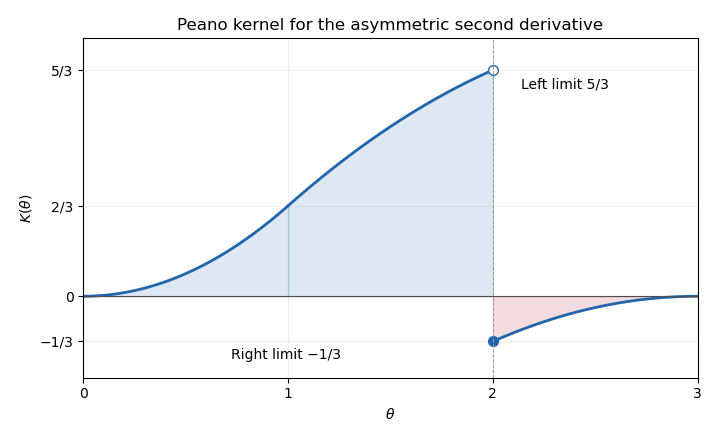
Peano kernel for the asymmetric three-point second derivative, showing its jump at two and the positive and negative regions controlling sharp error bounds
. Details. 
Past exam of the mathematics course of the University of Cambridge 2014 ib Paper 2 18A Solution Created 2026-09-24 Updated 2026-10-06
For a conductor in electrostatic equilibrium, the interior field is zero and the surface is equipotential. The tangential exterior field is zero. A thin Gaussian pillbox gives the normal jump . Thus, in vacuum and with pointing out of the conductor,These are the electrostatic boundary conditions at a conductor.
To obtain electrostatic energy in field form, integrate over the space outside the conductors, cutting it off first at a large sphere. From the Maxwell equations, and , soOn a conductor boundary, the outward normal of the integration region points into the conductor, so its flux contribution is . At the remote outer boundary the flux integral tends to zero: for a localized charge distribution, and . The divergence theorem therefore givesSince the field vanishes inside conductors,The field integral is over all space, although the charges occupy a finite volume. For a finite outer integration boundary there is additionally the term .
For the electrostatic energy of alternating-charge concentric shells, the total enclosed charge after shell isBy spherical symmetry and Gauss's law, the field is zero for , and in every subsequent gap, including outside the last shell,Although its direction alternates, its squared magnitude is the same in every gap. ConsequentlyThe coefficient of is , independent of the other radii and of the number of shells.
Past exam of the mathematics course of the University of Cambridge 2014 ib Paper 2 17A ii Created 2026-09-24 Updated 2026-09-24
Past exam of the mathematics course of the University of Cambridge 2014 ib Paper 2 17A i Created 2026-09-24 Updated 2026-09-24
Past exam of the mathematics course of the University of Cambridge 2014 ib Paper 2 16D b Created 2026-09-24 Updated 2026-09-24
Past exam of the mathematics course of the University of Cambridge 2014 ib Paper 2 16D a Created 2026-09-24 Updated 2026-09-24
Past exam of the mathematics course of the University of Cambridge 2014 ib Paper 2 15C Solution Created 2026-09-24 Updated 2026-10-06
For fixed endpoints, the Euler-Lagrange equation isLet the sphere have radius and write the speed as , with . The infinitesimal travel time in the interior isThis is the flat-cylinder travel metric for sine-latitude speed. IntroduceThe travel-time metric becomes , an ordinary Euclidean metric on a cylinder because is periodic. After choosing a lift of , shortest paths are straight segments in . For a route that is a graph over , the Euler-Lagrange equation for readsThus is constant and . Transforming back,This proves the requested form for nonmeridional routes, including the equator when . It is also globally minimizing for its chosen azimuthal lift: Euclidean arc length is at least the straight-line separation, and the shortest lift minimizes that separation among angular differences differing by .
There is a coordinate exception to the printed universal form. When the shortest angular separation is zero, the fastest path is the meridian ; it is a vertical straight line on the cylinder and cannot be represented by finite as a graph over . The poles correspond to and cannot be reached in finite time with this speed law.
Past exam of the mathematics course of the University of Cambridge 2014 ib Paper 2 14F Solution Created 2026-09-24 Updated 2026-10-14
First obtain the hyperbolic circle in the upper half-plane. For centre , the fractional-linear map takes the Poincaré half-plane model isometrically to the Poincare disc model, sending to zero. Direct differentiation transforms the metric to . A radial segment from zero to modulus has length . Any path to that modulus has at least this length, by ; thus it is the hyperbolic distance.
A circle of hyperbolic radius therefore satisfiesSquaring and rearranging givesHence it is a circle in Euclidean geometry, with Euclidean centre and radius . Its lowest point has height , so it stays entirely in the upper half-plane. The centres differ whenever : for example, the hyperbolic circle centred at has Euclidean centre , rather than .
For hyperbolic side-side-side congruence, use the standard fact that hyperbolic isometries act transitively on ordered point pairs with the same positive separation, and that reflection in a hyperbolic line is an isometry. Map to . The image of has prescribed distances from and from , just as does. There are at most two such points, interchanged by reflection in the line .
For completeness, normalize to points on the positive imaginary axis. Their distance circles are Euclidean circles with centres on that axis by the formula above. Subtracting their equations determines one height , and then the abscissa is determined up to its sign. Reflection interchanges these choices. Therefore either the chosen isometry or its composition with that reflection maps all three labelled vertices correctly. Equal three side lengths imply a hyperbolic isometry between the triangles.
Two sides and an unspecified equal angle do not suffice. Here is an explicit hyperbolic side-side-angle ambiguity. Fix the angle at to be , let and , and chooseBoth are positive and distinct. The hyperbolic cosine rule at becomesSetting , the condition is , whose two roots are . Construct each triangle from sides meeting at angle ; its opposite side is the same by the cosine rule. The triangles therefore share but have different third sides and cannot be isometric. If the common angle is specifically the included angle between the two given sides, the cosine rule determines the third side and side-side-side congruence does apply.
Past exam of the mathematics course of the University of Cambridge 2014 ib Paper 2 13B Solution Created 2026-09-24 Updated 2026-10-06
Use the rectangular contour for an exponential beta integral. For , integrate counterclockwise around the rectangle with vertices . Its only pole is at , withThe right vertical side is bounded in modulus by , and the left by . Both tend to zero because . On the top edge , and that edge is traversed right to left. The residue theorem therefore givesSince ,The same inequalities establish convergence at both real infinities. With , this integral becomes . Taking gives
There are unlisted articles, also show them or only show them.